




ABCD is a parallelogram with side $AB=10cm$. Its diagonals $AC$ and $BD$ are of length $12cm$ and $16cm$ respectively. Find the area of the parallelogram $ABCD$.
Answer
 Verified
564.6k+ views
Hint: Here, we can see that the diagonals of the parallelogram divides the parallelogram into 4 equal triangles. So, to find the area of the parallelogram, we need to find the area of any one triangle and then multiply it by 4. For finding the area of the triangle, we will be using the Heron’s formula. The Heron’s formula is
$ A = \sqrt {s\left( {s - a} \right)\left( {s - b} \right)\left( {s - c} \right)} $
Where, $s = $semi-perimeter and $s = \dfrac{{a + b + c}}{2}$ and $a, b$ and $c$ are the sides of the triangle.
Complete step by step solution:
In this question, we are given a parallelogram ABCD and we are given the length of its one side AB equal to 10 cm and diagonals AC and BD equal to 12 cm and 16 cm respectively. We have to find the area of this parallelogram. So, first of all let us draw a figure of this parallelogram.
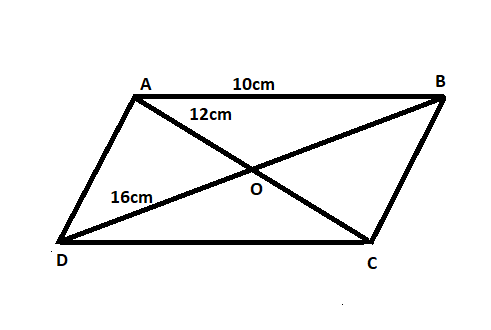
Given data:
$AB = 10cm$
$AC = 12cm$
$BD = 16cm$
Now, we need to find the area of parallelogram ABCD.
Now, here we can see that the diagonals have divided the parallelogram into 4 equal triangles. So, the area of the parallelogram will be equal to 4 times the area of one triangle.
Let us find the area of $\Delta AOB$. In $\Delta AOB$,
$AO = \dfrac{{AC}}{2} = \dfrac{{12}}{2} = 6cm$
$OB = \dfrac{{BD}}{2} = \dfrac{{16}}{2} = 8cm$
$AB = 10cm$
So, to find the area of $\Delta AOB$, we are going to use the Heron’s formula. Heron’s formula is
$ \Rightarrow A = \sqrt {s\left( {s - a} \right)\left( {s - b} \right)\left( {s - c} \right)} $
Where, $s = $semi-perimeter and $s = \dfrac{{a + b + c}}{2}$ and a, b and c are the sides of the triangle.
Here, we have $a = 10,b = 6,c = 8$. Therefore,
$ \Rightarrow s = \dfrac{{10 + 6 + 8}}{2} = \dfrac{{24}}{2} = 12$
Therefore, area of the triangle will be
$ \Rightarrow A = \sqrt {12\left( {12 - 10} \right)\left( {12 - 6} \right)\left( {12 - 8} \right)} $
$
= \sqrt {12\left( 2 \right)\left( 6 \right)\left( 4 \right)} \\
= \sqrt {12\left( {48} \right)} \\
= \sqrt {576} \\
= 24 \\
$
Hence, the area of $\Delta AOB$ is $24c{m^2}$.
Now, the area is equal to 4 times the area of $\Delta AOB$ because the diagonals of the parallelogram divides it into 4 equal triangles.
Therefore,
$ \Rightarrow $Area of ABCD$ = 4 \times \Delta AOB$
$
= 4 \times 24 \\
= 96 \\
$
Hence, the area of the given parallelogram ABCD is $96c{m^2}$.
Note:
The regular formula for finding the area of a parallelogram is
$ A = b \times h$, $b$ is the base and $h$ is the height.
Now that we have found the area, we can find its height too.
$
\Rightarrow 96 = 10 \times h \\
\Rightarrow h = \dfrac{{96}}{{10}} = 9.6cm \\
$
Note that writing proper units while solving the area based questions is most important. So make sure you have written the proper unit with your final answer.
$ A = \sqrt {s\left( {s - a} \right)\left( {s - b} \right)\left( {s - c} \right)} $
Where, $s = $semi-perimeter and $s = \dfrac{{a + b + c}}{2}$ and $a, b$ and $c$ are the sides of the triangle.
Complete step by step solution:
In this question, we are given a parallelogram ABCD and we are given the length of its one side AB equal to 10 cm and diagonals AC and BD equal to 12 cm and 16 cm respectively. We have to find the area of this parallelogram. So, first of all let us draw a figure of this parallelogram.
Given data:
$AB = 10cm$
$AC = 12cm$
$BD = 16cm$
Now, we need to find the area of parallelogram ABCD.
Now, here we can see that the diagonals have divided the parallelogram into 4 equal triangles. So, the area of the parallelogram will be equal to 4 times the area of one triangle.
Let us find the area of $\Delta AOB$. In $\Delta AOB$,
$AO = \dfrac{{AC}}{2} = \dfrac{{12}}{2} = 6cm$
$OB = \dfrac{{BD}}{2} = \dfrac{{16}}{2} = 8cm$
$AB = 10cm$
So, to find the area of $\Delta AOB$, we are going to use the Heron’s formula. Heron’s formula is
$ \Rightarrow A = \sqrt {s\left( {s - a} \right)\left( {s - b} \right)\left( {s - c} \right)} $
Where, $s = $semi-perimeter and $s = \dfrac{{a + b + c}}{2}$ and a, b and c are the sides of the triangle.
Here, we have $a = 10,b = 6,c = 8$. Therefore,
$ \Rightarrow s = \dfrac{{10 + 6 + 8}}{2} = \dfrac{{24}}{2} = 12$
Therefore, area of the triangle will be
$ \Rightarrow A = \sqrt {12\left( {12 - 10} \right)\left( {12 - 6} \right)\left( {12 - 8} \right)} $
$
= \sqrt {12\left( 2 \right)\left( 6 \right)\left( 4 \right)} \\
= \sqrt {12\left( {48} \right)} \\
= \sqrt {576} \\
= 24 \\
$
Hence, the area of $\Delta AOB$ is $24c{m^2}$.
Now, the area is equal to 4 times the area of $\Delta AOB$ because the diagonals of the parallelogram divides it into 4 equal triangles.
Therefore,
$ \Rightarrow $Area of ABCD$ = 4 \times \Delta AOB$
$
= 4 \times 24 \\
= 96 \\
$
Hence, the area of the given parallelogram ABCD is $96c{m^2}$.
Note:
The regular formula for finding the area of a parallelogram is
$ A = b \times h$, $b$ is the base and $h$ is the height.
Now that we have found the area, we can find its height too.
$
\Rightarrow 96 = 10 \times h \\
\Rightarrow h = \dfrac{{96}}{{10}} = 9.6cm \\
$
Note that writing proper units while solving the area based questions is most important. So make sure you have written the proper unit with your final answer.
Recently Updated Pages
Master Class 9 General Knowledge: Engaging Questions & Answers for Success

Master Class 9 Maths: Engaging Questions & Answers for Success
Master Class 9 Science: Engaging Questions & Answers for Success
Master Class 9 English: Engaging Questions & Answers for Success
Master Class 9 Social Science: Engaging Questions & Answers for Success
Class 9 Question and Answer - Your Ultimate Solutions Guide
Trending doubts