




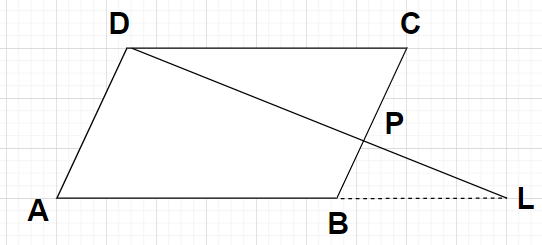
ABCD is a parallelogram, P is a point on side BC such that DP produced meets AB produced at L. Prove that
$
\left( {\text{i}} \right){\text{ }}\dfrac{{{\text{DP}}}}{{{\text{PL}}}} = \dfrac{{{\text{DC}}}}{{{\text{BL}}}} \\
\left( {{\text{ii}}} \right){\text{ }}\dfrac{{{\text{DL}}}}{{{\text{DP}}}} = \dfrac{{{\text{AL}}}}{{{\text{DC}}}} \\
$
Answer
 Verified
640.2k+ views
Hint: Here, we will proceed by using the property of the parallelogram i.e., Pair of the opposite sides in any parallelogram are always equal and parallel. Here, will also apply Basic Proportionality Theorem i.e., if a line is drawn parallel to one side of a triangle to intersect the other two sides at distinct points then the other two sides are divided in the same ratio.
Complete step-by-step answer:
Let us suppose a parallelogram ABCD with sides AB$\parallel $CD and BC$\parallel $AD as shown in the figure.
$\left( {\text{i}} \right)$ To prove: $\dfrac{{{\text{DP}}}}{{{\text{PL}}}} = \dfrac{{{\text{DC}}}}{{{\text{BL}}}}$
As, BC$\parallel $AD and when side BC is divided into two parts i.e., BP and PC then we can write
BP$\parallel $AD and PC$\parallel $AD
According to Basic Proportionality Theorem, if a line is drawn parallel to one side of a triangle to intersect the other two sides at distinct points then the other two sides are divided in the same ratio.
Using the Basic Proportionality Theorem in triangle ALD with BP$\parallel $AD, we can write
$\dfrac{{{\text{BL}}}}{{{\text{AB}}}} = \dfrac{{{\text{PL}}}}{{{\text{DP}}}}{\text{ }} \to {\text{(1)}}$
According to the property of the parallelogram i.e., Pair of the opposite sides in any parallelogram are always equal and parallel.
So, AB = DC [Pair of opposite sides in the parallelogram ABCD]
Using AB = DC in equation (1), we get
$ \Rightarrow \dfrac{{{\text{BL}}}}{{{\text{DC}}}} = \dfrac{{{\text{PL}}}}{{{\text{DP}}}}$
By taking the reciprocal of both sides, we get
$
\Rightarrow \dfrac{{{\text{DC}}}}{{{\text{BL}}}} = \dfrac{{{\text{DP}}}}{{{\text{PL}}}} \\
\Rightarrow \dfrac{{{\text{DP}}}}{{{\text{PL}}}} = \dfrac{{{\text{DC}}}}{{{\text{BL}}}} \\
$
The above equation is the same equation which needs to be proved.
$\left( {{\text{ii}}} \right)$ To prove: $\dfrac{{{\text{DL}}}}{{{\text{DP}}}} = \dfrac{{{\text{AL}}}}{{{\text{DC}}}}$
By equation (1), we have
$\dfrac{{{\text{BL}}}}{{{\text{AB}}}} = \dfrac{{{\text{PL}}}}{{{\text{DP}}}}$
By adding 1 on both sides of the above equation, we get
$
\Rightarrow \dfrac{{{\text{BL}}}}{{{\text{AB}}}} + 1 = \dfrac{{{\text{PL}}}}{{{\text{DP}}}} + 1 \\
\Rightarrow \dfrac{{{\text{BL + AB}}}}{{{\text{AB}}}} = \dfrac{{{\text{PL + DP}}}}{{{\text{DP}}}}{\text{ }} \to (2{\text{)}} \\
$
Clearly from the figure, BL + AB = AL and PL +DP = DL
Using the above equations in equation (2), we get
$ \Rightarrow \dfrac{{{\text{AL}}}}{{{\text{AB}}}} = \dfrac{{{\text{DL}}}}{{{\text{DP}}}}$
Using AB = DC in the above equation, we get
$
\Rightarrow \dfrac{{{\text{AL}}}}{{{\text{DC}}}} = \dfrac{{{\text{DL}}}}{{{\text{DP}}}} \\
\Rightarrow \dfrac{{{\text{DL}}}}{{{\text{DP}}}} = \dfrac{{{\text{AL}}}}{{{\text{DC}}}} \\
$
The above equation is the same equation which needs to be proved.
Note- Converse of Basic Proportionality Theorem also exists in this particular problem i.e., if we would have given that if the ratio in which is a line divides two sides of a triangle are equal, then that line is definitely parallel to the third (or remaining) side of the triangle. Rectangle is a special case of parallelogram in which the interior angles made at each vertex is a right angle.
Complete step-by-step answer:
Let us suppose a parallelogram ABCD with sides AB$\parallel $CD and BC$\parallel $AD as shown in the figure.
$\left( {\text{i}} \right)$ To prove: $\dfrac{{{\text{DP}}}}{{{\text{PL}}}} = \dfrac{{{\text{DC}}}}{{{\text{BL}}}}$
As, BC$\parallel $AD and when side BC is divided into two parts i.e., BP and PC then we can write
BP$\parallel $AD and PC$\parallel $AD
According to Basic Proportionality Theorem, if a line is drawn parallel to one side of a triangle to intersect the other two sides at distinct points then the other two sides are divided in the same ratio.
Using the Basic Proportionality Theorem in triangle ALD with BP$\parallel $AD, we can write
$\dfrac{{{\text{BL}}}}{{{\text{AB}}}} = \dfrac{{{\text{PL}}}}{{{\text{DP}}}}{\text{ }} \to {\text{(1)}}$
According to the property of the parallelogram i.e., Pair of the opposite sides in any parallelogram are always equal and parallel.
So, AB = DC [Pair of opposite sides in the parallelogram ABCD]
Using AB = DC in equation (1), we get
$ \Rightarrow \dfrac{{{\text{BL}}}}{{{\text{DC}}}} = \dfrac{{{\text{PL}}}}{{{\text{DP}}}}$
By taking the reciprocal of both sides, we get
$
\Rightarrow \dfrac{{{\text{DC}}}}{{{\text{BL}}}} = \dfrac{{{\text{DP}}}}{{{\text{PL}}}} \\
\Rightarrow \dfrac{{{\text{DP}}}}{{{\text{PL}}}} = \dfrac{{{\text{DC}}}}{{{\text{BL}}}} \\
$
The above equation is the same equation which needs to be proved.
$\left( {{\text{ii}}} \right)$ To prove: $\dfrac{{{\text{DL}}}}{{{\text{DP}}}} = \dfrac{{{\text{AL}}}}{{{\text{DC}}}}$
By equation (1), we have
$\dfrac{{{\text{BL}}}}{{{\text{AB}}}} = \dfrac{{{\text{PL}}}}{{{\text{DP}}}}$
By adding 1 on both sides of the above equation, we get
$
\Rightarrow \dfrac{{{\text{BL}}}}{{{\text{AB}}}} + 1 = \dfrac{{{\text{PL}}}}{{{\text{DP}}}} + 1 \\
\Rightarrow \dfrac{{{\text{BL + AB}}}}{{{\text{AB}}}} = \dfrac{{{\text{PL + DP}}}}{{{\text{DP}}}}{\text{ }} \to (2{\text{)}} \\
$
Clearly from the figure, BL + AB = AL and PL +DP = DL
Using the above equations in equation (2), we get
$ \Rightarrow \dfrac{{{\text{AL}}}}{{{\text{AB}}}} = \dfrac{{{\text{DL}}}}{{{\text{DP}}}}$
Using AB = DC in the above equation, we get
$
\Rightarrow \dfrac{{{\text{AL}}}}{{{\text{DC}}}} = \dfrac{{{\text{DL}}}}{{{\text{DP}}}} \\
\Rightarrow \dfrac{{{\text{DL}}}}{{{\text{DP}}}} = \dfrac{{{\text{AL}}}}{{{\text{DC}}}} \\
$
The above equation is the same equation which needs to be proved.
Note- Converse of Basic Proportionality Theorem also exists in this particular problem i.e., if we would have given that if the ratio in which is a line divides two sides of a triangle are equal, then that line is definitely parallel to the third (or remaining) side of the triangle. Rectangle is a special case of parallelogram in which the interior angles made at each vertex is a right angle.
Recently Updated Pages
Master Class 12 Business Studies: Engaging Questions & Answers for Success

Master Class 12 Biology: Engaging Questions & Answers for Success
Master Class 12 Chemistry: Engaging Questions & Answers for Success
Class 12 Question and Answer - Your Ultimate Solutions Guide
Master Class 11 Social Science: Engaging Questions & Answers for Success
Master Class 11 English: Engaging Questions & Answers for Success
Trending doubts
Explain the Treaty of Vienna of 1815 class 10 social science CBSE
Who Won 36 Oscar Awards? Record Holder Revealed
What is the median of the first 10 natural numbers class 10 maths CBSE
Why is it 530 pm in india when it is 1200 afternoon class 10 social science CBSE
The highest temperature in Karnataka is recorded in class 10 social science CBSE
Define Potential, Developed, Stock and Reserved resources