




ABCD is a parallelogram. L is a point on BC which divides BC in the ratio 1:2. AL intersects BD at P. M is a point on DC which divides DC in the ratio 1:2 and AM intersects BD in Q. \[\]
Point P divides AL in the ratio\[\]
A.$1:2$\[\]
B.$1:3$\[\]
C.$3:1$\[\]
D.$2:1$\[\]
Answer
 Verified
629.1k+ views
Hint: We use property of ratio to have$BL:BC=1:3$. We prove the similarity of triangles APB and LPD using equality of alternate angles and vertically opposite angles. We use proportionality of length of sides $\dfrac{AP}{LP}=\dfrac{AD}{BL}$ and the use equality of sides in a parallelogram to find $AP: LP$.\[\]
Complete step-by-step solution:
We draw the diagram of the required parallelogram ABCD .\[\]
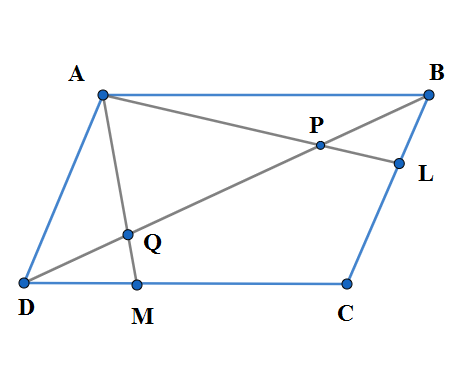
We are given the question that. L is the point on BC which divides BC in the ratio 1:2. So we have
\[BL:CL=2:1\]
We know from the property of ratio that $a:b=ak:bk$ for any non-zero integer $k$. So let us have $BL=2k,CL=k$ then we have $BC=BL+CL=2k+k=3k$. Now we have;
\[\dfrac{BL}{BC}=\dfrac{k}{3k}=\dfrac{1}{3}....\left( 1 \right)\]
Let us observe the triangles APB and LPD. We have the vertically opposite angles subtended at the point P which are always equal. So we have;
\[\angle APB=\angle LPD\]
We know that opposite sides of a parallelogram are equal. So we have parallel sides AD and BC and the transversal AL which makes alternate angles $\angle PDA,\angle PBL$. Since alternate angles are always equal, we have ;
\[\angle PDA=\angle PBL\]
So by angle-angle or AA criterion we have;
\[\Delta APD\sim \Delta LPB\]
Since in similar triangles the opposite sides will be in equal ratio, we have opposite sides of the equal angles $\angle PDA=\angle PBL$ and $\angle APB=\angle LPD$ in proportion as;
\[\dfrac{AP}{LP}=\dfrac{AD}{BL}\]
Since opposite sides of a parallelogram are equal we have $AD=BC$. Now we replace AD by BC in the above step to have;
\[\begin{align}
& \Rightarrow \dfrac{AP}{LP}=\dfrac{BC}{BL} \\
& \Rightarrow \dfrac{AP}{LP}=\dfrac{1}{\dfrac{BL}{BC}} \\
\end{align}\]
We put the obtained value of $\dfrac{BL}{BC}$ in the above step to have;
\[\begin{align}
& \Rightarrow \dfrac{AP}{LP}=\dfrac{1}{\dfrac{1}{3}} \\
& \Rightarrow \dfrac{AP}{LP}=\dfrac{3}{1}=3:1 \\
\end{align}\]
So P divides AL in ratio 3:1 and hence the correct option is C.
Note: We must be careful that when we say a point P divides AB in a ratio $a:b$ then it means $AP:PB=a:b$ not $P:B=a:b$. So we should not calculate $A:P: LP=1: 3$. We can similarly prove that Q divides AM in the ratio 3:1. We can solve alternatively if we know about vectors and represent AL and AM as resultant vectors of the sides.
Complete step-by-step solution:
We draw the diagram of the required parallelogram ABCD .\[\]
We are given the question that. L is the point on BC which divides BC in the ratio 1:2. So we have
\[BL:CL=2:1\]
We know from the property of ratio that $a:b=ak:bk$ for any non-zero integer $k$. So let us have $BL=2k,CL=k$ then we have $BC=BL+CL=2k+k=3k$. Now we have;
\[\dfrac{BL}{BC}=\dfrac{k}{3k}=\dfrac{1}{3}....\left( 1 \right)\]
Let us observe the triangles APB and LPD. We have the vertically opposite angles subtended at the point P which are always equal. So we have;
\[\angle APB=\angle LPD\]
We know that opposite sides of a parallelogram are equal. So we have parallel sides AD and BC and the transversal AL which makes alternate angles $\angle PDA,\angle PBL$. Since alternate angles are always equal, we have ;
\[\angle PDA=\angle PBL\]
So by angle-angle or AA criterion we have;
\[\Delta APD\sim \Delta LPB\]
Since in similar triangles the opposite sides will be in equal ratio, we have opposite sides of the equal angles $\angle PDA=\angle PBL$ and $\angle APB=\angle LPD$ in proportion as;
\[\dfrac{AP}{LP}=\dfrac{AD}{BL}\]
Since opposite sides of a parallelogram are equal we have $AD=BC$. Now we replace AD by BC in the above step to have;
\[\begin{align}
& \Rightarrow \dfrac{AP}{LP}=\dfrac{BC}{BL} \\
& \Rightarrow \dfrac{AP}{LP}=\dfrac{1}{\dfrac{BL}{BC}} \\
\end{align}\]
We put the obtained value of $\dfrac{BL}{BC}$ in the above step to have;
\[\begin{align}
& \Rightarrow \dfrac{AP}{LP}=\dfrac{1}{\dfrac{1}{3}} \\
& \Rightarrow \dfrac{AP}{LP}=\dfrac{3}{1}=3:1 \\
\end{align}\]
So P divides AL in ratio 3:1 and hence the correct option is C.
Note: We must be careful that when we say a point P divides AB in a ratio $a:b$ then it means $AP:PB=a:b$ not $P:B=a:b$. So we should not calculate $A:P: LP=1: 3$. We can similarly prove that Q divides AM in the ratio 3:1. We can solve alternatively if we know about vectors and represent AL and AM as resultant vectors of the sides.
Recently Updated Pages
Which will be the least stable resonating structure class 11 chemistry CBSE

How many 5 digit telephone numbers can be construc-class-11-maths-CBSE
How do you find the angle of the resultant vector class 11 physics CBSE
Draw labelled diagram of the following i Gram seed class 11 biology CBSE
What is the need and importance of classification class 11 biology CBSE
The way in which the sparrows expressed their sorrow class 11 english CBSE
Trending doubts
One Metric ton is equal to kg A 10000 B 1000 C 100 class 11 physics CBSE
Find the value of the expression given below sin 30circ class 11 maths CBSE
1 Quintal is equal to a 110 kg b 10 kg c 100kg d 1000 class 11 physics CBSE
Draw a diagram of nephron and explain its structur class 11 biology CBSE
10 examples of friction in our daily life
Proton was discovered by A Thomson B Rutherford C Chadwick class 11 chemistry CBSE