




ABCD is a parallelogram in which the coordinates of $A,B$ and $C$ are $\left( 1,2 \right)$ , $\left( 7,-1 \right)$ and $\left( -1,-2 \right)$ respectively.
Calculate the area of the parallelogram.
Answer
 Verified
541.8k+ views
Hint: Here, to calculate the area of parallelogram, firstly we will divide this parallelogram into two triangles by drawing a diagonal line and will find the area of triangle by using the formula that is $\frac{1}{2}\left| {{x}_{1}}\left( {{y}_{2}}-{{y}_{3}} \right)+{{x}_{2}}\left( {{y}_{3}}-{{y}_{1}} \right)+{{x}_{3}}\left( {{y}_{1}}-{{y}_{2}} \right) \right|$ . Since, the diagonal divides parallelograms into two equal triangles. So, the area of the triangle is double the area of the triangle.
Complete step-by-step answer:
Since, we need to find the area of the parallelogram, we draw a diagonal line from point $A$ to point $C$ . It will divide the parallelogram into two equal triangles that are $\Delta ABC$ and $\Delta ADC$ . Since, $area\left( \Delta ABC \right)=area\left( \Delta ADC \right)$ . So, we will use the formula to get the area of $\Delta ABC$ as:
$\Rightarrow area\left( \Delta ABC \right)=\dfrac{1}{2}\left| {{x}_{1}}\left( {{y}_{2}}-{{y}_{3}} \right)+{{x}_{2}}\left( {{y}_{3}}-{{y}_{1}} \right)+{{x}_{3}}\left( {{y}_{1}}-{{y}_{2}} \right) \right|$
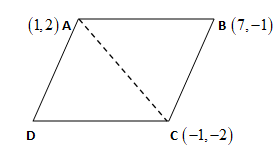
Here, we will use the coordinates of $A,B$ and $C$ as $\left( {{x}_{1}},{{y}_{1}} \right),\left( {{x}_{2}},{{y}_{2}} \right)$ and $\left( {{x}_{3}},{{y}_{3}} \right)$ respectively.
\[\Rightarrow area\left( \Delta ABC \right)=\dfrac{1}{2}\left| 1\left( -1-\left( -2 \right) \right)+7\left( -2-2 \right)+\left( -1 \right)\left( 2-\left( -1 \right) \right) \right|\]
Now, we will do required calculation as:
\[\Rightarrow area\left( \Delta ABC \right)=\dfrac{1}{2}\left| 1\left( -1+2 \right)+7\left( -2-2 \right)-1\left( 2+1 \right) \right|\]
Now, we will do the calculation for small brackets as:
\[\Rightarrow area\left( \Delta ABC \right)=\dfrac{1}{2}\left| 1\left( 1 \right)+7\left( -4 \right)-1\left( 3 \right) \right|\]
Here, we will open the bracket as:
\[\Rightarrow area\left( \Delta ABC \right)=\dfrac{1}{2}\left| 1-28-3 \right|\]
Now, we will precede the calculation as:
\[\Rightarrow area\left( \Delta ABC \right)=\dfrac{1}{2}\left| 1-31 \right|\]
\[\Rightarrow area\left( \Delta ABC \right)=\dfrac{1}{2}\left| -30 \right|\]
Here, we will remove mod and the value of mod is always positive as:
\[\Rightarrow area\left( \Delta ABC \right)=\dfrac{1}{2}\times 30\]
Now, we will have the area of triangle from the above step as:
\[\Rightarrow area\left( \Delta ABC \right)=15\]
As we know that the diagonal of the parallelogram divides the parallelogram into two equal triangles. So, the area of the Parallelogram is double the area of any one triangle as:
$\Rightarrow \text{Area of parallelogram }=2\times area\left( \Delta ABC \right)$
Now, we will use the area of triangle in the above formula as:
$\Rightarrow \text{Area of parallelogram }=2\times 15$
Here, we will complete the calculation as:
$\Rightarrow \text{Area of parallelogram }=30$
Hence, the area of parallelogram is $30$ square unit.
Note: Since, we does not have the coordinates of point $D$ , otherwise we can use the formula from the diagram as the area of parallelogram is equal to the sum of the area of both triangles as:
$\Rightarrow area\text{ }of\text{ }\square ABCD=area\left( \Delta ABC \right)+area\left( \Delta ADC \right)$
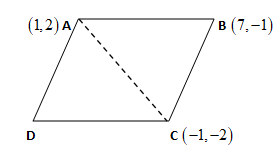
Or, we can use the formula of the area of parallelogram as:
$\Rightarrow area\text{ }of\text{ }\square ABCD=base\times height$
Complete step-by-step answer:
Since, we need to find the area of the parallelogram, we draw a diagonal line from point $A$ to point $C$ . It will divide the parallelogram into two equal triangles that are $\Delta ABC$ and $\Delta ADC$ . Since, $area\left( \Delta ABC \right)=area\left( \Delta ADC \right)$ . So, we will use the formula to get the area of $\Delta ABC$ as:
$\Rightarrow area\left( \Delta ABC \right)=\dfrac{1}{2}\left| {{x}_{1}}\left( {{y}_{2}}-{{y}_{3}} \right)+{{x}_{2}}\left( {{y}_{3}}-{{y}_{1}} \right)+{{x}_{3}}\left( {{y}_{1}}-{{y}_{2}} \right) \right|$
Here, we will use the coordinates of $A,B$ and $C$ as $\left( {{x}_{1}},{{y}_{1}} \right),\left( {{x}_{2}},{{y}_{2}} \right)$ and $\left( {{x}_{3}},{{y}_{3}} \right)$ respectively.
\[\Rightarrow area\left( \Delta ABC \right)=\dfrac{1}{2}\left| 1\left( -1-\left( -2 \right) \right)+7\left( -2-2 \right)+\left( -1 \right)\left( 2-\left( -1 \right) \right) \right|\]
Now, we will do required calculation as:
\[\Rightarrow area\left( \Delta ABC \right)=\dfrac{1}{2}\left| 1\left( -1+2 \right)+7\left( -2-2 \right)-1\left( 2+1 \right) \right|\]
Now, we will do the calculation for small brackets as:
\[\Rightarrow area\left( \Delta ABC \right)=\dfrac{1}{2}\left| 1\left( 1 \right)+7\left( -4 \right)-1\left( 3 \right) \right|\]
Here, we will open the bracket as:
\[\Rightarrow area\left( \Delta ABC \right)=\dfrac{1}{2}\left| 1-28-3 \right|\]
Now, we will precede the calculation as:
\[\Rightarrow area\left( \Delta ABC \right)=\dfrac{1}{2}\left| 1-31 \right|\]
\[\Rightarrow area\left( \Delta ABC \right)=\dfrac{1}{2}\left| -30 \right|\]
Here, we will remove mod and the value of mod is always positive as:
\[\Rightarrow area\left( \Delta ABC \right)=\dfrac{1}{2}\times 30\]
Now, we will have the area of triangle from the above step as:
\[\Rightarrow area\left( \Delta ABC \right)=15\]
As we know that the diagonal of the parallelogram divides the parallelogram into two equal triangles. So, the area of the Parallelogram is double the area of any one triangle as:
$\Rightarrow \text{Area of parallelogram }=2\times area\left( \Delta ABC \right)$
Now, we will use the area of triangle in the above formula as:
$\Rightarrow \text{Area of parallelogram }=2\times 15$
Here, we will complete the calculation as:
$\Rightarrow \text{Area of parallelogram }=30$
Hence, the area of parallelogram is $30$ square unit.
Note: Since, we does not have the coordinates of point $D$ , otherwise we can use the formula from the diagram as the area of parallelogram is equal to the sum of the area of both triangles as:
$\Rightarrow area\text{ }of\text{ }\square ABCD=area\left( \Delta ABC \right)+area\left( \Delta ADC \right)$
Or, we can use the formula of the area of parallelogram as:
$\Rightarrow area\text{ }of\text{ }\square ABCD=base\times height$
Recently Updated Pages
Master Class 11 Business Studies: Engaging Questions & Answers for Success

Master Class 11 Economics: Engaging Questions & Answers for Success
Master Class 11 Computer Science: Engaging Questions & Answers for Success
Master Class 11 English: Engaging Questions & Answers for Success
Master Class 11 Maths: Engaging Questions & Answers for Success
Master Class 11 Biology: Engaging Questions & Answers for Success
Trending doubts
One Metric ton is equal to kg A 10000 B 1000 C 100 class 11 physics CBSE
Discuss the various forms of bacteria class 11 biology CBSE
Draw a diagram of a plant cell and label at least eight class 11 biology CBSE
State the laws of reflection of light
Explain zero factorial class 11 maths CBSE
10 examples of friction in our daily life