




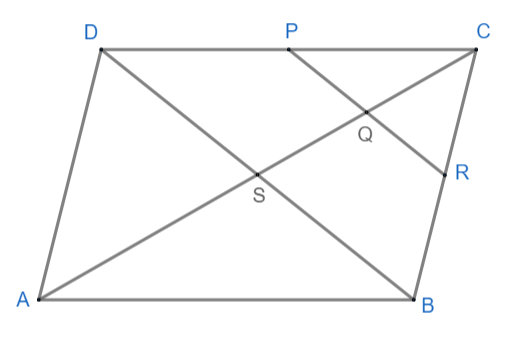
ABCD is a parallelogram in which P is the midpoint of DC and Q is a point on AC such that $CQ=\dfrac{1}{4}AC$. If PQ produced meets BC at R, prove that R is the midpoint of BC
Answer
 Verified
587.1k+ views
Hint:
In this question, we need to prove R as the midpoint of BC. For this, we will first prove Q as the midpoint of CS by using the given condition and using the property of the diagonal of the parallelogram. After that, in $\Delta DCS$ we will use the midpoint theorem. For triangles to prove $PQ\parallel DS$. Using $PQ\parallel DS$ we can say $QR\parallel SB$. So we will use the converse of the midpoint theorem in $\Delta CSB$ to prove R as the midpoint of BC. Theorem and properties are given as:
(I) Diagonals of a parallelogram bisect each other.
(II) Midpoint theorem: the line segment is a triangle joining the midpoint of two sides of the triangle is said to be parallel to its third side.
(III) Converse of midpoint theorem: if a line is drawn through the midpoint of one side of a triangle and parallel to the other side, it bisects the third side.
Complete step by step answer:
Here we are given a parallelogram ABCD where P is the midpoint of CD. Also, AC and BD are the two diagonals which meet each other at S. We are given the CQ as $CQ=\dfrac{1}{4}AC$ of AC.
We know that the diagonals of a parallelogram bisect each other. Therefore, CS = AS (BD bisects AC at S).
Since CS becomes half of AC. So, $CS=\dfrac{1}{2}AC\cdots \cdots \cdots \left( 1 \right)$.
Also we are given that, $CQ=\dfrac{1}{4}AC\cdots \cdots \cdots \left( 2 \right)$.
Dividing equation (2) by (1) we get $\dfrac{CQ}{CS}=\dfrac{\dfrac{1}{4}AC}{\dfrac{1}{2}AC}$.
Cancelling AC on the right side we get $\dfrac{CQ}{CS}=\dfrac{\dfrac{1}{4}}{\dfrac{1}{2}}$.
Simplifying the right side we get $\dfrac{CQ}{CS}=\dfrac{1}{2}$.
Taking S to the other side we get $CQ=\dfrac{1}{2}CS$.
Hence Q is the midpoint of CS.
Now in $\Delta CDS$, we see that P is the midpoint of CD and Q is the midpoint of CS. So we can apply the midpoint theorem here.
According to the midpoint theorem, the line segment in a triangle joining the midpoint of two sides of the triangle is said to be parallel to its third side.
In $\Delta CDS$. P is the midpoint of CD and Q is the midpoint of CS.
Therefore PQ is parallel to the side DS.
Now since QR is just the extension of PQ and SB is the extension of DS, so we can say $QR\parallel SB$.
Therefore, in $\Delta CSB, QR\parallel SB$ and Q is the midpoint of CS.
So we can apply the converse of the midpoint theorem here.
According to the converse of the midpoint theorem, if a line is drawn through the midpoint of one side of a triangle and parallel to the other side, it bisects the third side.
Here $QR\parallel SB$ and Q is the midpoint of CS. So QR bisects BC at R. Hence R is the midpoint of BC.
Hence proved.
Note:
Students should know the statement of the midpoint theorem and its converse. Keep in mind the properties of a parallelogram. Take care while dividing the equation (1) and (2). Note that PQ and QR are parts of line PR. Similarly, DS and SB are parts of DB. So if PQ is parallel to DS then PR is parallel to DB and thus QR is parallel to SB.
In this question, we need to prove R as the midpoint of BC. For this, we will first prove Q as the midpoint of CS by using the given condition and using the property of the diagonal of the parallelogram. After that, in $\Delta DCS$ we will use the midpoint theorem. For triangles to prove $PQ\parallel DS$. Using $PQ\parallel DS$ we can say $QR\parallel SB$. So we will use the converse of the midpoint theorem in $\Delta CSB$ to prove R as the midpoint of BC. Theorem and properties are given as:
(I) Diagonals of a parallelogram bisect each other.
(II) Midpoint theorem: the line segment is a triangle joining the midpoint of two sides of the triangle is said to be parallel to its third side.
(III) Converse of midpoint theorem: if a line is drawn through the midpoint of one side of a triangle and parallel to the other side, it bisects the third side.
Complete step by step answer:
Here we are given a parallelogram ABCD where P is the midpoint of CD. Also, AC and BD are the two diagonals which meet each other at S. We are given the CQ as $CQ=\dfrac{1}{4}AC$ of AC.
We know that the diagonals of a parallelogram bisect each other. Therefore, CS = AS (BD bisects AC at S).
Since CS becomes half of AC. So, $CS=\dfrac{1}{2}AC\cdots \cdots \cdots \left( 1 \right)$.
Also we are given that, $CQ=\dfrac{1}{4}AC\cdots \cdots \cdots \left( 2 \right)$.
Dividing equation (2) by (1) we get $\dfrac{CQ}{CS}=\dfrac{\dfrac{1}{4}AC}{\dfrac{1}{2}AC}$.
Cancelling AC on the right side we get $\dfrac{CQ}{CS}=\dfrac{\dfrac{1}{4}}{\dfrac{1}{2}}$.
Simplifying the right side we get $\dfrac{CQ}{CS}=\dfrac{1}{2}$.
Taking S to the other side we get $CQ=\dfrac{1}{2}CS$.
Hence Q is the midpoint of CS.
Now in $\Delta CDS$, we see that P is the midpoint of CD and Q is the midpoint of CS. So we can apply the midpoint theorem here.
According to the midpoint theorem, the line segment in a triangle joining the midpoint of two sides of the triangle is said to be parallel to its third side.
In $\Delta CDS$. P is the midpoint of CD and Q is the midpoint of CS.
Therefore PQ is parallel to the side DS.
Now since QR is just the extension of PQ and SB is the extension of DS, so we can say $QR\parallel SB$.
Therefore, in $\Delta CSB, QR\parallel SB$ and Q is the midpoint of CS.
So we can apply the converse of the midpoint theorem here.
According to the converse of the midpoint theorem, if a line is drawn through the midpoint of one side of a triangle and parallel to the other side, it bisects the third side.
Here $QR\parallel SB$ and Q is the midpoint of CS. So QR bisects BC at R. Hence R is the midpoint of BC.
Hence proved.
Note:
Students should know the statement of the midpoint theorem and its converse. Keep in mind the properties of a parallelogram. Take care while dividing the equation (1) and (2). Note that PQ and QR are parts of line PR. Similarly, DS and SB are parts of DB. So if PQ is parallel to DS then PR is parallel to DB and thus QR is parallel to SB.
Recently Updated Pages
Three beakers labelled as A B and C each containing 25 mL of water were taken A small amount of NaOH anhydrous CuSO4 and NaCl were added to the beakers A B and C respectively It was observed that there was an increase in the temperature of the solutions contained in beakers A and B whereas in case of beaker C the temperature of the solution falls Which one of the following statements isarecorrect i In beakers A and B exothermic process has occurred ii In beakers A and B endothermic process has occurred iii In beaker C exothermic process has occurred iv In beaker C endothermic process has occurred

Master Class 10 Social Science: Engaging Questions & Answers for Success
Master Class 10 Science: Engaging Questions & Answers for Success
Master Class 10 Maths: Engaging Questions & Answers for Success
Master Class 10 General Knowledge: Engaging Questions & Answers for Success
Master Class 10 Computer Science: Engaging Questions & Answers for Success
Three beakers labelled as A B and C each containing 25 mL of water were taken A small amount of NaOH anhydrous CuSO4 and NaCl were added to the beakers A B and C respectively It was observed that there was an increase in the temperature of the solutions contained in beakers A and B whereas in case of beaker C the temperature of the solution falls Which one of the following statements isarecorrect i In beakers A and B exothermic process has occurred ii In beakers A and B endothermic process has occurred iii In beaker C exothermic process has occurred iv In beaker C endothermic process has occurred
Master Class 10 Social Science: Engaging Questions & Answers for Success
Master Class 10 Science: Engaging Questions & Answers for Success
Trending doubts
In cricket, what is the term for a bowler taking five wickets in an innings?
Who Won 36 Oscar Awards? Record Holder Revealed
What is the name of Japan Parliament?
What is deficiency disease class 10 biology CBSE
Why is there a time difference of about 5 hours between class 10 social science CBSE
Write an application to the principal requesting five class 10 english CBSE