



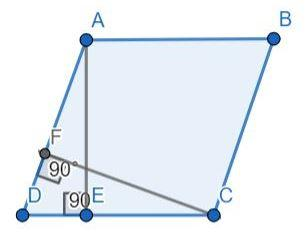
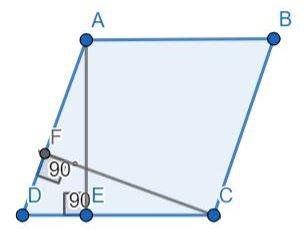
ABCD is a parallelogram in which AE $\bot $ DC, CF $\bot $ AD. If AB = 16 cm, AE = 8 cm, CF = 10 cm, find the value of AD.
Answer
 Verified
601.2k+ views
Hint: To solve this problem we first need to know how to calculate the area of a parallelogram i.e. area of parallelogram is given by, base $\times $ height. So to solve this we will first calculate the area of the parallelogram using DC (value of DC will be equal to AB, property of parallelogram) as the base and AE as the height and then equate the obtained area when we take AD as the base and CF as the height and from that we will get the required value of CF.
Complete step by step answer:
In the parallelogram ABCD,
We are given that,
AB = 16 cm,
AE = 8 cm,
CF = 10 cm
We know that we can find the area of the parallelogram using the formula,
Base $\times $Height,
As we know opposite sides of the parallelogram are equal so AB = DC = 10 cm.
First we will find the area using DC as base and AE as height, i.e.
Area of parallelogram is =
$DC\times AE$
\[\begin{align}
& =16\times 8 \\
& =128c{{m}^{2}}\,\,\,\,\,....\left( 1 \right) \\
\end{align}\]
Now finding the area using AD as base and CF as the height we get,
Area of parallelogram is =
$AD\times CF$
$\begin{align}
& =AD\times 10 \\
& =10AD\,c{{m}^{2}}\,\,\,....\left( 2 \right) \\
\end{align}$
Now equating equation 1 and 2, we get
10 $\times $ AD = 128
AD = $\dfrac{128}{10}$
AD = $12.8\,cm$
Hence the value of AD is 12.8 cm.
Note: To solve these kinds of problems first try to think of all the properties that you know about the geometric figure given and after that try to apply the property which you think can be productive and will help to find the answer easily. Also remember the mentioned formula for area of the parallelogram for future reference.
Complete step by step answer:
In the parallelogram ABCD,
We are given that,
AB = 16 cm,
AE = 8 cm,
CF = 10 cm
We know that we can find the area of the parallelogram using the formula,
Base $\times $Height,
As we know opposite sides of the parallelogram are equal so AB = DC = 10 cm.
First we will find the area using DC as base and AE as height, i.e.
Area of parallelogram is =
$DC\times AE$
\[\begin{align}
& =16\times 8 \\
& =128c{{m}^{2}}\,\,\,\,\,....\left( 1 \right) \\
\end{align}\]
Now finding the area using AD as base and CF as the height we get,
Area of parallelogram is =
$AD\times CF$
$\begin{align}
& =AD\times 10 \\
& =10AD\,c{{m}^{2}}\,\,\,....\left( 2 \right) \\
\end{align}$
Now equating equation 1 and 2, we get
10 $\times $ AD = 128
AD = $\dfrac{128}{10}$
AD = $12.8\,cm$
Hence the value of AD is 12.8 cm.
Note: To solve these kinds of problems first try to think of all the properties that you know about the geometric figure given and after that try to apply the property which you think can be productive and will help to find the answer easily. Also remember the mentioned formula for area of the parallelogram for future reference.
Recently Updated Pages
Master Class 9 Social Science: Engaging Questions & Answers for Success

Master Class 9 Science: Engaging Questions & Answers for Success
Master Class 9 Maths: Engaging Questions & Answers for Success
Master Class 9 General Knowledge: Engaging Questions & Answers for Success
Class 9 Question and Answer - Your Ultimate Solutions Guide
Master Class 8 Social Science: Engaging Questions & Answers for Success
Trending doubts
Find the sum of series 1 + 2 + 3 + 4 + 5 + + 100 class 9 maths CBSE
What is the Full Form of ISI and RAW
Fill the blanks with the suitable prepositions 1 The class 9 english CBSE
Difference Between Plant Cell and Animal Cell
Who is eligible for RTE class 9 social science CBSE
What is pollution? How many types of pollution? Define it