




ABC is an isosceles triangle with AC = BC. If \[A{{B}^{2}}=2A{{C}^{2}}\], then the value of \[\angle ACB\] is
A). less than \[{{60}^{\circ }}\]
B). equal to \[{{60}^{\circ }}\]
C). equal to \[{{90}^{\circ }}\]
D). less than \[{{30}^{\circ }}\]
Answer
 Verified
577.5k+ views
Hint: Use cosine law of triangle to get a relation between all three sides and an angle of the triangle. Put appropriate given information and get the result.
Complete step-by-step solution
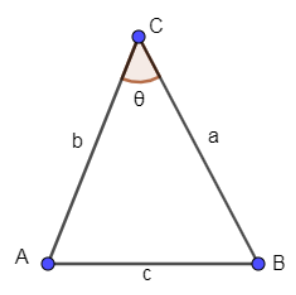
Let us assume that \[\angle ACB=\theta \] and represent AB, BC, AC as c, a, b respectively. In the below figure, we have shown an isosceles triangle ABC with sides AB, BC, AC as c, a, b respectively, and \[\angle ACB=\theta \].
Now it is given that AC = BC. Hence we can write a = b
Again it is given that \[A{{B}^{2}}=2A{{C}^{2}}\]. So, we can write \[{{c}^{2}}=2{{b}^{2}}\]
Now we know from the cosine law that \[{{c}^{2}}={{a}^{2}}+{{b}^{2}}-2ab\cos \theta \] where every parameter represents standard things.
So using the above equation we get,\[{{c}^{2}}={{a}^{2}}+{{b}^{2}}-2ab\cos \theta \]
Now as a = b then we get \[{{c}^{2}}={{b}^{2}}+{{b}^{2}}-2{{b}^{2}}\cos \theta \]
\[\Rightarrow {{c}^{2}}=2{{b}^{2}}-2{{b}^{2}}\cos \theta \]
Or we can write \[{{c}^{2}}-2{{b}^{2}}= -2{{b}^{2}}\cos \theta \]
But it is given that \[{{c}^{2}}=2{{b}^{2}}\]. So, \[{{c}^{2}}-2{{b}^{2}}=0\]
Hence, we can write \[2{{b}^{2}}\cos \theta =0\]
As b is non-zero we can cancel it out from both sides and hence we get that \[\cos \theta =0\]
From trigonometry we know that the angle which satisfies the above equation is \[{{90}^{\circ }}\]. Because it is at an angle of a triangle so it has a restricted value.
Hence, the value of \[\angle ACB\] is \[{{90}^{\circ }}\].
Hence, the correct answer to the given question is an option (c) equal to \[{{90}^{\circ }}\]
Note: In the above solution, you might have thought why we have written the solution for \[\cos \theta =0\] as \[{{90}^{\circ }}\], cosine is 0 at the odd multiple of $\dfrac{\pi }{2}$ so $\theta $ can be $\dfrac{3\pi }{2},\dfrac{5\pi }{2}$ and so one. The answer is we know the each of the three angles in a triangle can take value greater than ${{0}^{\circ }}$ and less than $\pi $ and the angles from $\dfrac{3\pi }{2},\dfrac{5\pi }{2}$ and so on are greater than $\pi $ that’s why we have not consider these solutions and only took $\theta =\dfrac{\pi }{2}$.
Complete step-by-step solution
Let us assume that \[\angle ACB=\theta \] and represent AB, BC, AC as c, a, b respectively. In the below figure, we have shown an isosceles triangle ABC with sides AB, BC, AC as c, a, b respectively, and \[\angle ACB=\theta \].
Now it is given that AC = BC. Hence we can write a = b
Again it is given that \[A{{B}^{2}}=2A{{C}^{2}}\]. So, we can write \[{{c}^{2}}=2{{b}^{2}}\]
Now we know from the cosine law that \[{{c}^{2}}={{a}^{2}}+{{b}^{2}}-2ab\cos \theta \] where every parameter represents standard things.
So using the above equation we get,\[{{c}^{2}}={{a}^{2}}+{{b}^{2}}-2ab\cos \theta \]
Now as a = b then we get \[{{c}^{2}}={{b}^{2}}+{{b}^{2}}-2{{b}^{2}}\cos \theta \]
\[\Rightarrow {{c}^{2}}=2{{b}^{2}}-2{{b}^{2}}\cos \theta \]
Or we can write \[{{c}^{2}}-2{{b}^{2}}= -2{{b}^{2}}\cos \theta \]
But it is given that \[{{c}^{2}}=2{{b}^{2}}\]. So, \[{{c}^{2}}-2{{b}^{2}}=0\]
Hence, we can write \[2{{b}^{2}}\cos \theta =0\]
As b is non-zero we can cancel it out from both sides and hence we get that \[\cos \theta =0\]
From trigonometry we know that the angle which satisfies the above equation is \[{{90}^{\circ }}\]. Because it is at an angle of a triangle so it has a restricted value.
Hence, the value of \[\angle ACB\] is \[{{90}^{\circ }}\].
Hence, the correct answer to the given question is an option (c) equal to \[{{90}^{\circ }}\]
Note: In the above solution, you might have thought why we have written the solution for \[\cos \theta =0\] as \[{{90}^{\circ }}\], cosine is 0 at the odd multiple of $\dfrac{\pi }{2}$ so $\theta $ can be $\dfrac{3\pi }{2},\dfrac{5\pi }{2}$ and so one. The answer is we know the each of the three angles in a triangle can take value greater than ${{0}^{\circ }}$ and less than $\pi $ and the angles from $\dfrac{3\pi }{2},\dfrac{5\pi }{2}$ and so on are greater than $\pi $ that’s why we have not consider these solutions and only took $\theta =\dfrac{\pi }{2}$.
Recently Updated Pages
Master Class 10 Computer Science: Engaging Questions & Answers for Success

Master Class 10 English: Engaging Questions & Answers for Success
Master Class 10 Social Science: Engaging Questions & Answers for Success
Master Class 10 General Knowledge: Engaging Questions & Answers for Success
Master Class 10 Maths: Engaging Questions & Answers for Success
Master Class 10 Science: Engaging Questions & Answers for Success
Trending doubts
Why is there a time difference of about 5 hours between class 10 social science CBSE
The draft of the Preamble of the Indian Constitution class 10 social science CBSE
What is the median of the first 10 natural numbers class 10 maths CBSE
Who gave "Inqilab Zindabad" slogan?
Who was Subhash Chandra Bose Why was he called Net class 10 english CBSE
Write a letter to the principal requesting him to grant class 10 english CBSE