




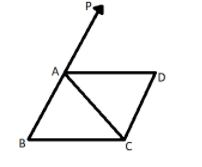
ABC is an isosceles triangle in which AB = AC, AD is the bisector of exterior angle PAC and CD is parallel to AB, prove that
$\left( i \right)\angle DAC = \angle BCA$
$\left( {ii} \right)$ ABCD is a parallelogram.
Answer
 Verified
611.7k+ views
Hint: In this particular question use the concept that in an isosceles triangle opposite angle to the same side are always equal so, $\angle ABC = \angle ACB$, and later on use that in a parallelogram opposite sides are parallel to each other, so use these properties to reach the solution of the question.
Complete step-by-step answer:
Given data:
ABC is an isosceles triangle in which AB = AC
Proof –
$\left( i \right)\angle DAC = \angle BCA$
As we all know that in an isosceles triangle opposite angles to the same side are always equal.
So, $\angle ABC = \angle BCA$................. (1)
Now it is also given that AD is the bisector of exterior angle PAC.
So, $\angle PAD = \angle DAC$............. (2)
Now as we all know that in a straight line the sum of all angles at a particular point is equal to 180 degrees.
$ \Rightarrow \angle PAD + \angle DAC + \angle CAB = {180^o}$
Now from equation (2) we have,
$ \Rightarrow \angle DAC + \angle DAC + \angle CAB = {180^o}$
$ \Rightarrow \angle CAB = {180^o} - 2\angle DAC$................ (3)
Now in any triangle the sum of all angles are equal to 180 degrees, so in triangle ABC we have,
$ \Rightarrow \angle ABC + \angle BCA + \angle CAB = {180^o}$
Now from equation (3) we have,
$ \Rightarrow \angle ABC + \angle BCA + {180^o} - 2\angle DAC = {180^o}$
Now simplify it we have,
$ \Rightarrow \angle ABC + \angle BCA = 2\angle DAC$
Now from equation (1), i.e. $\angle ABC = \angle BCA$ s we have,
$ \Rightarrow \angle BCA + \angle BCA = 2\angle DAC$
$ \Rightarrow 2\angle BCA = 2\angle DAC$
$ \Rightarrow \angle BCA = \angle DAC$
Hence proved.
$\left( {ii} \right)$ ABCD is a parallelogram.
Proof –
Now it is given that the CD is parallel to AB.
Therefore, CD||AB.
Now from the above proof $\angle BCA = \angle DAC$, this is only possible if side AD is parallel to BC.
Therefore, AD||BC.
Now we all know that in a parallelogram opposite sides are parallel to each other.
As we see that CD||AB and AD||BC.
Therefore, ABCD is a parallelogram.
Hence proved.
Note: Whenever we face such types of questions always recall that in any triangle the sum of all angles are equal to 180 degrees, and in a straight line the sum of all angles at a particular point is equal to 180 degrees, so just write the equation as above and simplify we will get the required result.
Complete step-by-step answer:
Given data:
ABC is an isosceles triangle in which AB = AC
Proof –
$\left( i \right)\angle DAC = \angle BCA$
As we all know that in an isosceles triangle opposite angles to the same side are always equal.
So, $\angle ABC = \angle BCA$................. (1)
Now it is also given that AD is the bisector of exterior angle PAC.
So, $\angle PAD = \angle DAC$............. (2)
Now as we all know that in a straight line the sum of all angles at a particular point is equal to 180 degrees.
$ \Rightarrow \angle PAD + \angle DAC + \angle CAB = {180^o}$
Now from equation (2) we have,
$ \Rightarrow \angle DAC + \angle DAC + \angle CAB = {180^o}$
$ \Rightarrow \angle CAB = {180^o} - 2\angle DAC$................ (3)
Now in any triangle the sum of all angles are equal to 180 degrees, so in triangle ABC we have,
$ \Rightarrow \angle ABC + \angle BCA + \angle CAB = {180^o}$
Now from equation (3) we have,
$ \Rightarrow \angle ABC + \angle BCA + {180^o} - 2\angle DAC = {180^o}$
Now simplify it we have,
$ \Rightarrow \angle ABC + \angle BCA = 2\angle DAC$
Now from equation (1), i.e. $\angle ABC = \angle BCA$ s we have,
$ \Rightarrow \angle BCA + \angle BCA = 2\angle DAC$
$ \Rightarrow 2\angle BCA = 2\angle DAC$
$ \Rightarrow \angle BCA = \angle DAC$
Hence proved.
$\left( {ii} \right)$ ABCD is a parallelogram.
Proof –
Now it is given that the CD is parallel to AB.
Therefore, CD||AB.
Now from the above proof $\angle BCA = \angle DAC$, this is only possible if side AD is parallel to BC.
Therefore, AD||BC.
Now we all know that in a parallelogram opposite sides are parallel to each other.
As we see that CD||AB and AD||BC.
Therefore, ABCD is a parallelogram.
Hence proved.
Note: Whenever we face such types of questions always recall that in any triangle the sum of all angles are equal to 180 degrees, and in a straight line the sum of all angles at a particular point is equal to 180 degrees, so just write the equation as above and simplify we will get the required result.
Recently Updated Pages
Master Class 10 Social Science: Engaging Questions & Answers for Success

Master Class 10 Science: Engaging Questions & Answers for Success
Master Class 10 Maths: Engaging Questions & Answers for Success
Master Class 10 General Knowledge: Engaging Questions & Answers for Success
Master Class 10 Computer Science: Engaging Questions & Answers for Success
Class 10 Question and Answer - Your Ultimate Solutions Guide
Trending doubts
What is the full form of PNG A Petrol Natural Gas B class 10 chemistry CBSE
Explain the Treaty of Vienna of 1815 class 10 social science CBSE
In cricket, how many legal balls are there in a standard over?
Why is there a time difference of about 5 hours between class 10 social science CBSE
Who Won 36 Oscar Awards? Record Holder Revealed
What is the median of the first 10 natural numbers class 10 maths CBSE