



ABC is a triangle with \[\angle A = {30^ \circ },BC = 10cm\] . The area of the circumcircle of the triangle is
A.\[100\pi \;sqcm\]
B.\[5\;sqcm\]
C.\[25\;sqcm\]
D.\[\dfrac{{100\pi }}{3}\;sqcm\]
Answer
 Verified
522k+ views
Hint: Firstly, construct the diagram with the help of given information. Find the dimensions of the triangle in order to get the value for radius of the circumcircle. Then find the area of the circumcircle using the formula \[\pi {r^2}\]. The circumcircle of a triangle always passes through all the vertices of the triangle.
Complete step-by-step answer:
Construction of diagram as per the given dimensions:
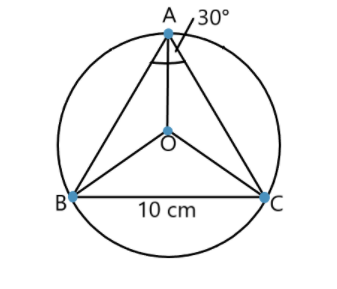
Given that ABC is a triangle and \[\angle A = {30^ \circ },BC = 10cm\] .
We need to find the area of the circumcircle of the triangle.
Let O be the center of the circumcircle of the given triangle.
According to the Inscribed Angle Theorem, we know that:
The centered angle is equal to twice of the opposite angle.
So, \[\angle BOC = 2\angle A\]
Therefore, \[\angle BOC = {60^ \circ }\]
Hence OB and OC are the radii of the circumcircle of the given triangle.
Thus, \[\angle OBC = \angle OCB = {60^ \circ }\]
Therefore, OBC is an equilateral triangle.
The radius of the circle\[ = OB = OC = BC = 10cm\]
Hence the area of the circumcircle of a triangle \[ = \pi {r^2}\]
Since, the radius of the circumcircle of the given triangle is \[10\,cm\].
Therefore, we get the area of the circumcircle of a triangle as:
\[ = \pi {10^2} = 100\pi \]
Therefore, area of the circumcircle \[ = 100\pi {\text{ sq cm}}\]
Hence, we get the required answer to the question.
So, the correct answer is “Option A”.
Note: Locate accurately which line of the triangle forms the radius of the circumcircle. Keep in mind that the circumcircle of a triangle always passes through all the vertices of the triangle. We should have accuracy in calculations, derivatives and arithmetic in order to be sure of the final answer. We must know that there may be additional information given in the question that is not of use in solving the problem.
Complete step-by-step answer:
Construction of diagram as per the given dimensions:
Given that ABC is a triangle and \[\angle A = {30^ \circ },BC = 10cm\] .
We need to find the area of the circumcircle of the triangle.
Let O be the center of the circumcircle of the given triangle.
According to the Inscribed Angle Theorem, we know that:
The centered angle is equal to twice of the opposite angle.
So, \[\angle BOC = 2\angle A\]
Therefore, \[\angle BOC = {60^ \circ }\]
Hence OB and OC are the radii of the circumcircle of the given triangle.
Thus, \[\angle OBC = \angle OCB = {60^ \circ }\]
Therefore, OBC is an equilateral triangle.
The radius of the circle\[ = OB = OC = BC = 10cm\]
Hence the area of the circumcircle of a triangle \[ = \pi {r^2}\]
Since, the radius of the circumcircle of the given triangle is \[10\,cm\].
Therefore, we get the area of the circumcircle of a triangle as:
\[ = \pi {10^2} = 100\pi \]
Therefore, area of the circumcircle \[ = 100\pi {\text{ sq cm}}\]
Hence, we get the required answer to the question.
So, the correct answer is “Option A”.
Note: Locate accurately which line of the triangle forms the radius of the circumcircle. Keep in mind that the circumcircle of a triangle always passes through all the vertices of the triangle. We should have accuracy in calculations, derivatives and arithmetic in order to be sure of the final answer. We must know that there may be additional information given in the question that is not of use in solving the problem.
Recently Updated Pages
Master Class 11 English: Engaging Questions & Answers for Success

Master Class 11 Maths: Engaging Questions & Answers for Success
Class 11 Question and Answer - Your Ultimate Solutions Guide
Master Class 11 Biology: Engaging Questions & Answers for Success
Master Class 11 Physics: Engaging Questions & Answers for Success
Master Class 11 Accountancy: Engaging Questions & Answers for Success
Trending doubts
Find the sum of series 1 + 2 + 3 + 4 + 5 + + 100 class 9 maths CBSE
Fill the blanks with the suitable prepositions 1 The class 9 english CBSE
Difference Between Plant Cell and Animal Cell
How many hours before the closure of election must class 9 social science CBSE
What is pollution? How many types of pollution? Define it
Name 10 Living and Non living things class 9 biology CBSE