




ABC is a triangle where A = (2,3,5), B = (-1,3,2) and C = (x,5,y). If median through A is equally inclined to the axes then the length of median is?
Answer
 Verified
647.4k+ views
Hint: We solve the above problem by using the below formulas
1. Distance formulae for 3 plane coordinates = $\sqrt {{{\left( {{x_2} - {x_1}} \right)}^2} + {{\left( {{y_2} - {y_1}} \right)}^2} + {{\left( {{z_2} - {z_1}} \right)}^2}} $
2. To find out the coordinates of a median (x,y,z) of two points (x1,y1,z1) and (x2,y2,z2)
$\begin{gathered}
x = \dfrac{{{x_1} + {x_2}}}{2} \\
y = \dfrac{{{y_1} + {y_2}}}{2} \\
z = \dfrac{{{z_1} + {z_2}}}{2} \\
\end{gathered} $
3. Direction cosines of a line from A(x1,y1,z1) to B(x2,y2,z2) is given by
\[\left( {{x_2} - {x_1},{\text{ }}{y_2} - {y_1},{\text{ }}{z_2} - {z_1}} \right)\]
4. Direction ratios of a line from A(x1,y1,z1) to B(x2,y2,z2) is given by
$\dfrac{{{x_2} - {x_1}}}{{\sqrt {{{\left( {{x_2} - {x_1}} \right)}^2} + {{\left( {{y_2} - {y_1}} \right)}^2} + {{\left( {{z_2} - {z_1}} \right)}^2}} }},\dfrac{{{y_2} - {y_1}}}{{\sqrt {{{\left( {{x_2} - {x_1}} \right)}^2} + {{\left( {{y_2} - {y_1}} \right)}^2} + {{\left( {{z_2} - {z_1}} \right)}^2}} }},\dfrac{{{z_2} - {z_1}}}{{\sqrt {{{\left( {{x_2} - {x_1}} \right)}^2} + {{\left( {{y_2} - {y_1}} \right)}^2} + {{\left( {{z_2} - {z_1}} \right)}^2}} }}$
Complete step-by-step solution:
1. Assuming the triangle ABC, which has a point D on BC which has a median through A.
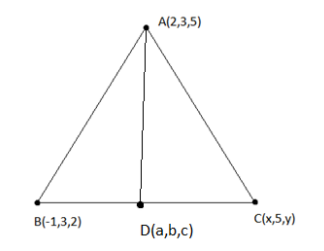
And assuming the coordinates of point D = (a,b,c)
Now, Point D is the median of the line BC. Which implies that
$\begin{gathered}
a = \dfrac{{x + ( - 1)}}{2} \\
a = \dfrac{{x - 1}}{2} \\
\end{gathered} $ ......(1)
$\begin{gathered}
b = \dfrac{{5 + 3}}{2} \\
b = \dfrac{8}{2} \\
b = 4 \\
\end{gathered} $ ......(2)
And
$c = \dfrac{{y + 2}}{2}$ ......(3)
We have got the point coordinates of the point D
2. Now as to find out the values of x and y we need to find out the direction cosines of line AD.
Direction cosines of line AD is given by
$\begin{gathered}
\left( {a - 2,b - 3,c - 5} \right) \\
\\
\end{gathered} $
Substituting the values of a, b and c from Eqn (1), (2) and(3), we get
$\left( {\dfrac{{x - 1}}{2} - 2,4 - 3,\dfrac{{y + 2}}{2} - 5} \right)$
$\begin{gathered}
\left( {\dfrac{{x - 1 - 4}}{2},1,\dfrac{{y + 2 - 10}}{2}} \right) \\
\left( {\dfrac{{x - 5}}{2},1,\dfrac{{y - 8}}{2}} \right) \\
\end{gathered} $
3. Since it was said that the median through point A makes equal angles with the axes. It means that the direction ratios of line AD are equal
i.e. $\dfrac{{\dfrac{{x - 5}}{2}}}{{\sqrt {{{\left( {\dfrac{{x - 5}}{2}} \right)}^2} + {1^2} + {{\left( {\dfrac{{y - 8}}{2}} \right)}^2}} }} = \dfrac{1}{{\sqrt {{{\left( {\dfrac{{x - 5}}{2}} \right)}^2} + {1^2} + {{\left( {\dfrac{{y - 8}}{2}} \right)}^2}} }} = \dfrac{{\dfrac{{y - 8}}{2}}}{{\sqrt {{{\left( {\dfrac{{x - 5}}{2}} \right)}^2} + {1^2} + {{\left( {\dfrac{{y - 8}}{2}} \right)}^2}} }}$
4. Comparing the first two parts of direction ratios, we get
$\dfrac{{\dfrac{{x - 5}}{2}}}{{\sqrt {{{\left( {\dfrac{{x - 5}}{2}} \right)}^2} + {1^2} + {{\left( {\dfrac{{y - 8}}{2}} \right)}^2}} }} = \dfrac{1}{{\sqrt {{{\left( {\dfrac{{x - 5}}{2}} \right)}^2} + {1^2} + {{\left( {\dfrac{{y - 8}}{2}} \right)}^2}} }}$
Since the denominators are same, they will get cancelled out and we will be left with
$\dfrac{{x - 5}}{2} = 1$
Multiply both sides with 2, we get
$x - 5 = 2$
Adding 5 both sides we will get
$x = 7$
The x-coordinate of point c is 7.
5. Comparing last two parts of direction ratios we get
$\dfrac{{\dfrac{{y - 8}}{2}}}{{\sqrt {{{\left( {\dfrac{{x - 5}}{2}} \right)}^2} + {1^2} + {{\left( {\dfrac{{y - 8}}{2}} \right)}^2}} }} = \dfrac{1}{{\sqrt {{{\left( {\dfrac{{x - 5}}{2}} \right)}^2} + {1^2} + {{\left( {\dfrac{{y - 8}}{2}} \right)}^2}} }}$
Since the denominators are same they will get cancelled out and we will be left with
$\dfrac{{y - 8}}{2} = 1$
Multiplying both sides with 2 we will get
$y - 8 = 2$
Adding 2 both sides we will get
$y = 10$
The z-coordinate of point C is 10
6. Now the point C has coordinates (7,5,10)
7. Putting the values of x and y in Eqn (1) and (2), we get
$\begin{gathered}
a = \dfrac{{7 - 1}}{2} \\
a = \dfrac{6}{2} \\
a = 3 \\
\end{gathered} $
And
$\begin{gathered}
c = \dfrac{{10 + 2}}{2} \\
c = \dfrac{{12}}{2} \\
c = 6 \\
\end{gathered} $
8. The coordinates of point D are (3,4,6)
Now, to find out the length of median AD, we need to find out the distance between the point A and D
9. So, using the distance formulae for three coordinate points
Distance between A(2,3,5) and D(3,4,6) will be
$\begin{gathered}
\sqrt {{{\left( {3 - 2} \right)}^2} + {{\left( {4 - 3} \right)}^2} + {{\left( {6 - 5} \right)}^2}} \\
\sqrt {{{\left( 1 \right)}^2} + {{\left( 1 \right)}^2} + {{\left( 1 \right)}^2}} \\
\sqrt {1 + 1 + 1} \\
\sqrt 3 \\
\end{gathered} $
Therefore, the length of median AD is $\sqrt 3 $units.
Note:The median is a point always on the centre of line which bisects the line into two equal parts.
i.e. If I consider a line AB, and point C to be its median.

Then I can say that point C divides the line AB in two equal parts
i.e. AC = BC
1. Distance formulae for 3 plane coordinates = $\sqrt {{{\left( {{x_2} - {x_1}} \right)}^2} + {{\left( {{y_2} - {y_1}} \right)}^2} + {{\left( {{z_2} - {z_1}} \right)}^2}} $
2. To find out the coordinates of a median (x,y,z) of two points (x1,y1,z1) and (x2,y2,z2)
$\begin{gathered}
x = \dfrac{{{x_1} + {x_2}}}{2} \\
y = \dfrac{{{y_1} + {y_2}}}{2} \\
z = \dfrac{{{z_1} + {z_2}}}{2} \\
\end{gathered} $
3. Direction cosines of a line from A(x1,y1,z1) to B(x2,y2,z2) is given by
\[\left( {{x_2} - {x_1},{\text{ }}{y_2} - {y_1},{\text{ }}{z_2} - {z_1}} \right)\]
4. Direction ratios of a line from A(x1,y1,z1) to B(x2,y2,z2) is given by
$\dfrac{{{x_2} - {x_1}}}{{\sqrt {{{\left( {{x_2} - {x_1}} \right)}^2} + {{\left( {{y_2} - {y_1}} \right)}^2} + {{\left( {{z_2} - {z_1}} \right)}^2}} }},\dfrac{{{y_2} - {y_1}}}{{\sqrt {{{\left( {{x_2} - {x_1}} \right)}^2} + {{\left( {{y_2} - {y_1}} \right)}^2} + {{\left( {{z_2} - {z_1}} \right)}^2}} }},\dfrac{{{z_2} - {z_1}}}{{\sqrt {{{\left( {{x_2} - {x_1}} \right)}^2} + {{\left( {{y_2} - {y_1}} \right)}^2} + {{\left( {{z_2} - {z_1}} \right)}^2}} }}$
Complete step-by-step solution:
1. Assuming the triangle ABC, which has a point D on BC which has a median through A.
And assuming the coordinates of point D = (a,b,c)
Now, Point D is the median of the line BC. Which implies that
$\begin{gathered}
a = \dfrac{{x + ( - 1)}}{2} \\
a = \dfrac{{x - 1}}{2} \\
\end{gathered} $ ......(1)
$\begin{gathered}
b = \dfrac{{5 + 3}}{2} \\
b = \dfrac{8}{2} \\
b = 4 \\
\end{gathered} $ ......(2)
And
$c = \dfrac{{y + 2}}{2}$ ......(3)
We have got the point coordinates of the point D
2. Now as to find out the values of x and y we need to find out the direction cosines of line AD.
Direction cosines of line AD is given by
$\begin{gathered}
\left( {a - 2,b - 3,c - 5} \right) \\
\\
\end{gathered} $
Substituting the values of a, b and c from Eqn (1), (2) and(3), we get
$\left( {\dfrac{{x - 1}}{2} - 2,4 - 3,\dfrac{{y + 2}}{2} - 5} \right)$
$\begin{gathered}
\left( {\dfrac{{x - 1 - 4}}{2},1,\dfrac{{y + 2 - 10}}{2}} \right) \\
\left( {\dfrac{{x - 5}}{2},1,\dfrac{{y - 8}}{2}} \right) \\
\end{gathered} $
3. Since it was said that the median through point A makes equal angles with the axes. It means that the direction ratios of line AD are equal
i.e. $\dfrac{{\dfrac{{x - 5}}{2}}}{{\sqrt {{{\left( {\dfrac{{x - 5}}{2}} \right)}^2} + {1^2} + {{\left( {\dfrac{{y - 8}}{2}} \right)}^2}} }} = \dfrac{1}{{\sqrt {{{\left( {\dfrac{{x - 5}}{2}} \right)}^2} + {1^2} + {{\left( {\dfrac{{y - 8}}{2}} \right)}^2}} }} = \dfrac{{\dfrac{{y - 8}}{2}}}{{\sqrt {{{\left( {\dfrac{{x - 5}}{2}} \right)}^2} + {1^2} + {{\left( {\dfrac{{y - 8}}{2}} \right)}^2}} }}$
4. Comparing the first two parts of direction ratios, we get
$\dfrac{{\dfrac{{x - 5}}{2}}}{{\sqrt {{{\left( {\dfrac{{x - 5}}{2}} \right)}^2} + {1^2} + {{\left( {\dfrac{{y - 8}}{2}} \right)}^2}} }} = \dfrac{1}{{\sqrt {{{\left( {\dfrac{{x - 5}}{2}} \right)}^2} + {1^2} + {{\left( {\dfrac{{y - 8}}{2}} \right)}^2}} }}$
Since the denominators are same, they will get cancelled out and we will be left with
$\dfrac{{x - 5}}{2} = 1$
Multiply both sides with 2, we get
$x - 5 = 2$
Adding 5 both sides we will get
$x = 7$
The x-coordinate of point c is 7.
5. Comparing last two parts of direction ratios we get
$\dfrac{{\dfrac{{y - 8}}{2}}}{{\sqrt {{{\left( {\dfrac{{x - 5}}{2}} \right)}^2} + {1^2} + {{\left( {\dfrac{{y - 8}}{2}} \right)}^2}} }} = \dfrac{1}{{\sqrt {{{\left( {\dfrac{{x - 5}}{2}} \right)}^2} + {1^2} + {{\left( {\dfrac{{y - 8}}{2}} \right)}^2}} }}$
Since the denominators are same they will get cancelled out and we will be left with
$\dfrac{{y - 8}}{2} = 1$
Multiplying both sides with 2 we will get
$y - 8 = 2$
Adding 2 both sides we will get
$y = 10$
The z-coordinate of point C is 10
6. Now the point C has coordinates (7,5,10)
7. Putting the values of x and y in Eqn (1) and (2), we get
$\begin{gathered}
a = \dfrac{{7 - 1}}{2} \\
a = \dfrac{6}{2} \\
a = 3 \\
\end{gathered} $
And
$\begin{gathered}
c = \dfrac{{10 + 2}}{2} \\
c = \dfrac{{12}}{2} \\
c = 6 \\
\end{gathered} $
8. The coordinates of point D are (3,4,6)
Now, to find out the length of median AD, we need to find out the distance between the point A and D
9. So, using the distance formulae for three coordinate points
Distance between A(2,3,5) and D(3,4,6) will be
$\begin{gathered}
\sqrt {{{\left( {3 - 2} \right)}^2} + {{\left( {4 - 3} \right)}^2} + {{\left( {6 - 5} \right)}^2}} \\
\sqrt {{{\left( 1 \right)}^2} + {{\left( 1 \right)}^2} + {{\left( 1 \right)}^2}} \\
\sqrt {1 + 1 + 1} \\
\sqrt 3 \\
\end{gathered} $
Therefore, the length of median AD is $\sqrt 3 $units.
Note:The median is a point always on the centre of line which bisects the line into two equal parts.
i.e. If I consider a line AB, and point C to be its median.
Then I can say that point C divides the line AB in two equal parts
i.e. AC = BC
Recently Updated Pages
Class 10 Question and Answer - Your Ultimate Solutions Guide

Master Class 10 Computer Science: Engaging Questions & Answers for Success
Master Class 10 General Knowledge: Engaging Questions & Answers for Success
Master Class 12 Economics: Engaging Questions & Answers for Success
Master Class 12 Social Science: Engaging Questions & Answers for Success
Master Class 12 English: Engaging Questions & Answers for Success
Trending doubts
Explain the Treaty of Vienna of 1815 class 10 social science CBSE
The slogan Jai Hind was given by A Lal Bahadur Shastri class 10 social science CBSE
10 examples of evaporation in daily life with explanations
What is the full form of POSCO class 10 social science CBSE
Identify the feminine form of noun nephew a shenephew class 10 english CBSE
CSIR full form?