




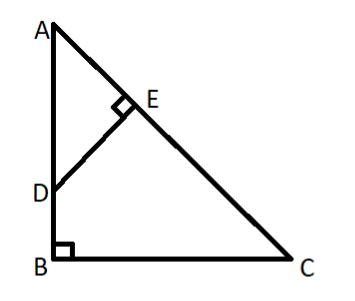
ABC is a right angle triangle with $\angle ABC = {90^\circ }$. D is any point on AB and DE is perpendicular to AC, prove that:
$\left( i \right)\Delta ADE \sim \Delta ACB$
$\left( {ii} \right)$ If AC = 13cm, BC = 5cm and AE = 4cm, find DE and AD.
$\left( {iii} \right)$ Find, area of $\Delta ADE$ : area of quadrilateral BCED.
Answer
 Verified
595.8k+ views
Hint: In this particular question use the concept that if all the angles in a triangle are equal to the corresponding angles of the other triangle then the triangle is similar, and use that in a similar triangle the ratio of the respective sides are equal so use these concepts to reach the solution of the question.
Complete step-by-step answer:
Given data:
ABC is a right angle triangle with $\angle ABC = {90^\circ }$
D is any point on AB and DE is perpendicular to AC,
$ \Rightarrow \angle DEA = {90^\circ }$
Let, $\angle DAE = \angle BAC = \theta $ (common angle for both the triangle)
$\left( i \right)\Delta ADE \sim \Delta ACB$
Proof –
Now in triangle ADE and in triangle ABC we have,
$\angle DEA = \angle ABC = {90^\circ }$
$\angle DAE = \angle BAC$ (Common angle)
$\angle EDA = \angle BCA = 90 - \theta $
So by AAA congruence both the triangles are similar to each other.
Therefore, $\Delta ADE \sim \Delta ACB$
Hence Proved.
$\left( {ii} \right)$ If AC = 13cm, BC = 5cm and AE = 4cm, find DE and AD.
Now according to properties of similar triangles the ratio of the respective sides are equal.
$ \Rightarrow \dfrac{{AE}}{{AB}} = \dfrac{{DE}}{{BC}} = \dfrac{{AD}}{{AC}}$
Now substitute the values we have,
$ \Rightarrow \dfrac{4}{{AB}} = \dfrac{{DE}}{5} = \dfrac{{AD}}{{13}}$.................... (1)
Now in triangle ABC apply Pythagoras theorem we have,
$ \Rightarrow {\left( {{\text{Hypotenuse}}} \right)^2} = {\left( {{\text{perpendicular}}} \right)^2} + {\left( {{\text{base}}} \right)^2}$
$ \Rightarrow {\left( {{\text{AC}}} \right)^2} = {\left( {{\text{AB}}} \right)^2} + {\left( {{\text{BC}}} \right)^2}$
Now substitute the values we have,
$ \Rightarrow {\left( {{\text{13}}} \right)^2} = {\left( {AB} \right)^2} + {\left( {\text{5}} \right)^2}$
$ \Rightarrow {\left( {AB} \right)^2} = {\left( {{\text{13}}} \right)^2} - {\left( {\text{5}} \right)^2} = 169 - 25 = 144 = {\left( {12} \right)^2}$
$ \Rightarrow AB = 12$
From equation (1) we have,
$ \Rightarrow \dfrac{4}{{AB}} = \dfrac{{DE}}{5}$
$ \Rightarrow \dfrac{4}{{12}} = \dfrac{{DE}}{5}$
$ \Rightarrow DE = \dfrac{5}{3} = 1.67$
From equation (1) we have,
$ \Rightarrow \dfrac{4}{{AB}} = \dfrac{{AD}}{{13}}$
$ \Rightarrow \dfrac{4}{{12}} = \dfrac{{AD}}{{13}}$
$ \Rightarrow AD = \dfrac{{13}}{3} = 4.33$
$\left( {iii} \right)$ Find, area of $\Delta ADE$: area of quadrilateral BCED.
Now as we know that the area of the right angle triangle is half times the perpendicular multiplied by base.
So area (${A_1}$) of triangle ABC = $\dfrac{1}{2}\left( {AB} \right)\left( {BC} \right)$
Now substitute the values we have,
$ \Rightarrow {A_1} = \dfrac{1}{2}\left( {12} \right)\left( 5 \right) = 30$ Sq. units.
So area (${A_2}$) of triangle ADE = $\dfrac{1}{2}\left( {DE} \right)\left( {AE} \right)$
Now substitute the values we have,
$ \Rightarrow {A_2} = \dfrac{1}{2}\left( {\dfrac{5}{3}} \right)\left( 4 \right) = \dfrac{{10}}{3}$ Sq. units.
Now the area $\left( {{A_3}} \right)$ of the quadrilateral is the difference of the area of triangle ABC and area of triangle ADE.
$ \Rightarrow {A_3} = {A_1} - {A_2}$
$ \Rightarrow {A_3} = 30 - \dfrac{{10}}{3} = \dfrac{{30\left( 3 \right) - 10}}{5} = \dfrac{{80}}{3}$ Sq. units.
$ \Rightarrow {A_2}:{A_3} = \dfrac{{\dfrac{{10}}{3}}}{{\dfrac{{80}}{3}}} = \dfrac{1}{8}$
So this is the required answer.
Note: Whenever we face such types of questions the key concept we have to remember is that always recall that in a right triangle according to Pythagoras theorem the square of the hypotenuse is equal to the sum of squares of the two legs of the right triangle, and also recall the area of the right triangle which is stated above.
Complete step-by-step answer:
Given data:
ABC is a right angle triangle with $\angle ABC = {90^\circ }$
D is any point on AB and DE is perpendicular to AC,
$ \Rightarrow \angle DEA = {90^\circ }$
Let, $\angle DAE = \angle BAC = \theta $ (common angle for both the triangle)
$\left( i \right)\Delta ADE \sim \Delta ACB$
Proof –
Now in triangle ADE and in triangle ABC we have,
$\angle DEA = \angle ABC = {90^\circ }$
$\angle DAE = \angle BAC$ (Common angle)
$\angle EDA = \angle BCA = 90 - \theta $
So by AAA congruence both the triangles are similar to each other.
Therefore, $\Delta ADE \sim \Delta ACB$
Hence Proved.
$\left( {ii} \right)$ If AC = 13cm, BC = 5cm and AE = 4cm, find DE and AD.
Now according to properties of similar triangles the ratio of the respective sides are equal.
$ \Rightarrow \dfrac{{AE}}{{AB}} = \dfrac{{DE}}{{BC}} = \dfrac{{AD}}{{AC}}$
Now substitute the values we have,
$ \Rightarrow \dfrac{4}{{AB}} = \dfrac{{DE}}{5} = \dfrac{{AD}}{{13}}$.................... (1)
Now in triangle ABC apply Pythagoras theorem we have,
$ \Rightarrow {\left( {{\text{Hypotenuse}}} \right)^2} = {\left( {{\text{perpendicular}}} \right)^2} + {\left( {{\text{base}}} \right)^2}$
$ \Rightarrow {\left( {{\text{AC}}} \right)^2} = {\left( {{\text{AB}}} \right)^2} + {\left( {{\text{BC}}} \right)^2}$
Now substitute the values we have,
$ \Rightarrow {\left( {{\text{13}}} \right)^2} = {\left( {AB} \right)^2} + {\left( {\text{5}} \right)^2}$
$ \Rightarrow {\left( {AB} \right)^2} = {\left( {{\text{13}}} \right)^2} - {\left( {\text{5}} \right)^2} = 169 - 25 = 144 = {\left( {12} \right)^2}$
$ \Rightarrow AB = 12$
From equation (1) we have,
$ \Rightarrow \dfrac{4}{{AB}} = \dfrac{{DE}}{5}$
$ \Rightarrow \dfrac{4}{{12}} = \dfrac{{DE}}{5}$
$ \Rightarrow DE = \dfrac{5}{3} = 1.67$
From equation (1) we have,
$ \Rightarrow \dfrac{4}{{AB}} = \dfrac{{AD}}{{13}}$
$ \Rightarrow \dfrac{4}{{12}} = \dfrac{{AD}}{{13}}$
$ \Rightarrow AD = \dfrac{{13}}{3} = 4.33$
$\left( {iii} \right)$ Find, area of $\Delta ADE$: area of quadrilateral BCED.
Now as we know that the area of the right angle triangle is half times the perpendicular multiplied by base.
So area (${A_1}$) of triangle ABC = $\dfrac{1}{2}\left( {AB} \right)\left( {BC} \right)$
Now substitute the values we have,
$ \Rightarrow {A_1} = \dfrac{1}{2}\left( {12} \right)\left( 5 \right) = 30$ Sq. units.
So area (${A_2}$) of triangle ADE = $\dfrac{1}{2}\left( {DE} \right)\left( {AE} \right)$
Now substitute the values we have,
$ \Rightarrow {A_2} = \dfrac{1}{2}\left( {\dfrac{5}{3}} \right)\left( 4 \right) = \dfrac{{10}}{3}$ Sq. units.
Now the area $\left( {{A_3}} \right)$ of the quadrilateral is the difference of the area of triangle ABC and area of triangle ADE.
$ \Rightarrow {A_3} = {A_1} - {A_2}$
$ \Rightarrow {A_3} = 30 - \dfrac{{10}}{3} = \dfrac{{30\left( 3 \right) - 10}}{5} = \dfrac{{80}}{3}$ Sq. units.
$ \Rightarrow {A_2}:{A_3} = \dfrac{{\dfrac{{10}}{3}}}{{\dfrac{{80}}{3}}} = \dfrac{1}{8}$
So this is the required answer.
Note: Whenever we face such types of questions the key concept we have to remember is that always recall that in a right triangle according to Pythagoras theorem the square of the hypotenuse is equal to the sum of squares of the two legs of the right triangle, and also recall the area of the right triangle which is stated above.
Recently Updated Pages
Master Class 10 Computer Science: Engaging Questions & Answers for Success

Master Class 10 General Knowledge: Engaging Questions & Answers for Success
Master Class 10 English: Engaging Questions & Answers for Success
Master Class 10 Social Science: Engaging Questions & Answers for Success
Master Class 10 Maths: Engaging Questions & Answers for Success
Master Class 10 Science: Engaging Questions & Answers for Success
Trending doubts
What is the median of the first 10 natural numbers class 10 maths CBSE
Which women's tennis player has 24 Grand Slam singles titles?
Who is the Brand Ambassador of Incredible India?
Why is there a time difference of about 5 hours between class 10 social science CBSE
Write a letter to the principal requesting him to grant class 10 english CBSE
A moving boat is observed from the top of a 150 m high class 10 maths CBSE