




AB and CD are two parallel chords of a circle such that AB = 10 cm and CD = 24 cm. If the chords are on the opposite sides of the centre and the distance between them is 17 cm, the radius of the circle is:
$
{\text{A}}{\text{. 14cm}} \\
{\text{B}}{\text{. 10cm}} \\
{\text{C}}{\text{. 13cm}} \\
{\text{D}}{\text{. 15cm}} \\
$
Answer
 Verified
629.4k+ views
Hint: Consider the distance of chord AB from the centre of the circle to be x. The line joining the centre with the midpoint of the chord, the radius of the circle along with the half length segment of the chord will form a right angled triangle. Apply basic trigonometry to obtain the radius of the circle.
Complete step by step answer:
Consider the distance between the centre O and the chord AB as x. Therefore, the distance between centre O and chord CD becomes (17 – x).
The following diagram should be drawn first, as per the information given.
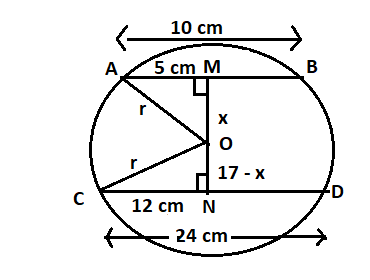
From triangle AMO, using Pythagoras theorem-
$
A{M^2} + O{M^2} = O{A^2} \\
{5^2} + {x^2} = {r^2}.....\left( i \right) \\
$
Similarly from triangle OCN
$
O{N^2} + C{N^2} = O{N^2} \\
{(17 - x)^2} + {12^2} = {r^2}.....\left( {ii} \right) \\
$
From (i) and (ii)
$
{5^2} + {x^2} = {(17 - x)^2} + {12^2} \\
25 + {x^2} = 289 + {x^2} - 34x + 144 \\
34x = 264 + 144 \\
34x = 408 \\
x = 12 \\
$
AS, now we know the value of x, we can use its value in triangle AMO, to obtain r,
$
{5^2} + {12^2} = {r^2} \\
25 + 144 = {r^2} \\
169 = {r^2} \\
\sqrt {169} = r \\
13 = r \\
$
The value of r = 13 cm.
So, the correct answer is “Option C”.
Note: The perpendicular line from the centre which meets the chord always intersects the chord at its mid point. This is why we get a right angled triangle. This property of the circle has been used to solve the question.
Complete step by step answer:
Consider the distance between the centre O and the chord AB as x. Therefore, the distance between centre O and chord CD becomes (17 – x).
The following diagram should be drawn first, as per the information given.
From triangle AMO, using Pythagoras theorem-
$
A{M^2} + O{M^2} = O{A^2} \\
{5^2} + {x^2} = {r^2}.....\left( i \right) \\
$
Similarly from triangle OCN
$
O{N^2} + C{N^2} = O{N^2} \\
{(17 - x)^2} + {12^2} = {r^2}.....\left( {ii} \right) \\
$
From (i) and (ii)
$
{5^2} + {x^2} = {(17 - x)^2} + {12^2} \\
25 + {x^2} = 289 + {x^2} - 34x + 144 \\
34x = 264 + 144 \\
34x = 408 \\
x = 12 \\
$
AS, now we know the value of x, we can use its value in triangle AMO, to obtain r,
$
{5^2} + {12^2} = {r^2} \\
25 + 144 = {r^2} \\
169 = {r^2} \\
\sqrt {169} = r \\
13 = r \\
$
The value of r = 13 cm.
So, the correct answer is “Option C”.
Note: The perpendicular line from the centre which meets the chord always intersects the chord at its mid point. This is why we get a right angled triangle. This property of the circle has been used to solve the question.
Recently Updated Pages
Master Class 12 Economics: Engaging Questions & Answers for Success

Master Class 12 English: Engaging Questions & Answers for Success
Master Class 12 Social Science: Engaging Questions & Answers for Success
Master Class 12 Maths: Engaging Questions & Answers for Success
Master Class 12 Physics: Engaging Questions & Answers for Success
Master Class 11 Social Science: Engaging Questions & Answers for Success
Trending doubts
One Metric ton is equal to kg A 10000 B 1000 C 100 class 11 physics CBSE
Difference Between Prokaryotic Cells and Eukaryotic Cells
Find the value of the expression given below sin 30circ class 11 maths CBSE
1 ton equals to A 100 kg B 1000 kg C 10 kg D 10000 class 11 physics CBSE
Two of the body parts which do not appear in MRI are class 11 biology CBSE
Draw a diagram of nephron and explain its structur class 11 biology CBSE