




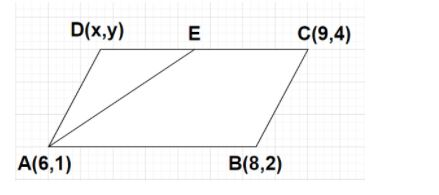
A(6,1), B(8,2) and C(9,4) are three vertices of a parallelogram ABCD. If E is the midpoint of DC, find the area of $\vartriangle $ADE.
${\text{A}}{\text{. 6}}$ sq. units
${\text{B}}{\text{. }}\dfrac{3}{2}$ sq. units
${\text{C}}{\text{. }}\dfrac{3}{4}$ sq. units
${\text{D}}{\text{. 12}}$ sq. units
Answer
 Verified
662.1k+ views
Hint: Here, we will proceed by finding out the coordinates of the vertex D of the parallelogram ABCD using distance formula i.e., $D = \sqrt {{{\left( {d - b} \right)}^2} + {{\left( {c - a} \right)}^2}} $ and property of the parallelogram i.e., the pair of any two opposite sides are always equal in length.
Complete step-by-step answer:
Let us consider a parallelogram ABCD having vertices as A(6,1), B(8,2), C(9,4) and D(x,y). Point E is the midpoint of side DC as shown in the figure.
As we know that according to distance formula, the distance between any two points (a,b) and (c,d) is given by
$D = \sqrt {{{\left( {d - b} \right)}^2} + {{\left( {c - a} \right)}^2}} {\text{ }} \to {\text{(1)}}$
Using equation (1), the distance between the points A(6,1) and B(8,2) is given by
AB = $\sqrt {{{\left( {2 - 1} \right)}^2} + {{\left( {8 - 6} \right)}^2}} = \sqrt {{1^2} + {2^2}} = \sqrt {1 + 4} = \sqrt 5 $ units
Using equation (1), the distance between the points B(8,2) and C(9,4) is given by
BC = $\sqrt {{{\left( {4 - 2} \right)}^2} + {{\left( {9 - 8} \right)}^2}} = \sqrt {{2^2} + {1^2}} = \sqrt {4 + 1} = \sqrt 5 $ units
Using equation (1), the distance between the points C(9,4) and D(x,y) is given by
CD = $\sqrt {{{\left( {y - 4} \right)}^2} + {{\left( {x - 9} \right)}^2}} = \sqrt {\left( {{y^2} + {4^2} - 8y} \right) + \left( {{x^2} + {9^2} - 18x} \right)} $
$ \Rightarrow $CD$ = \sqrt {{y^2} + 16 - 8y + {x^2} + 81 - 18x} = \sqrt {{y^2} - 8y + {x^2} - 18x + 97} $units
Using equation (1), the distance between the points D(x,y) and A(6,1) is given by
$ \Rightarrow $DA = $\sqrt {{{\left( {1 - y} \right)}^2} + {{\left( {6 - x} \right)}^2}} = \sqrt {\left( {{1^2} + {y^2} - 2y} \right) + \left( {{6^2} + {x^2} - 12x} \right)} $
$ \Rightarrow $DA = $\sqrt {1 + {y^2} - 2y + 36 + {x^2} - 12x} = \sqrt {{y^2} - 2y + {x^2} - 12x + 37} $ units
According to the property of parallelogram, the pair of any two opposite sides are always equal in length
i.e., For any parallelogram ABCD, AB = CD and BC = DA
By substituting the values of AB, BC, CD and DA obtained in the above two equations, we get
$ \Rightarrow \sqrt 5 = \sqrt {{y^2} - 8y + {x^2} - 18x + 97} $ and $ \Rightarrow \sqrt 5 = \sqrt {{y^2} - 2y + {x^2} - 12x + 37} $
Squaring on both sides of the above two equations, we get
$\begin{gathered}
\Rightarrow 5 = {y^2} - 8y + {x^2} - 18x + 97 \\
\Rightarrow {y^2} - 8y + {x^2} - 18x + 92 = 0{\text{ }} \to {\text{(2)}} \\
\end{gathered} $ and
$\begin{gathered}
\Rightarrow 5 = {y^2} - 2y + {x^2} - 12x + 37 \\
\Rightarrow {y^2} - 2y + {x^2} - 12x + 32 = 0{\text{ }} \to {\text{(3)}} \\
\end{gathered}$
By subtracting equation (2) from equation (3), we get
\[
\Rightarrow {y^2} - 2y + {x^2} - 12x + 32 - \left( {{y^2} - 8y + {x^2} - 18x + 92} \right) = 0 - 0 \\
\Rightarrow {y^2} - 2y + {x^2} - 12x + 32 - {y^2} + 8y - {x^2} + 18x - 92 = 0 \\
\Rightarrow 6x + 6y - 60 = 0 \\
\Rightarrow 6\left( {x + y} \right) = 60 \\
\Rightarrow x + y = \dfrac{{60}}{6} \\
\Rightarrow x + y = 10 \\
\Rightarrow x = 10 - y{\text{ }} \to {\text{(4)}} \\
\]
By substituting the value of x from equation (4) in equation (2), we get
\[
\Rightarrow {y^2} - 8y + {\left( {10 - y{\text{ }}} \right)^2} - 18\left( {10 - y{\text{ }}} \right) + 92 = 0 \\
\Rightarrow {y^2} - 8y + \left( {100 + {y^2} - 20y} \right) - \left( {180 - 18y{\text{ }}} \right) + 92 = 0 \\
\Rightarrow {y^2} - 8y + 100 + {y^2} - 20y - 180 + 18y + 92 = 0 \\
\Rightarrow 2{y^2} - 10y + 12 = 0 \\
\Rightarrow 2\left( {{y^2} - 5y + 6} \right) = 0 \\
\Rightarrow {y^2} - 5y + 6 = 0 \\
\]
The above quadratic equation in y can be solved by splitting the middle term method.
\[
\Rightarrow {y^2} - 2y - 3y + 6 = 0 \\
\Rightarrow y\left( {y - 2} \right) - 3\left( {y - 2} \right) = 0 \\
\Rightarrow \left( {y - 3} \right)\left( {y - 2} \right) = 0 \\
\]
Either \[
y - 3 = 0 \\
\Rightarrow y = 3 \\
\] or \[
y - 2 = 0 \\
\Rightarrow y = 2 \\
\]
By putting y = 3 in equation (4), we have
\[ \Rightarrow x = 10 - 3 = 7\]
By putting y = 2 in equation (4), we have
\[ \Rightarrow x = 10 - 2 = 8\]
So, the coordinates of point D can be (7,3) or (8,2) but coordinates of vertex B are also (8,2). For parallelogram ABCD, any two vertices can never coincide. So, (8,2) is rejected.
The coordinates of point D is (7,3).
According to midpoint theorem, the coordinates of the midpoint of any line joining points (a,b) and (c,d) is given by $\left( {\dfrac{{a + c}}{2},\dfrac{{b + d}}{2}} \right)$
Using the above theorem, the coordinates of the midpoint E of the line joining points D(7,3) and C(9,4) is given by $\left( {\dfrac{{7 + 9}}{2},\dfrac{{3 + 4}}{2}} \right) = \left( {\dfrac{{16}}{2},\dfrac{7}{2}} \right) = \left( {8,\dfrac{7}{2}} \right)$
Also, area of any triangle ADE having vertices A$\left( {{x_1},{y_1}} \right)$, D$\left( {{x_2},{y_2}} \right)$ and E$\left( {{x_3},{y_3}} \right)$ is given by
ar(ADE) = \[\dfrac{1}{2}\left| {\begin{array}{*{20}{c}}
{{x_1}}&{{x_2}}&{{x_3}} \\
{{y_1}}&{{y_2}}&{{y_3}} \\
1&1&1
\end{array}} \right| = \dfrac{1}{2}\left| {{x_1}\left( {{y_2} \times 1 - {y_3} \times 1} \right) - {x_2}\left( {{y_1} \times 1 - {y_3} \times 1} \right) + {x_3}\left( {{y_1} \times 1 - {y_2} \times 1} \right)} \right|\]
$ \Rightarrow $ar(ADE) \[ = \dfrac{1}{2}\left| {{x_1}\left( {{y_2} - {y_3}} \right) - {x_2}\left( {{y_1} - {y_3}} \right) + {x_3}\left( {{y_1} - {y_2}} \right)} \right|{\text{ }} \to {\text{(5)}}\]
By comparing the coordinates, we get
${x_1} = 6,{y_1} = 1,{x_2} = 7,{y_2} = 3,{x_3} = 8,{y_3} = \dfrac{7}{2}$
By putting these above obtained values in the formula given by equation (5), we get
$ \Rightarrow $ar(ADE) = \[\dfrac{1}{2}\left| {6\left( {3 - \dfrac{7}{2}} \right) - 7\left( {1 - \dfrac{7}{2}} \right) + 8\left( {1 - 3} \right)} \right|\]
$ \Rightarrow $ar(ADE) = \[\dfrac{1}{2}\left| {6\left( {\dfrac{{3 \times 2 - 7}}{2}} \right) - 7\left( {\dfrac{{2 - 7}}{2}} \right) + 8\left( { - 2} \right)} \right| = \dfrac{1}{2}\left| {6\left( {\dfrac{{6 - 7}}{2}} \right) - 7\left( {\dfrac{{ - 5}}{2}} \right) - 16} \right|\]
$ \Rightarrow $ar(ADE) = \[\dfrac{1}{2}\left| {6\left( {\dfrac{{ - 1}}{2}} \right) + \dfrac{{35}}{2} - 16} \right| = \dfrac{1}{2}\left| { - 3 + \dfrac{{35}}{2} - 16} \right| = \dfrac{1}{2}\left| {\dfrac{{35}}{2} - 19} \right| = \dfrac{1}{2}\left| {\dfrac{{35 - 19 \times 2}}{2}} \right| = \dfrac{1}{2}\left| {\dfrac{{ - 3}}{2}} \right| = \dfrac{1}{2}\left( {\dfrac{3}{2}} \right) = \dfrac{3}{4}\] sq. units
So, the correct answer is “Option C”.
Note: In this particular problem, we have substituted the value of x i.e., \[x = 10 - y\] in equation (2). Here, we can also substitute this value of x in equation (3) in order to find the values of y. Also, the important step is neglecting the coordinates (8,2) because these coordinates are the same as that of the vertex B of the parallelogram.
Complete step-by-step answer:
Let us consider a parallelogram ABCD having vertices as A(6,1), B(8,2), C(9,4) and D(x,y). Point E is the midpoint of side DC as shown in the figure.
As we know that according to distance formula, the distance between any two points (a,b) and (c,d) is given by
$D = \sqrt {{{\left( {d - b} \right)}^2} + {{\left( {c - a} \right)}^2}} {\text{ }} \to {\text{(1)}}$
Using equation (1), the distance between the points A(6,1) and B(8,2) is given by
AB = $\sqrt {{{\left( {2 - 1} \right)}^2} + {{\left( {8 - 6} \right)}^2}} = \sqrt {{1^2} + {2^2}} = \sqrt {1 + 4} = \sqrt 5 $ units
Using equation (1), the distance between the points B(8,2) and C(9,4) is given by
BC = $\sqrt {{{\left( {4 - 2} \right)}^2} + {{\left( {9 - 8} \right)}^2}} = \sqrt {{2^2} + {1^2}} = \sqrt {4 + 1} = \sqrt 5 $ units
Using equation (1), the distance between the points C(9,4) and D(x,y) is given by
CD = $\sqrt {{{\left( {y - 4} \right)}^2} + {{\left( {x - 9} \right)}^2}} = \sqrt {\left( {{y^2} + {4^2} - 8y} \right) + \left( {{x^2} + {9^2} - 18x} \right)} $
$ \Rightarrow $CD$ = \sqrt {{y^2} + 16 - 8y + {x^2} + 81 - 18x} = \sqrt {{y^2} - 8y + {x^2} - 18x + 97} $units
Using equation (1), the distance between the points D(x,y) and A(6,1) is given by
$ \Rightarrow $DA = $\sqrt {{{\left( {1 - y} \right)}^2} + {{\left( {6 - x} \right)}^2}} = \sqrt {\left( {{1^2} + {y^2} - 2y} \right) + \left( {{6^2} + {x^2} - 12x} \right)} $
$ \Rightarrow $DA = $\sqrt {1 + {y^2} - 2y + 36 + {x^2} - 12x} = \sqrt {{y^2} - 2y + {x^2} - 12x + 37} $ units
According to the property of parallelogram, the pair of any two opposite sides are always equal in length
i.e., For any parallelogram ABCD, AB = CD and BC = DA
By substituting the values of AB, BC, CD and DA obtained in the above two equations, we get
$ \Rightarrow \sqrt 5 = \sqrt {{y^2} - 8y + {x^2} - 18x + 97} $ and $ \Rightarrow \sqrt 5 = \sqrt {{y^2} - 2y + {x^2} - 12x + 37} $
Squaring on both sides of the above two equations, we get
$\begin{gathered}
\Rightarrow 5 = {y^2} - 8y + {x^2} - 18x + 97 \\
\Rightarrow {y^2} - 8y + {x^2} - 18x + 92 = 0{\text{ }} \to {\text{(2)}} \\
\end{gathered} $ and
$\begin{gathered}
\Rightarrow 5 = {y^2} - 2y + {x^2} - 12x + 37 \\
\Rightarrow {y^2} - 2y + {x^2} - 12x + 32 = 0{\text{ }} \to {\text{(3)}} \\
\end{gathered}$
By subtracting equation (2) from equation (3), we get
\[
\Rightarrow {y^2} - 2y + {x^2} - 12x + 32 - \left( {{y^2} - 8y + {x^2} - 18x + 92} \right) = 0 - 0 \\
\Rightarrow {y^2} - 2y + {x^2} - 12x + 32 - {y^2} + 8y - {x^2} + 18x - 92 = 0 \\
\Rightarrow 6x + 6y - 60 = 0 \\
\Rightarrow 6\left( {x + y} \right) = 60 \\
\Rightarrow x + y = \dfrac{{60}}{6} \\
\Rightarrow x + y = 10 \\
\Rightarrow x = 10 - y{\text{ }} \to {\text{(4)}} \\
\]
By substituting the value of x from equation (4) in equation (2), we get
\[
\Rightarrow {y^2} - 8y + {\left( {10 - y{\text{ }}} \right)^2} - 18\left( {10 - y{\text{ }}} \right) + 92 = 0 \\
\Rightarrow {y^2} - 8y + \left( {100 + {y^2} - 20y} \right) - \left( {180 - 18y{\text{ }}} \right) + 92 = 0 \\
\Rightarrow {y^2} - 8y + 100 + {y^2} - 20y - 180 + 18y + 92 = 0 \\
\Rightarrow 2{y^2} - 10y + 12 = 0 \\
\Rightarrow 2\left( {{y^2} - 5y + 6} \right) = 0 \\
\Rightarrow {y^2} - 5y + 6 = 0 \\
\]
The above quadratic equation in y can be solved by splitting the middle term method.
\[
\Rightarrow {y^2} - 2y - 3y + 6 = 0 \\
\Rightarrow y\left( {y - 2} \right) - 3\left( {y - 2} \right) = 0 \\
\Rightarrow \left( {y - 3} \right)\left( {y - 2} \right) = 0 \\
\]
Either \[
y - 3 = 0 \\
\Rightarrow y = 3 \\
\] or \[
y - 2 = 0 \\
\Rightarrow y = 2 \\
\]
By putting y = 3 in equation (4), we have
\[ \Rightarrow x = 10 - 3 = 7\]
By putting y = 2 in equation (4), we have
\[ \Rightarrow x = 10 - 2 = 8\]
So, the coordinates of point D can be (7,3) or (8,2) but coordinates of vertex B are also (8,2). For parallelogram ABCD, any two vertices can never coincide. So, (8,2) is rejected.
The coordinates of point D is (7,3).
According to midpoint theorem, the coordinates of the midpoint of any line joining points (a,b) and (c,d) is given by $\left( {\dfrac{{a + c}}{2},\dfrac{{b + d}}{2}} \right)$
Using the above theorem, the coordinates of the midpoint E of the line joining points D(7,3) and C(9,4) is given by $\left( {\dfrac{{7 + 9}}{2},\dfrac{{3 + 4}}{2}} \right) = \left( {\dfrac{{16}}{2},\dfrac{7}{2}} \right) = \left( {8,\dfrac{7}{2}} \right)$
Also, area of any triangle ADE having vertices A$\left( {{x_1},{y_1}} \right)$, D$\left( {{x_2},{y_2}} \right)$ and E$\left( {{x_3},{y_3}} \right)$ is given by
ar(ADE) = \[\dfrac{1}{2}\left| {\begin{array}{*{20}{c}}
{{x_1}}&{{x_2}}&{{x_3}} \\
{{y_1}}&{{y_2}}&{{y_3}} \\
1&1&1
\end{array}} \right| = \dfrac{1}{2}\left| {{x_1}\left( {{y_2} \times 1 - {y_3} \times 1} \right) - {x_2}\left( {{y_1} \times 1 - {y_3} \times 1} \right) + {x_3}\left( {{y_1} \times 1 - {y_2} \times 1} \right)} \right|\]
$ \Rightarrow $ar(ADE) \[ = \dfrac{1}{2}\left| {{x_1}\left( {{y_2} - {y_3}} \right) - {x_2}\left( {{y_1} - {y_3}} \right) + {x_3}\left( {{y_1} - {y_2}} \right)} \right|{\text{ }} \to {\text{(5)}}\]
By comparing the coordinates, we get
${x_1} = 6,{y_1} = 1,{x_2} = 7,{y_2} = 3,{x_3} = 8,{y_3} = \dfrac{7}{2}$
By putting these above obtained values in the formula given by equation (5), we get
$ \Rightarrow $ar(ADE) = \[\dfrac{1}{2}\left| {6\left( {3 - \dfrac{7}{2}} \right) - 7\left( {1 - \dfrac{7}{2}} \right) + 8\left( {1 - 3} \right)} \right|\]
$ \Rightarrow $ar(ADE) = \[\dfrac{1}{2}\left| {6\left( {\dfrac{{3 \times 2 - 7}}{2}} \right) - 7\left( {\dfrac{{2 - 7}}{2}} \right) + 8\left( { - 2} \right)} \right| = \dfrac{1}{2}\left| {6\left( {\dfrac{{6 - 7}}{2}} \right) - 7\left( {\dfrac{{ - 5}}{2}} \right) - 16} \right|\]
$ \Rightarrow $ar(ADE) = \[\dfrac{1}{2}\left| {6\left( {\dfrac{{ - 1}}{2}} \right) + \dfrac{{35}}{2} - 16} \right| = \dfrac{1}{2}\left| { - 3 + \dfrac{{35}}{2} - 16} \right| = \dfrac{1}{2}\left| {\dfrac{{35}}{2} - 19} \right| = \dfrac{1}{2}\left| {\dfrac{{35 - 19 \times 2}}{2}} \right| = \dfrac{1}{2}\left| {\dfrac{{ - 3}}{2}} \right| = \dfrac{1}{2}\left( {\dfrac{3}{2}} \right) = \dfrac{3}{4}\] sq. units
So, the correct answer is “Option C”.
Note: In this particular problem, we have substituted the value of x i.e., \[x = 10 - y\] in equation (2). Here, we can also substitute this value of x in equation (3) in order to find the values of y. Also, the important step is neglecting the coordinates (8,2) because these coordinates are the same as that of the vertex B of the parallelogram.
Recently Updated Pages
If x a + bt + ct2 where x is in meters and t is in class 11 physics CBSE

A car covers the first half distance between two places class 11 physics CBSE
The resultant of two vectors overrightarrow P and overrightarrow class 11 physics CBSE
Find the value of cos 135 class 11 maths CBSE
A mass M is held in place by an applied force F and class 11 physics CBSE
A solution of glucose in water is labelled as 10 dfracwv class 11 chemistry CBSE
Trending doubts
One Metric ton is equal to kg A 10000 B 1000 C 100 class 11 physics CBSE
Find the value of the expression given below sin 30circ class 11 maths CBSE
What do you mean by retardation What is its SI uni class 11 physics CBSE
Draw a diagram of nephron and explain its structur class 11 biology CBSE
10 examples of friction in our daily life
Difference between physical and chemical change class 11 chemistry CBSE