




(a) Write the Haworth structure of the sucrose.
(b) Sucrose is a non-reducing sugar. Why?
Answer
 Verified
610.5k+ views
Hint: Carbohydrates are one of the class biomolecules composed of carbon, hydrogen, and oxygen elements. The general formula of the carbohydrates is \[{{\text{C}}_{\text{x}}}{\left( {{{\text{H}}_{\text{2}}}{\text{O}}} \right)_{\text{y}}}\]. Starch, sugars, and fiber are some examples of carbohydrates. Based on the forming units or units present carbohydrates are classified as monosaccharides, disaccharides, oligosaccharides, and polysaccharides.
Complete step-by-step answer:
(a)Here, in the question, sucrose is given which is a disaccharide composed of the two monosaccharides that are glucose and fructose.In the case of sucrose, glucose and fructose are linked by \[{\text{\alpha - 1,\beta - 2 - glycosidic linkage}}\].
The Haworth structure of the sucrose is as follows:
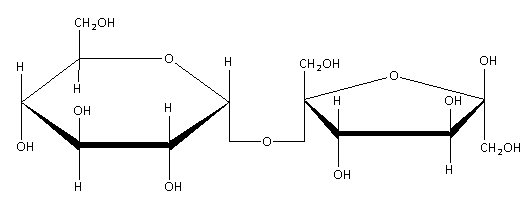
Here, in the structure, a six membered ring compound is glucose and five membered ring compounds is fructose. Glucose and fructose both are the monosaccharides. Here, glucose and fructose are linked together by the glycosidic linkage as shown in the above structure.
(b)In the above structure, we can see that there is no free aldehyde or ketone group adjacent to \[{\text{ - CHOH}}\] group. Sucrose is the non-reducing sugar because the reducing groups of glucose and fructose are involved in the formation of the \[{\text{\alpha - 1,\beta - 2 - glycosidic linkage}}\] formation. Hence, it is not possible to reduce the sucrose molecule, and hence, acts as a non-reducing sugar.
Note: Based on the groups present in the sugars they are classified as reducing sugars and non-reducing sugars.Reducing sugars contain free aldehyde or ketone groups while non-reducing sugars do not contain free aldehyde or ketone groups. Reducing sugars gives Fehling’s test positive. All monosaccharides and some disaccharides are reducing sugars while some disaccharides and all polysaccharides are non-reducing sugars. Non-reducing sugars give negative Fehling’s test
Complete step-by-step answer:
(a)Here, in the question, sucrose is given which is a disaccharide composed of the two monosaccharides that are glucose and fructose.In the case of sucrose, glucose and fructose are linked by \[{\text{\alpha - 1,\beta - 2 - glycosidic linkage}}\].
The Haworth structure of the sucrose is as follows:
Here, in the structure, a six membered ring compound is glucose and five membered ring compounds is fructose. Glucose and fructose both are the monosaccharides. Here, glucose and fructose are linked together by the glycosidic linkage as shown in the above structure.
(b)In the above structure, we can see that there is no free aldehyde or ketone group adjacent to \[{\text{ - CHOH}}\] group. Sucrose is the non-reducing sugar because the reducing groups of glucose and fructose are involved in the formation of the \[{\text{\alpha - 1,\beta - 2 - glycosidic linkage}}\] formation. Hence, it is not possible to reduce the sucrose molecule, and hence, acts as a non-reducing sugar.
Note: Based on the groups present in the sugars they are classified as reducing sugars and non-reducing sugars.Reducing sugars contain free aldehyde or ketone groups while non-reducing sugars do not contain free aldehyde or ketone groups. Reducing sugars gives Fehling’s test positive. All monosaccharides and some disaccharides are reducing sugars while some disaccharides and all polysaccharides are non-reducing sugars. Non-reducing sugars give negative Fehling’s test
Recently Updated Pages
Basicity of sulphurous acid and sulphuric acid are

Master Class 11 English: Engaging Questions & Answers for Success
Master Class 11 Physics: Engaging Questions & Answers for Success
Master Class 11 Computer Science: Engaging Questions & Answers for Success
Master Class 11 Chemistry: Engaging Questions & Answers for Success
Master Class 11 Social Science: Engaging Questions & Answers for Success
Trending doubts
Difference Between Prokaryotic Cells and Eukaryotic Cells
Two of the body parts which do not appear in MRI are class 11 biology CBSE
One Metric ton is equal to kg A 10000 B 1000 C 100 class 11 physics CBSE
10 examples of friction in our daily life
Draw a diagram of nephron and explain its structur class 11 biology CBSE
What will happen if the mucus is not secreted by the class 11 biology CBSE