




A wooden block of mass 5 kg slides from rest down an inclined plane of \[30{}^\circ \]and acquires a velocity of \[10{m}/{s}\;\]after sliding through 32 m along the plane. Calculate 1) loss of its PE 2) gain in its KE 3) average resistive force acting on it when sliding down the plane.
Answer
 Verified
531.6k+ views
Hint: We will make use of the potential energy, kinetic energy and the average resistive force formula to compute the values. Even we have to compute the height of the wooden block while sliding down and should be computed using the vertical component of the inclination.
Formulae used:
\[h=d\sin \theta \]
\[\begin{align}
& PE=mgh \\
& KE=\dfrac{1}{2}m{{v}^{2}} \\
& F=\dfrac{E}{ds} \\
\end{align}\]
Complete step by step answer:
From the given information, we have the data as follows.
The mass of the wooden block, \[m=5kg\]
The velocity of the wooden block, \[v=10{m}/{s}\;\]
The inclination angle, \[\theta =30{}^\circ \]
The distance covered, \[d=32\,m\]
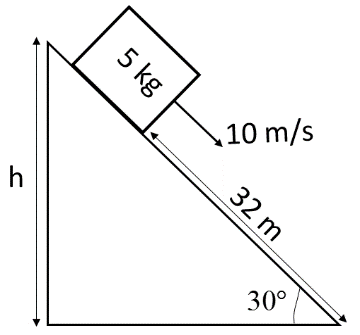
Now, we will compute the height by which the plane is inclined.
The formula for computing the height is given as follows.
\[h=d\sin \theta \]
Where \[d\] is the distance and \[\theta \] is the inclination angle.
Substitute the values in the above formula
\[\begin{align}
& h=32\sin 30{}^\circ \\
& \Rightarrow h=32\times \dfrac{1}{2} \\
& \Rightarrow h=16\,m \\
\end{align}\]
Therefore, the height by which the plane is inclined is 16 m.
1) The loss of its PE
The potential energy of the wooden block sliding down the inclined plane is given by the formula as follows.
\[PE=mgh\]
Where \[m\]is the mass of the block, \[g\]is the acceleration due to gravity and \[h\]is the height.
Substitute the values in the above formula
\[\begin{align}
& PE=5\times 9.8\times 16 \\
& \Rightarrow PE=784\,J \\
\end{align}\]
Therefore, the loss in the potential energy of the wooden block sliding down the inclined plane is 784 J.
2) The gain in its KE
The kinetic energy of the wooden block sliding down the inclined plane is given by the formula as follows.
\[KE=\dfrac{1}{2}m{{v}^{2}}\]
Where \[m\]is the mass of the block and \[v\]is the velocity.
Substitute the values in the above formula
\[\begin{align}
& KE=\dfrac{1}{2}\times 5\times {{10}^{2}} \\
& \Rightarrow KE=250\,J \\
\end{align}\]
Therefore, the gain in the kinetic energy of the wooden block sliding down the inclined plane is 250 J.
3) The average resistive force acting on it when sliding down the plane
The average resistive force acting on the wooden block sliding down the inclined plane is given by the formula as follows.
\[F=\dfrac{E}{ds}\]
Where \[E\] is the energy and \[ds\] is the change in distance.
Substitute the values in the above formula
\[\begin{align}
& F=\dfrac{(784-250)}{(32-0)} \\
& \Rightarrow F=\dfrac{534}{32} \\
& \therefore F=16.68\,N \\
\end{align}\]
Therefore, the average resistive force acting on the wooden block sliding down the inclined plane is 16.68 N.
\[\therefore \]The loss of wooden block’s PE is 784 J, the gain in its KE is 250 J and the average resistive force acting on it when sliding down the plane is 16.68 N.
Note: The formula for computing the value of the height by which the plane is inclined should be known to solve this problem. The relation between the force and energy, that is, force equals energy by the change in distance is the important formal.
Formulae used:
\[h=d\sin \theta \]
\[\begin{align}
& PE=mgh \\
& KE=\dfrac{1}{2}m{{v}^{2}} \\
& F=\dfrac{E}{ds} \\
\end{align}\]
Complete step by step answer:
From the given information, we have the data as follows.
The mass of the wooden block, \[m=5kg\]
The velocity of the wooden block, \[v=10{m}/{s}\;\]
The inclination angle, \[\theta =30{}^\circ \]
The distance covered, \[d=32\,m\]
Now, we will compute the height by which the plane is inclined.
The formula for computing the height is given as follows.
\[h=d\sin \theta \]
Where \[d\] is the distance and \[\theta \] is the inclination angle.
Substitute the values in the above formula
\[\begin{align}
& h=32\sin 30{}^\circ \\
& \Rightarrow h=32\times \dfrac{1}{2} \\
& \Rightarrow h=16\,m \\
\end{align}\]
Therefore, the height by which the plane is inclined is 16 m.
1) The loss of its PE
The potential energy of the wooden block sliding down the inclined plane is given by the formula as follows.
\[PE=mgh\]
Where \[m\]is the mass of the block, \[g\]is the acceleration due to gravity and \[h\]is the height.
Substitute the values in the above formula
\[\begin{align}
& PE=5\times 9.8\times 16 \\
& \Rightarrow PE=784\,J \\
\end{align}\]
Therefore, the loss in the potential energy of the wooden block sliding down the inclined plane is 784 J.
2) The gain in its KE
The kinetic energy of the wooden block sliding down the inclined plane is given by the formula as follows.
\[KE=\dfrac{1}{2}m{{v}^{2}}\]
Where \[m\]is the mass of the block and \[v\]is the velocity.
Substitute the values in the above formula
\[\begin{align}
& KE=\dfrac{1}{2}\times 5\times {{10}^{2}} \\
& \Rightarrow KE=250\,J \\
\end{align}\]
Therefore, the gain in the kinetic energy of the wooden block sliding down the inclined plane is 250 J.
3) The average resistive force acting on it when sliding down the plane
The average resistive force acting on the wooden block sliding down the inclined plane is given by the formula as follows.
\[F=\dfrac{E}{ds}\]
Where \[E\] is the energy and \[ds\] is the change in distance.
Substitute the values in the above formula
\[\begin{align}
& F=\dfrac{(784-250)}{(32-0)} \\
& \Rightarrow F=\dfrac{534}{32} \\
& \therefore F=16.68\,N \\
\end{align}\]
Therefore, the average resistive force acting on the wooden block sliding down the inclined plane is 16.68 N.
\[\therefore \]The loss of wooden block’s PE is 784 J, the gain in its KE is 250 J and the average resistive force acting on it when sliding down the plane is 16.68 N.
Note: The formula for computing the value of the height by which the plane is inclined should be known to solve this problem. The relation between the force and energy, that is, force equals energy by the change in distance is the important formal.
Recently Updated Pages
Master Class 11 Computer Science: Engaging Questions & Answers for Success

Master Class 11 Business Studies: Engaging Questions & Answers for Success
Master Class 11 Economics: Engaging Questions & Answers for Success
Master Class 11 English: Engaging Questions & Answers for Success
Master Class 11 Maths: Engaging Questions & Answers for Success
Master Class 11 Biology: Engaging Questions & Answers for Success
Trending doubts
One Metric ton is equal to kg A 10000 B 1000 C 100 class 11 physics CBSE
There are 720 permutations of the digits 1 2 3 4 5 class 11 maths CBSE
Discuss the various forms of bacteria class 11 biology CBSE
Draw a diagram of a plant cell and label at least eight class 11 biology CBSE
State the laws of reflection of light
Explain zero factorial class 11 maths CBSE