




A wooden block of mass 10 g is dropped from a tower 100m high. Simultaneously, a bullet of mass 10g is fired from the foot of the tower vertically upwards with a velocity of 100m/s. If the bullet is embedded in it, how high will the block rise above the top of the tower before it starts falling? ($g = 10m/{s^2}$)
(a) 75m
(b) 85m
(c) 80m
(d) 10m
Answer
 Verified
666k+ views
Hint: According to the law of conservation of momentum, initial momentum of a system before collision is equal to the final momentum after collision.
Formula Used:
Equations of motion:
$y = ut + \dfrac{1}{2}a{t^2}$ …… (1)
$v = u + at$ …… (2)
${v^2} - {u^2} = 2ay$ …… (3)
where,
y is the distance covered by a particle in vertical direction.
u is initial velocity.
a is constant acceleration
t is time taken to cover y distance.
Conservation of momentum for bodies which stick together after collision:
${m_1}{v_1} + {m_2}{v_2} = ({m_1} + {m_2})V$ …… (4)
where,
${m_1}$is the mass of the 1st body.
${m_2}$is the mass of the 2nd body.
${v_1}$ is the velocity of the 1st body before collision.
${v_2}$is the velocity of the 2nd body before collision.
V is the combined velocity after collision.
Complete step by step answer:
Given:
1. Mass of wooden block (${m_1}$) = 10g
2. Mass of bullet (${m_2}$) = 10g
3. Initial velocity of wooden block (${u_1}$) = 0m/s
4. Initial velocity of bullet (${u_2}$) = 100 m/s.
5.Height of tower = 100m
To find: The height covered by the bullet-block system after collision before it starts to fall again.
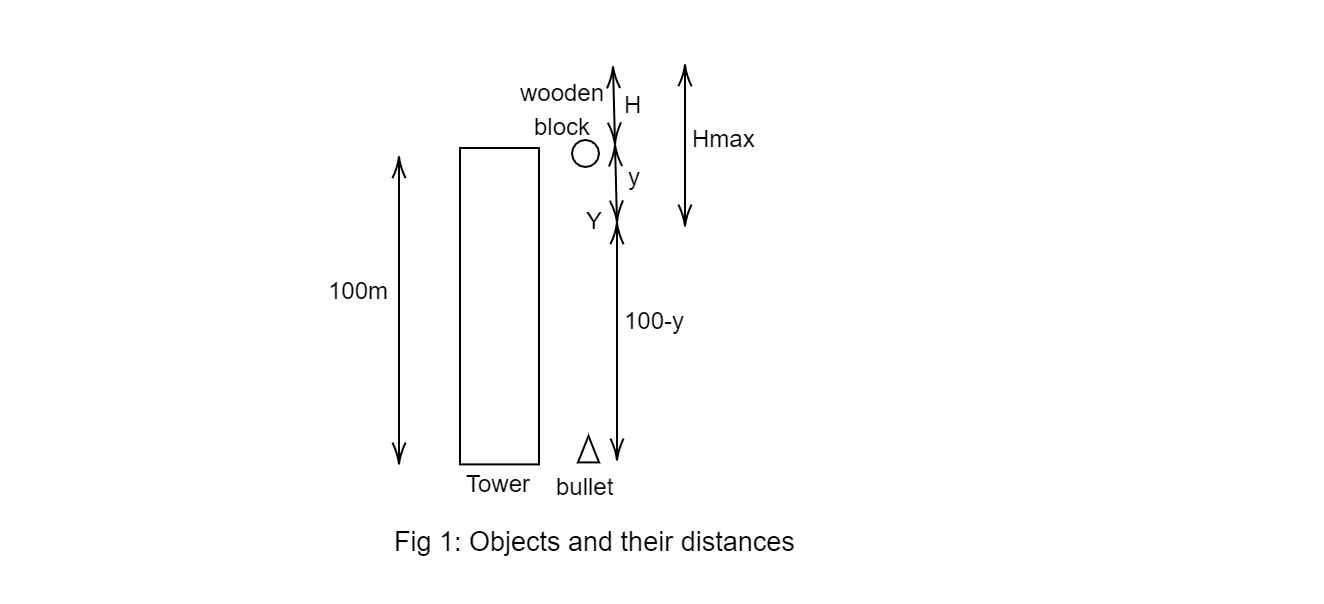
Rough sketch:
Step 1 of 4:
Take the foot of the tower as its origin. Let the bullet and block collide at point Y after time t which is at distance y from the top of the tower.
Find distance y using eq (1) for wooden block:
$y = 0 + \dfrac{1}{2} \times 10 \times {t^2}$
$y = 5{t^2}$ …… (5)
Find distance y using eq (1) for bullet:
$100 - y = 100t - \dfrac{1}{2} \times 10 \times {t^2}$
$y = 5{t^2} - 100t + 100$ …… (6)
Solving eq (5) and (6) gives: $y = 5m$ and $t = 1s$.
Step 2 of 4:
Let the velocities of wooden block and bullet just before collision be ${v_1}$ and ${v_2}$ respectively.
Find ${v_1}$ using eq (2):
${v_1} = 0 + 10 \times 1$
${v_1} = 10m/s$
Find ${v_2}$ using eq (2):
${v_2} = 100 - 10 \times 1$
${v_2} = 90m/s$
Step 3 of 4:
Find the combined velocity after collision using eq (4):
$
- 10 \times 10 + 10 \times 90 = 2 \times 10 \times V \\
V = 40m/s \\
$
Step 4 of 4:
Find the height covered by the bullet-block system using eq (3):
$
0 - {40^2} = 2( - 10){H_{\max }} \\
{H_{\max }} = 80m \\
$
Here, ${H_{\max }}$is the distance covered in vertical direction from the point Y.
Find the distance covered above the tower by subtracting y from ${H_{\max }}$:
$
H = {H_{\max }} - y \\
H = 80 - 5 \\
H = 75m \\
$
Correct Answer: Height by which the block will rise above the tower: (a) 75m.
Note: In questions where we have to find the distance travelled after collision, first find the velocities of bodies before collision. Apply conservation of momentum and then find the distance covered by the combined body using equations of motion.
Formula Used:
Equations of motion:
$y = ut + \dfrac{1}{2}a{t^2}$ …… (1)
$v = u + at$ …… (2)
${v^2} - {u^2} = 2ay$ …… (3)
where,
y is the distance covered by a particle in vertical direction.
u is initial velocity.
a is constant acceleration
t is time taken to cover y distance.
Conservation of momentum for bodies which stick together after collision:
${m_1}{v_1} + {m_2}{v_2} = ({m_1} + {m_2})V$ …… (4)
where,
${m_1}$is the mass of the 1st body.
${m_2}$is the mass of the 2nd body.
${v_1}$ is the velocity of the 1st body before collision.
${v_2}$is the velocity of the 2nd body before collision.
V is the combined velocity after collision.
Complete step by step answer:
Given:
1. Mass of wooden block (${m_1}$) = 10g
2. Mass of bullet (${m_2}$) = 10g
3. Initial velocity of wooden block (${u_1}$) = 0m/s
4. Initial velocity of bullet (${u_2}$) = 100 m/s.
5.Height of tower = 100m
To find: The height covered by the bullet-block system after collision before it starts to fall again.
Rough sketch:
Step 1 of 4:
Take the foot of the tower as its origin. Let the bullet and block collide at point Y after time t which is at distance y from the top of the tower.
Find distance y using eq (1) for wooden block:
$y = 0 + \dfrac{1}{2} \times 10 \times {t^2}$
$y = 5{t^2}$ …… (5)
Find distance y using eq (1) for bullet:
$100 - y = 100t - \dfrac{1}{2} \times 10 \times {t^2}$
$y = 5{t^2} - 100t + 100$ …… (6)
Solving eq (5) and (6) gives: $y = 5m$ and $t = 1s$.
Step 2 of 4:
Let the velocities of wooden block and bullet just before collision be ${v_1}$ and ${v_2}$ respectively.
Find ${v_1}$ using eq (2):
${v_1} = 0 + 10 \times 1$
${v_1} = 10m/s$
Find ${v_2}$ using eq (2):
${v_2} = 100 - 10 \times 1$
${v_2} = 90m/s$
Step 3 of 4:
Find the combined velocity after collision using eq (4):
$
- 10 \times 10 + 10 \times 90 = 2 \times 10 \times V \\
V = 40m/s \\
$
Step 4 of 4:
Find the height covered by the bullet-block system using eq (3):
$
0 - {40^2} = 2( - 10){H_{\max }} \\
{H_{\max }} = 80m \\
$
Here, ${H_{\max }}$is the distance covered in vertical direction from the point Y.
Find the distance covered above the tower by subtracting y from ${H_{\max }}$:
$
H = {H_{\max }} - y \\
H = 80 - 5 \\
H = 75m \\
$
Correct Answer: Height by which the block will rise above the tower: (a) 75m.
Note: In questions where we have to find the distance travelled after collision, first find the velocities of bodies before collision. Apply conservation of momentum and then find the distance covered by the combined body using equations of motion.
Recently Updated Pages
If x a + bt + ct2 where x is in meters and t is in class 11 physics CBSE

A car covers the first half distance between two places class 11 physics CBSE
The resultant of two vectors overrightarrow P and overrightarrow class 11 physics CBSE
Find the value of cos 135 class 11 maths CBSE
A mass M is held in place by an applied force F and class 11 physics CBSE
A solution of glucose in water is labelled as 10 dfracwv class 11 chemistry CBSE
Trending doubts
One Metric ton is equal to kg A 10000 B 1000 C 100 class 11 physics CBSE
Find the value of the expression given below sin 30circ class 11 maths CBSE
What do you mean by retardation What is its SI uni class 11 physics CBSE
Draw a diagram of nephron and explain its structur class 11 biology CBSE
10 examples of friction in our daily life
Difference between physical and chemical change class 11 chemistry CBSE