




A wood ceiling with thermal resistance \[{R_1}\] , is covered with a layer of insulation with resistance \[{R_2}\] . Prove that the effective thermal resistance of the combination is \[R = {R_1} + {R_2}\].
Answer
 Verified
540k+ views
Hint: First let us understand the concept of thermal resistance and heat flux through a plane. So one can say that thermal resistance is a heat property which is a measurement of a temperature difference by which an object resists a heat flow while heat flux, a vector quantity is a flow of energy per unit of area per unit of time. Now use this concept to solve the question.
Complete step by step answer:
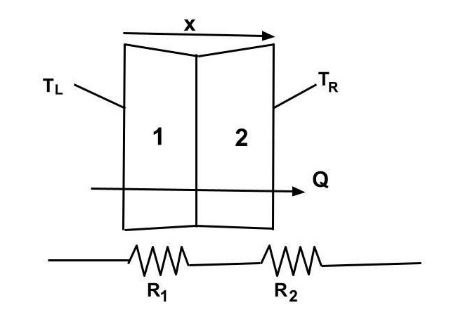
Let rate of flow of heat = $Q$
Then $Q{R_1} = {T_1} - T$............(1)
Where $R_1$ is the thermal resistance of the wooden ceiling and $T$ denotes the temperature of the interface between two layers.
Similarly $Q{R_2} = T - {T_2}$........(2)
Add (1) and (2), we get
$Q({R_1} + {R_2}) = {T_1} - {T_2}$
$\therefore ({R_1} + {R_2}) = \dfrac{{{T_1} - {T_2}}}{Q}$
So the effective thermal resistance of the combination is $R = ({R_1} + {R_2})$.
Note: Thermal resistance is inversely proportional to thermal Conductance. Thermal resistance is a measure of opposition to the flow of heat. More the thermal resistance it becomes difficult for the heat energy to flow from one place to another place. When the rods are connected in series the same rate of flow happens through both. But the temperature difference at the two ending junctions is going to be different because of the receiving of different heat energy. The temperature difference between the first and the last end is equal to the sum of temperature difference between the junctions as shown above.
Complete step by step answer:
Let rate of flow of heat = $Q$
Then $Q{R_1} = {T_1} - T$............(1)
Where $R_1$ is the thermal resistance of the wooden ceiling and $T$ denotes the temperature of the interface between two layers.
Similarly $Q{R_2} = T - {T_2}$........(2)
Add (1) and (2), we get
$Q({R_1} + {R_2}) = {T_1} - {T_2}$
$\therefore ({R_1} + {R_2}) = \dfrac{{{T_1} - {T_2}}}{Q}$
So the effective thermal resistance of the combination is $R = ({R_1} + {R_2})$.
Note: Thermal resistance is inversely proportional to thermal Conductance. Thermal resistance is a measure of opposition to the flow of heat. More the thermal resistance it becomes difficult for the heat energy to flow from one place to another place. When the rods are connected in series the same rate of flow happens through both. But the temperature difference at the two ending junctions is going to be different because of the receiving of different heat energy. The temperature difference between the first and the last end is equal to the sum of temperature difference between the junctions as shown above.
Recently Updated Pages
Which will be the least stable resonating structure class 11 chemistry CBSE

How many 5 digit telephone numbers can be construc-class-11-maths-CBSE
How do you find the angle of the resultant vector class 11 physics CBSE
Draw labelled diagram of the following i Gram seed class 11 biology CBSE
1 Quintal is equal to a 110 kg b 10 kg c 100kg d 1000 class 11 physics CBSE
What is the need and importance of classification class 11 biology CBSE
Trending doubts
One Metric ton is equal to kg A 10000 B 1000 C 100 class 11 physics CBSE
Find the value of the expression given below sin 30circ class 11 maths CBSE
Draw a diagram of nephron and explain its structur class 11 biology CBSE
10 examples of friction in our daily life
Proton was discovered by A Thomson B Rutherford C Chadwick class 11 chemistry CBSE
The teeth used for biting and cutting food are called class 11 biology CBSE