




A wireframe in the shape of an equilateral triangle is hinged at one vertex so that it can swing freely in a vertical plane, with the plane of the triangle always remaining vertical. The side of the frame is \[\dfrac{1}{{\sqrt 3 }}m\]. The time in seconds of small oscillations of the frame will be: $(g=10 m/s^2)$
A) \[\dfrac{\pi }{{\sqrt 2 }}\]
B) \[\dfrac{\pi }{{\sqrt 3 }}\]
C) \[\dfrac{\pi }{{\sqrt 6 }}\]
D) \[\dfrac{\pi }{{\sqrt 5 }}\]
Answer
 Verified
626.4k+ views
Hint: The process of repeating variations of any quantity is called Oscillation. It can also be defined as the periodic variation of the matter between the two values. The time required by the object to complete one full cycle is called the period of motion.
Complete step by step solution:
Given data:
The wireframe is in the shape of an equilateral triangle.
The side of the frame \[ = \dfrac{1}{{\sqrt 3 }}m\]
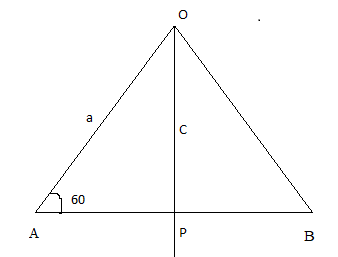
From the figure $OP = a\sin 60^\circ = \dfrac{{\sqrt 3 }}{2}a$
Then $OC = \dfrac{a}{{\sqrt 3 }}$
Inertia, $I = 2\left( {\dfrac{{m{a^2}}}{3}} \right) + m{\left( {OP} \right)^2} + \dfrac{{m{a^2}}}{{12}}$ $I = 2\left( {\dfrac{{ma2}}{{}}} \right)$
$ \Rightarrow I = \dfrac{2}{3}m{a^2} + \dfrac{3}{4}m{a^2} + \dfrac{{m{a^2}}}{{12}}$ $\left( {\because OP = \dfrac{{\sqrt 3 }}{2}a} \right)$
\[ \Rightarrow I = \dfrac{3}{2}m{a^2}\]
The time-period is given by the formula, $T = 2\pi \sqrt {\dfrac{I}{{\left( {3m} \right)gl}}} $
\[ \Rightarrow T = 2\pi \sqrt {\dfrac{{\left( {\dfrac{3}{{2m{a^2}}}} \right)}}{{\left( {3m} \right)g\left( {\dfrac{a}{{\sqrt 3 }}} \right)}}} \]
\[ \Rightarrow T = 2\pi \sqrt {\dfrac{{\sqrt 3 }}{2}} \dfrac{a}{g}\]
Substituting $a = \dfrac{1}{{\sqrt 3 }}andg = 10m/{s^2}$, we get, \[T = \dfrac{\pi }{{\sqrt 5 }}\sec \]
Thus the time-period in a sec, \[T = \dfrac{\pi }{{\sqrt 5 }}\sec \]
Hence the correct option is D.
Note: 1) The movement of any object from one position to another position for the observer is called motion. There are four basic types of motion namely oscillating, rotary, linear, and reciprocating.
2) The periodic motion is a repeated oscillation at regular intervals and the number of oscillations per unit time is the frequency. The period is defined as the time taken to complete one oscillation. The period depends on the mass of the oscillating system.
3) Vertex is a point where two or more lines or curves or edges meet. It can also be defined as a point where the two lines meet to form an angle.
4) The acceleration gained by the object due to the gravitational force is called acceleration due to gravity. It is denoted by g. It will have the magnitude as well as the direction. The acceleration due to gravity is zero at the center of the earth and is maximum at the poles.
Complete step by step solution:
Given data:
The wireframe is in the shape of an equilateral triangle.
The side of the frame \[ = \dfrac{1}{{\sqrt 3 }}m\]
From the figure $OP = a\sin 60^\circ = \dfrac{{\sqrt 3 }}{2}a$
Then $OC = \dfrac{a}{{\sqrt 3 }}$
Inertia, $I = 2\left( {\dfrac{{m{a^2}}}{3}} \right) + m{\left( {OP} \right)^2} + \dfrac{{m{a^2}}}{{12}}$ $I = 2\left( {\dfrac{{ma2}}{{}}} \right)$
$ \Rightarrow I = \dfrac{2}{3}m{a^2} + \dfrac{3}{4}m{a^2} + \dfrac{{m{a^2}}}{{12}}$ $\left( {\because OP = \dfrac{{\sqrt 3 }}{2}a} \right)$
\[ \Rightarrow I = \dfrac{3}{2}m{a^2}\]
The time-period is given by the formula, $T = 2\pi \sqrt {\dfrac{I}{{\left( {3m} \right)gl}}} $
\[ \Rightarrow T = 2\pi \sqrt {\dfrac{{\left( {\dfrac{3}{{2m{a^2}}}} \right)}}{{\left( {3m} \right)g\left( {\dfrac{a}{{\sqrt 3 }}} \right)}}} \]
\[ \Rightarrow T = 2\pi \sqrt {\dfrac{{\sqrt 3 }}{2}} \dfrac{a}{g}\]
Substituting $a = \dfrac{1}{{\sqrt 3 }}andg = 10m/{s^2}$, we get, \[T = \dfrac{\pi }{{\sqrt 5 }}\sec \]
Thus the time-period in a sec, \[T = \dfrac{\pi }{{\sqrt 5 }}\sec \]
Hence the correct option is D.
Note: 1) The movement of any object from one position to another position for the observer is called motion. There are four basic types of motion namely oscillating, rotary, linear, and reciprocating.
2) The periodic motion is a repeated oscillation at regular intervals and the number of oscillations per unit time is the frequency. The period is defined as the time taken to complete one oscillation. The period depends on the mass of the oscillating system.
3) Vertex is a point where two or more lines or curves or edges meet. It can also be defined as a point where the two lines meet to form an angle.
4) The acceleration gained by the object due to the gravitational force is called acceleration due to gravity. It is denoted by g. It will have the magnitude as well as the direction. The acceleration due to gravity is zero at the center of the earth and is maximum at the poles.
Recently Updated Pages
Master Class 11 Social Science: Engaging Questions & Answers for Success

Master Class 11 English: Engaging Questions & Answers for Success
Master Class 11 Accountancy: Engaging Questions & Answers for Success
Master Class 11 Physics: Engaging Questions & Answers for Success
Master Class 11 Computer Science: Engaging Questions & Answers for Success
Master Class 11 Business Studies: Engaging Questions & Answers for Success
Trending doubts
One Metric ton is equal to kg A 10000 B 1000 C 100 class 11 physics CBSE
Find the value of the expression given below sin 30circ class 11 maths CBSE
Draw a diagram of nephron and explain its structur class 11 biology CBSE
10 examples of friction in our daily life
Proton was discovered by A Thomson B Rutherford C Chadwick class 11 chemistry CBSE
The teeth used for biting and cutting food are called class 11 biology CBSE