




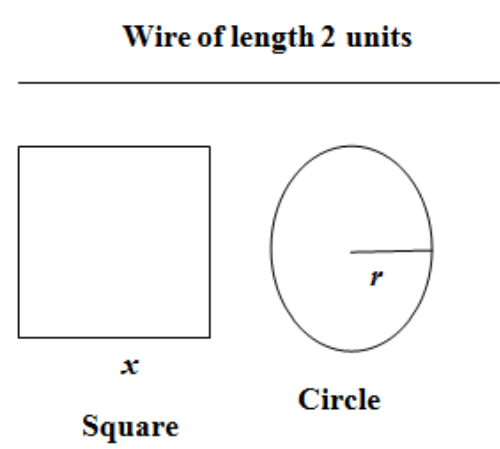
A wire of length 2 units is cut into two parts which are bent respectively to form a square of side $=x$ units and a circle of radius $=r$ units. If the sum of the areas of the square and the circle so formed is minimum, then: \[\]
A. $2c=r$\[\]
B. $2x=\left( \pi +4 \right)r$\[\]
C. $\left( 4-\pi \right)x=\pi r$\[\]
D. $x=2r$\[\]
Answer
 Verified
593.7k+ views
Hint: We see that the sum of perimeter of the square ${{P}_{s}}$ and the perimeter of the circle ${{P}_{c}}$ is the length of the wire of 2 units. We use ${{P}_{s}}+{{P}_{c}}=2$ to get an expression of $r$ in terms of $x$. We put the expression in total area $A\left( x \right)={{A}_{s}}+{{A}_{c}}$ and find the critical point say $x=c$ from the equation ${{A}^{'}}\left( x \right)=0$. We use the first derivative test to prove the area will be minimum at $x=c$ and the find $r$ by putting $x=c$ in the expression of $r$. We compare $x$ and $r$ to choose the correct option.
Complete step-by-step solution:
We know from the first derivative test that the critical points of a function are the points where the first-order derivative of the function is zero or is not defined. Mathematically, $x=c$ is a critical point if $f'(c)=0$ or $f'(c)$ does not exist. The minima or maxima occur only at critical points. The first derivative test tells us that $f\left( x \right)$ has a local minima at $x=c$ when ${{f}^{'}}\left( x \right)$ changes sign from negative to positive as we increase though the point $x=c$.
We are given the question that a wire of length 2 units is cut into two parts which are bent respectively to form a square of side $=x$ units and a circle of radius $=r$ units. So the sum of the perimeter of the square ${{P}_{s}}$ and the perimeter of the circle ${{P}_{c}}$ is the length of the wire. So we have
\[\begin{align}
& {{P}_{s}}+{{P}_{c}}=2 \\
& \Rightarrow 4x+2\pi r=2 \\
& \Rightarrow 2\pi r=2-4x \\
& \Rightarrow r=\dfrac{1-2x}{\pi }....\left( 1 \right) \\
\end{align}\]
So the sum of the area of square and circle in square units is
\[\begin{align}
& A={{A}_{s}}+{{A}_{c}} \\
& \Rightarrow A={{x}^{2}}+\pi {{r}^{2}} \\
& \Rightarrow A={{x}^{2}}+\pi \times {\left( \dfrac{1-2x}{{\pi }} \right)}^{2} \\
& \Rightarrow A\left( x \right)={{x}^{2}}+\dfrac{{{\left( 1-2x \right)}^{2}}}{\pi } \\
\end{align}\]
We are asked to find the relation between $x$ and $r$ when the total area $A\left( x \right)$ is minimum. Let us find the critical points by equating the differentiation of $A\left( x \right)$ that is ${{A}^{'}}\left( x \right)$ to 0. We have,
\[\begin{align}
& \therefore {{A}^{'}}\left( x \right)=\dfrac{d}{dx}A\left( x \right)=0 \\
& \Rightarrow \dfrac{d}{dx}\left[ {{x}^{2}}+\dfrac{{{\left( 1-2x \right)}^{2}}}{\pi } \right]=0 \\
& \Rightarrow 2x+\dfrac{2}{\pi }\left( 1-2x \right)\left( -2 \right)=0 \\
& \Rightarrow x+\dfrac{-2+4x}{\pi }=0 \\
\end{align}\]
We simplify the above step by multiplying $\pi $ in all the terms and proceed to have the critical point as ,
\[\begin{align}
& \Rightarrow x\pi -2+4x=0 \\
& \Rightarrow x\left( \pi +4 \right)=2 \\
& \Rightarrow x=\dfrac{2}{\pi +4}....\left( 2 \right) \\
\end{align}\]
Let us put two points before and after critical point $x=\dfrac{2}{\pi +4}$ as $x=0< \dfrac{2}{\pi +4}$ and $x=1> \dfrac{2}{\pi +4}$ in ${{A}^{'}}\left( x \right)$ to check the first derivative test. We have
\[\begin{align}
& {{\left. {{A}^{'}}\left( x \right) \right|}_{x=0}}=2\times 0+\dfrac{2}{\pi }\left( 1-2\times 0 \right)\left( -2 \right)< 0 \\
& {{\left. {{A}^{'}}\left( x \right) \right|}_{x=1}}=2\times 1+\dfrac{2}{\pi }\left( 1-2\times 1 \right)\left( -2 \right)=2+\dfrac{4}{\pi }> 0 \\
\end{align}\]
So the first derivative ${{A}^{'}}\left( x \right)$ changes sign from negative to positive through $x=\dfrac{2}{\pi +4}$. So there is a local minimum at $x=\dfrac{2}{\pi +4}$. We put $x=\dfrac{2}{\pi +4}$ in equation (1) and have,
\[r=\dfrac{1-2x}{\pi }=\dfrac{1-2\left( \dfrac{2}{\pi +4} \right)}{\pi }=\dfrac{\pi +4-4}{\left( \pi +4 \right)\pi }=\dfrac{1}{\pi +4}....\left( 3 \right)\]
We compare right hand side of equations (2) and (3) and conclude that
\[x=2r\]
So the correct option is D.
Note: We note that while taking two points before and after the critical point $x=c$ we must take them as close as possible because there can be more than one minimum for the function. The area function $A\left( x \right)={{x}^{2}}+\dfrac{{{\left( 1-2x \right)}^{2}}}{\pi }$ here is a upward parabolic function and like all upward parabolic function it has one critical point with local minima. We also note that the question assumes that the thickness of the wire to be approximately zero.
Complete step-by-step solution:
We know from the first derivative test that the critical points of a function are the points where the first-order derivative of the function is zero or is not defined. Mathematically, $x=c$ is a critical point if $f'(c)=0$ or $f'(c)$ does not exist. The minima or maxima occur only at critical points. The first derivative test tells us that $f\left( x \right)$ has a local minima at $x=c$ when ${{f}^{'}}\left( x \right)$ changes sign from negative to positive as we increase though the point $x=c$.
We are given the question that a wire of length 2 units is cut into two parts which are bent respectively to form a square of side $=x$ units and a circle of radius $=r$ units. So the sum of the perimeter of the square ${{P}_{s}}$ and the perimeter of the circle ${{P}_{c}}$ is the length of the wire. So we have
\[\begin{align}
& {{P}_{s}}+{{P}_{c}}=2 \\
& \Rightarrow 4x+2\pi r=2 \\
& \Rightarrow 2\pi r=2-4x \\
& \Rightarrow r=\dfrac{1-2x}{\pi }....\left( 1 \right) \\
\end{align}\]
So the sum of the area of square and circle in square units is
\[\begin{align}
& A={{A}_{s}}+{{A}_{c}} \\
& \Rightarrow A={{x}^{2}}+\pi {{r}^{2}} \\
& \Rightarrow A={{x}^{2}}+\pi \times {\left( \dfrac{1-2x}{{\pi }} \right)}^{2} \\
& \Rightarrow A\left( x \right)={{x}^{2}}+\dfrac{{{\left( 1-2x \right)}^{2}}}{\pi } \\
\end{align}\]
We are asked to find the relation between $x$ and $r$ when the total area $A\left( x \right)$ is minimum. Let us find the critical points by equating the differentiation of $A\left( x \right)$ that is ${{A}^{'}}\left( x \right)$ to 0. We have,
\[\begin{align}
& \therefore {{A}^{'}}\left( x \right)=\dfrac{d}{dx}A\left( x \right)=0 \\
& \Rightarrow \dfrac{d}{dx}\left[ {{x}^{2}}+\dfrac{{{\left( 1-2x \right)}^{2}}}{\pi } \right]=0 \\
& \Rightarrow 2x+\dfrac{2}{\pi }\left( 1-2x \right)\left( -2 \right)=0 \\
& \Rightarrow x+\dfrac{-2+4x}{\pi }=0 \\
\end{align}\]
We simplify the above step by multiplying $\pi $ in all the terms and proceed to have the critical point as ,
\[\begin{align}
& \Rightarrow x\pi -2+4x=0 \\
& \Rightarrow x\left( \pi +4 \right)=2 \\
& \Rightarrow x=\dfrac{2}{\pi +4}....\left( 2 \right) \\
\end{align}\]
Let us put two points before and after critical point $x=\dfrac{2}{\pi +4}$ as $x=0< \dfrac{2}{\pi +4}$ and $x=1> \dfrac{2}{\pi +4}$ in ${{A}^{'}}\left( x \right)$ to check the first derivative test. We have
\[\begin{align}
& {{\left. {{A}^{'}}\left( x \right) \right|}_{x=0}}=2\times 0+\dfrac{2}{\pi }\left( 1-2\times 0 \right)\left( -2 \right)< 0 \\
& {{\left. {{A}^{'}}\left( x \right) \right|}_{x=1}}=2\times 1+\dfrac{2}{\pi }\left( 1-2\times 1 \right)\left( -2 \right)=2+\dfrac{4}{\pi }> 0 \\
\end{align}\]
So the first derivative ${{A}^{'}}\left( x \right)$ changes sign from negative to positive through $x=\dfrac{2}{\pi +4}$. So there is a local minimum at $x=\dfrac{2}{\pi +4}$. We put $x=\dfrac{2}{\pi +4}$ in equation (1) and have,
\[r=\dfrac{1-2x}{\pi }=\dfrac{1-2\left( \dfrac{2}{\pi +4} \right)}{\pi }=\dfrac{\pi +4-4}{\left( \pi +4 \right)\pi }=\dfrac{1}{\pi +4}....\left( 3 \right)\]
We compare right hand side of equations (2) and (3) and conclude that
\[x=2r\]
So the correct option is D.
Note: We note that while taking two points before and after the critical point $x=c$ we must take them as close as possible because there can be more than one minimum for the function. The area function $A\left( x \right)={{x}^{2}}+\dfrac{{{\left( 1-2x \right)}^{2}}}{\pi }$ here is a upward parabolic function and like all upward parabolic function it has one critical point with local minima. We also note that the question assumes that the thickness of the wire to be approximately zero.
Recently Updated Pages
Master Class 12 Social Science: Engaging Questions & Answers for Success

Master Class 12 Physics: Engaging Questions & Answers for Success
Master Class 12 Maths: Engaging Questions & Answers for Success
Master Class 12 Economics: Engaging Questions & Answers for Success
Master Class 12 Chemistry: Engaging Questions & Answers for Success
Master Class 12 Business Studies: Engaging Questions & Answers for Success
Trending doubts
Which are the Top 10 Largest Countries of the World?
Draw a labelled sketch of the human eye class 12 physics CBSE
Explain the structure of megasporangium class 12 biology CBSE
What are the major means of transport Explain each class 12 social science CBSE
How many chromosomes are found in human ovum a 46 b class 12 biology CBSE
The diagram of the section of a maize grain is given class 12 biology CBSE