




A wire of length 1 meters and radius 1mm is subjected to a load. The extension is x. The wire is melted and then drawn into a wire of square cross-section of side 1mm. What is the extension under the same load?
A. ${\pi ^2}x$
B. $\pi {x^2}$
C. $\pi x$
D. $\dfrac{\pi }{x}$
Answer
 Verified
584.1k+ views
Hint: In this question, we need to determine the extension in the wire when a load is subjected to the wire of square cross-section. For this, we will use the concept that the volume of the material will remain constant for both the shapes of the wire and then apply the young modulus formula $y = \dfrac{{F\ell }}{{A\vartriangle \ell }}$.
Complete step by step answer:
For the cyclical wire, the given date is as follows:
The length of the wire is say ${\ell _1} = 1m$
The radius of the wire is say $r = 1mm = 1 \times {10^{ - 3}}m$
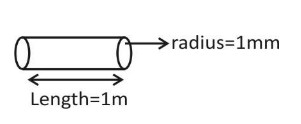
When this cylindrical cross-section area wire is subjected to a load, then the extension in the wire is given ‘x’.Now, this cylindrical cross section wire is melted and then drawn into a wire of square cross-section of side 1mm.
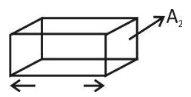
Now the same cylindrical wire is melted and reformed as a wire of square cross-section so the volume will remain unchanged.
$\therefore $The volume of circular cross section $ = $volume of square cross-section
Mathematically, $\pi {r^2}{\ell _1} = \left( {{\ell _2}} \right) \times area{\text{ }}of{\text{ }}cross{\text{ }}section$
Substituting the values of the known values, i.e., ${l_1} = 1m = 1000mm,{\text{ }}r = 1mm{\text{ and A = 1}} \times 1$ in the equation $\pi {r^2}{\ell _1} = \left( {{\ell _2}} \right) \times area{\text{ }}of{\text{ }}cross{\text{ }}section$ to determine the length of the wire with the square cross-section area.
$
\Rightarrow
\pi {r^2}{\ell _1} = \left( {{\ell _2}} \right) \times area{\text{ }}of{\text{ }}cross{\text{ }}section \\
\Rightarrow
\pi {\left( 1 \right)^2} \times 1000 = \left( {{\ell _2}} \right) \times 1 \\
\Rightarrow
\left( {{\ell _2}} \right) = 1000\pi \\
$
Also, the material in initial and final condition (i.e., after melting and forming wire of square cross-section) is the same so,
Initial young modulus $ = $final young modulus
Young modulus of cylindrical wire $ = $young modulus of a cuboidal wire
${y_i} = {y_f}$if the load applied F, then
$\dfrac{{F{\ell _1}}}{{{A_1}x}} = \dfrac{{F{\ell _2}}}{{{A_2} \times \vartriangle {\ell _2}}}$
Where $\vartriangle {\ell _2}$is the extension into a cuboidal wire after applying load F,
So,
$
\Rightarrow
\dfrac{{{\ell _1}}}{{{A_1}x}} = \dfrac{{{\ell _2}}}{{{A_2} \times \vartriangle {\ell _2}}} \\
\Rightarrow
\dfrac{{{\ell _1}}}{{\left( {\pi {r^2} \times x} \right)}} = \dfrac{{1000\pi }}{{{A_2} \\vartriangle {\ell _2}}} \\
\Rightarrow
\dfrac{{1000}}{{\pi {r^2}x}} = \dfrac{{1000\pi }}{{1 \times \vartriangle {\ell _2}}} \\
\Rightarrow
\dfrac{1}{{\pi \times 1 \times x}} = \dfrac{\pi }{{1 \times \vartriangle {\ell _2}}} \\
\Rightarrow
\vartriangle {\ell _2} = {\pi ^2}x \\
$
Hence, the extension in the wire having square cross section is given as ${\pi ^2}x$.
Hence,option A is the correct answer.
Note: When a wire is subjected to an external load, then it elongates. When the wire is melted and formed wire of different cross-sections, then volume remains the same because the density of the wire is the same before and after melting. When the material is the same, then the young modulus remains the same.
Complete step by step answer:
For the cyclical wire, the given date is as follows:
The length of the wire is say ${\ell _1} = 1m$
The radius of the wire is say $r = 1mm = 1 \times {10^{ - 3}}m$
When this cylindrical cross-section area wire is subjected to a load, then the extension in the wire is given ‘x’.Now, this cylindrical cross section wire is melted and then drawn into a wire of square cross-section of side 1mm.
Now the same cylindrical wire is melted and reformed as a wire of square cross-section so the volume will remain unchanged.
$\therefore $The volume of circular cross section $ = $volume of square cross-section
Mathematically, $\pi {r^2}{\ell _1} = \left( {{\ell _2}} \right) \times area{\text{ }}of{\text{ }}cross{\text{ }}section$
Substituting the values of the known values, i.e., ${l_1} = 1m = 1000mm,{\text{ }}r = 1mm{\text{ and A = 1}} \times 1$ in the equation $\pi {r^2}{\ell _1} = \left( {{\ell _2}} \right) \times area{\text{ }}of{\text{ }}cross{\text{ }}section$ to determine the length of the wire with the square cross-section area.
$
\Rightarrow
\pi {r^2}{\ell _1} = \left( {{\ell _2}} \right) \times area{\text{ }}of{\text{ }}cross{\text{ }}section \\
\Rightarrow
\pi {\left( 1 \right)^2} \times 1000 = \left( {{\ell _2}} \right) \times 1 \\
\Rightarrow
\left( {{\ell _2}} \right) = 1000\pi \\
$
Also, the material in initial and final condition (i.e., after melting and forming wire of square cross-section) is the same so,
Initial young modulus $ = $final young modulus
Young modulus of cylindrical wire $ = $young modulus of a cuboidal wire
${y_i} = {y_f}$if the load applied F, then
$\dfrac{{F{\ell _1}}}{{{A_1}x}} = \dfrac{{F{\ell _2}}}{{{A_2} \times \vartriangle {\ell _2}}}$
Where $\vartriangle {\ell _2}$is the extension into a cuboidal wire after applying load F,
So,
$
\Rightarrow
\dfrac{{{\ell _1}}}{{{A_1}x}} = \dfrac{{{\ell _2}}}{{{A_2} \times \vartriangle {\ell _2}}} \\
\Rightarrow
\dfrac{{{\ell _1}}}{{\left( {\pi {r^2} \times x} \right)}} = \dfrac{{1000\pi }}{{{A_2} \\vartriangle {\ell _2}}} \\
\Rightarrow
\dfrac{{1000}}{{\pi {r^2}x}} = \dfrac{{1000\pi }}{{1 \times \vartriangle {\ell _2}}} \\
\Rightarrow
\dfrac{1}{{\pi \times 1 \times x}} = \dfrac{\pi }{{1 \times \vartriangle {\ell _2}}} \\
\Rightarrow
\vartriangle {\ell _2} = {\pi ^2}x \\
$
Hence, the extension in the wire having square cross section is given as ${\pi ^2}x$.
Hence,option A is the correct answer.
Note: When a wire is subjected to an external load, then it elongates. When the wire is melted and formed wire of different cross-sections, then volume remains the same because the density of the wire is the same before and after melting. When the material is the same, then the young modulus remains the same.
Recently Updated Pages
Master Class 11 Computer Science: Engaging Questions & Answers for Success

Master Class 11 Business Studies: Engaging Questions & Answers for Success
Master Class 11 Economics: Engaging Questions & Answers for Success
Master Class 11 English: Engaging Questions & Answers for Success
Master Class 11 Maths: Engaging Questions & Answers for Success
Master Class 11 Biology: Engaging Questions & Answers for Success
Trending doubts
One Metric ton is equal to kg A 10000 B 1000 C 100 class 11 physics CBSE
There are 720 permutations of the digits 1 2 3 4 5 class 11 maths CBSE
Discuss the various forms of bacteria class 11 biology CBSE
Draw a diagram of a plant cell and label at least eight class 11 biology CBSE
State the laws of reflection of light
Explain zero factorial class 11 maths CBSE