




A wire KMN moves along the bisector of the angle \[\theta \]with a constant velocity v in a uniform magnetic field B perpendicular to the plane of the paper and directed inwards. Which of the following is correct?
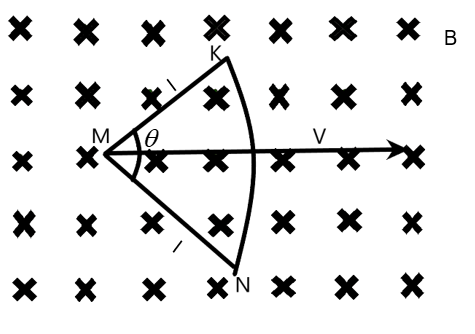
A) Effective length of the wire is \[2l\sin \dfrac{\theta }{2}\]
B) Emf induced between K and N is \[2Blv\sin \dfrac{\theta }{2}\]
C) The shape of KMN is immaterial, only the end points K and N are important.
D) All of the above.
Answer
 Verified
635.7k+ views
Hint: We are given the direction of motion of a conducting wire in a magnetic field with its velocity in the field. We need to find the related changes that occur in this wire due to this motion in the given magnetic field such as the emf and the effective length.
Complete answer:
We know that any conductor moving in a magnetic field which has a perpendicular component of motion to the field can develop a motional emf along its two ends. A conductor moving with a constant velocity and in a constant angle will not produce a change in flux, so there will be no emf produced.
In our case a wire KMN is moving with a constant velocity with an angle, therefore, a motional emf is generated along its motion.
We know that the motional emf of a conductor is given as –
\[\varepsilon =Blv\]
Where, l is the effective length of the wire used.
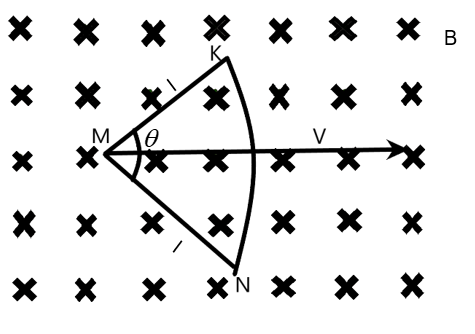
From the below figure, we can understand that the effective length of the wire is along \[\sin \dfrac{\theta }{2}\], so the length will be \[2l\sin \dfrac{\theta }{2}\], given that KM and MN is of length ‘l’.
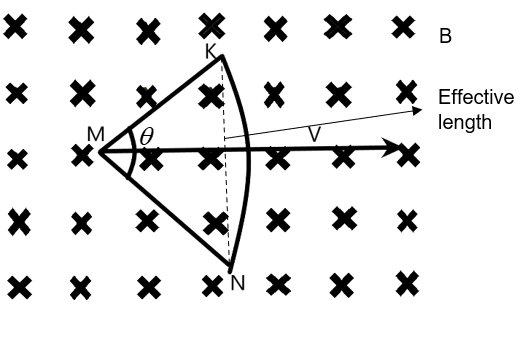
Now, let us calculate the motional emf of the wire KMN as –
\[\begin{align}
& \varepsilon =l(v\times B) \\
& \text{Here,} \\
& l=2l \\
& \Rightarrow \varepsilon =2Blv\sin \dfrac{\theta }{2} \\
\end{align}\]
Also, we find from our observations that the KMN is immaterial, what matters is just the two end endpoints K and N.
So, we have found that all the options in the question are true.
The correct answer is option D.
Note:
We will find from the above exercise that the shape of the wire doesn’t account for the motional emf induced in it. It is the effective length which determines the amount of emf induced due to the movement of the conductor through the magnetic field.
Complete answer:
We know that any conductor moving in a magnetic field which has a perpendicular component of motion to the field can develop a motional emf along its two ends. A conductor moving with a constant velocity and in a constant angle will not produce a change in flux, so there will be no emf produced.
In our case a wire KMN is moving with a constant velocity with an angle, therefore, a motional emf is generated along its motion.
We know that the motional emf of a conductor is given as –
\[\varepsilon =Blv\]
Where, l is the effective length of the wire used.
From the below figure, we can understand that the effective length of the wire is along \[\sin \dfrac{\theta }{2}\], so the length will be \[2l\sin \dfrac{\theta }{2}\], given that KM and MN is of length ‘l’.
Now, let us calculate the motional emf of the wire KMN as –
\[\begin{align}
& \varepsilon =l(v\times B) \\
& \text{Here,} \\
& l=2l \\
& \Rightarrow \varepsilon =2Blv\sin \dfrac{\theta }{2} \\
\end{align}\]
Also, we find from our observations that the KMN is immaterial, what matters is just the two end endpoints K and N.
So, we have found that all the options in the question are true.
The correct answer is option D.
Note:
We will find from the above exercise that the shape of the wire doesn’t account for the motional emf induced in it. It is the effective length which determines the amount of emf induced due to the movement of the conductor through the magnetic field.
Recently Updated Pages
If x a + bt + ct2 where x is in meters and t is in class 11 physics CBSE

A car covers the first half distance between two places class 11 physics CBSE
The resultant of two vectors overrightarrow P and overrightarrow class 11 physics CBSE
Find the value of cos 135 class 11 maths CBSE
A mass M is held in place by an applied force F and class 11 physics CBSE
A solution of glucose in water is labelled as 10 dfracwv class 11 chemistry CBSE
Trending doubts
One Metric ton is equal to kg A 10000 B 1000 C 100 class 11 physics CBSE
Find the value of the expression given below sin 30circ class 11 maths CBSE
What do you mean by retardation What is its SI uni class 11 physics CBSE
Draw a diagram of nephron and explain its structur class 11 biology CBSE
10 examples of friction in our daily life
Difference between physical and chemical change class 11 chemistry CBSE