




A wire is in the form of a circle of radius 35 cm. If it is bent into the shape of a rhombus, what is the side of the rhombus?
A) $32cm$
B) $70cm$
C) $55cm$
D) $17cm$
Answer
 Verified
613.8k+ views
Hint:
We can find the length of the wire by finding the circumference of the circle. As we bend the same wire to a rhombus, the perimeter of the rhombus will be also equal to the circumference of the circle. Then we can find the side of the rhombus by dividing the perimeter with 4 as all the sides of a rhombus are equal.
Complete step by step solution:
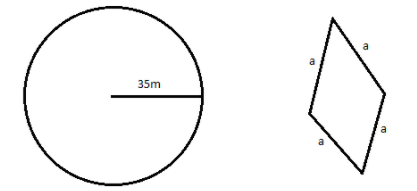
We are given that the radius of the circle is 35cm. Using the radius, we can find the circumference of the circle using the equation,
$C = 2\pi r$
On substituting the values, we get,
$ \Rightarrow C = 2 \times \dfrac{{22}}{7} \times 35$
On simplification we get,
$ \Rightarrow C = 2 \times 22 \times 5$
On multiplication we get,
$ \Rightarrow C = 220cm$
Thus, the circumference of the circle is 220cm.
Now we can consider the rhombus. We know that for a rhombus, all the four sides will be equal.
Let a be the length of the sides of the rhombus.
Then its perimeter is given by the sum of the sides.
\[ \Rightarrow P = a + a + a + a\]
So we have,
\[ \Rightarrow P = 4a\]
It is given that the wire in the form of the circle is bent into the shape of rhombus. So, their perimeter will be equal.
$ \Rightarrow C = P$
$ \Rightarrow 220cm = 4a$
On dividing throughout with 4, we get,
$ \Rightarrow a = \dfrac{{220}}{4}cm$
On simplification we get,
$ \Rightarrow a = 55cm$
Therefore, the length of the side is $55cm$ .
So, the correct answer is option C, $55cm$.
Note:
A rhombus is a quadrilateral with all the four sides equal. A rhombus cannot be considered as a regular quadrilateral as the angles are not equal. The difference between the rhombus and the square is that a square has all the four angles equal to $90^\circ $ and the rhombus can have any measure of angle. So, we can say that a square is a rhombus but the rhombus is not a square.
We must take the value of $\pi $ as $\dfrac{{22}}{7}$ because the radius is a multiple of 7 and the denominator can be cancelled. So, we can avoid decimals in the circumference. We must only equate the perimeter of the circle and rhombus, not the area.
We can find the length of the wire by finding the circumference of the circle. As we bend the same wire to a rhombus, the perimeter of the rhombus will be also equal to the circumference of the circle. Then we can find the side of the rhombus by dividing the perimeter with 4 as all the sides of a rhombus are equal.
Complete step by step solution:
We are given that the radius of the circle is 35cm. Using the radius, we can find the circumference of the circle using the equation,
$C = 2\pi r$
On substituting the values, we get,
$ \Rightarrow C = 2 \times \dfrac{{22}}{7} \times 35$
On simplification we get,
$ \Rightarrow C = 2 \times 22 \times 5$
On multiplication we get,
$ \Rightarrow C = 220cm$
Thus, the circumference of the circle is 220cm.
Now we can consider the rhombus. We know that for a rhombus, all the four sides will be equal.
Let a be the length of the sides of the rhombus.
Then its perimeter is given by the sum of the sides.
\[ \Rightarrow P = a + a + a + a\]
So we have,
\[ \Rightarrow P = 4a\]
It is given that the wire in the form of the circle is bent into the shape of rhombus. So, their perimeter will be equal.
$ \Rightarrow C = P$
$ \Rightarrow 220cm = 4a$
On dividing throughout with 4, we get,
$ \Rightarrow a = \dfrac{{220}}{4}cm$
On simplification we get,
$ \Rightarrow a = 55cm$
Therefore, the length of the side is $55cm$ .
So, the correct answer is option C, $55cm$.
Note:
A rhombus is a quadrilateral with all the four sides equal. A rhombus cannot be considered as a regular quadrilateral as the angles are not equal. The difference between the rhombus and the square is that a square has all the four angles equal to $90^\circ $ and the rhombus can have any measure of angle. So, we can say that a square is a rhombus but the rhombus is not a square.
We must take the value of $\pi $ as $\dfrac{{22}}{7}$ because the radius is a multiple of 7 and the denominator can be cancelled. So, we can avoid decimals in the circumference. We must only equate the perimeter of the circle and rhombus, not the area.
Recently Updated Pages
Master Class 12 Economics: Engaging Questions & Answers for Success

Master Class 12 English: Engaging Questions & Answers for Success
Master Class 12 Social Science: Engaging Questions & Answers for Success
Master Class 12 Maths: Engaging Questions & Answers for Success
Master Class 12 Physics: Engaging Questions & Answers for Success
Master Class 10 English: Engaging Questions & Answers for Success
Trending doubts
Explain the Treaty of Vienna of 1815 class 10 social science CBSE
Why is it 530 pm in india when it is 1200 afternoon class 10 social science CBSE
What is the full form of POSCO class 10 social science CBSE
Define Potential, Developed, Stock and Reserved resources
The speaker of the Lok Sabha is elected by the APresident class 10 social science CBSE
Complete the sentence with the most appropriate word class 10 english CBSE