




A wire in the form of a rectangle 18.7 cm long and 14.3cm wide is reshaped and bent into the form of a circle. Find the radius of the circle so formed.
Answer
 Verified
613.2k+ views
Hint – In this question use the concept that the perimeter of the rectangle will eventually be equal to the perimeter of the circle as the rectangle outline wire is reshaped and it’s the same length that has formed the circle.
Complete step by step answer:
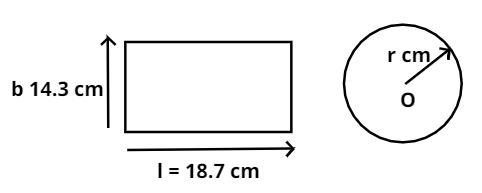
Let the radius of the circle be r cm.
As the rectangle is reshaped and bent into the circle as shown in figure.
Therefore the perimeter of the rectangle is equal to the circumference of the circle.
As we know that the perimeter of any shape is the sum of all the sides.
So the perimeter (P) of the rectangle is 2(l + b) cm.
Where l and b are the length and breadth of the rectangle respectively.
And we know that the circumference (C) of the circle is $2\pi r$ cm, where r is the radius of the circle.
$ \Rightarrow 2\left( {l + b} \right) = 2\pi r$
$ \Rightarrow \left( {l + b} \right) = \pi r$
$ \Rightarrow r = \dfrac{{l + b}}{\pi }$
Now substitute the values we have,
$ \Rightarrow r = \dfrac{{18.7 + 14.3}}{{\dfrac{{22}}{7}}} = \dfrac{{33 \times 7}}{{22}} = \dfrac{{21}}{2} = 10.5$ cm.
So the radius of the circle is 10.5 cm
So this is the required answer.
Note – It is advised to remember the direct general formula for perimeter, area, C.S.A, T.S.A of basic shapes like rectangle, circle, square etc. as it helps saving a lot of time. There can be another method to find the perimeter of the rectangle instead of using formula $2(l + b)$. We could have used the property that opposite sides of a rectangle are equal and thus the perimeter is simply the sum of all the sides.
Complete step by step answer:
Let the radius of the circle be r cm.
As the rectangle is reshaped and bent into the circle as shown in figure.
Therefore the perimeter of the rectangle is equal to the circumference of the circle.
As we know that the perimeter of any shape is the sum of all the sides.
So the perimeter (P) of the rectangle is 2(l + b) cm.
Where l and b are the length and breadth of the rectangle respectively.
And we know that the circumference (C) of the circle is $2\pi r$ cm, where r is the radius of the circle.
$ \Rightarrow 2\left( {l + b} \right) = 2\pi r$
$ \Rightarrow \left( {l + b} \right) = \pi r$
$ \Rightarrow r = \dfrac{{l + b}}{\pi }$
Now substitute the values we have,
$ \Rightarrow r = \dfrac{{18.7 + 14.3}}{{\dfrac{{22}}{7}}} = \dfrac{{33 \times 7}}{{22}} = \dfrac{{21}}{2} = 10.5$ cm.
So the radius of the circle is 10.5 cm
So this is the required answer.
Note – It is advised to remember the direct general formula for perimeter, area, C.S.A, T.S.A of basic shapes like rectangle, circle, square etc. as it helps saving a lot of time. There can be another method to find the perimeter of the rectangle instead of using formula $2(l + b)$. We could have used the property that opposite sides of a rectangle are equal and thus the perimeter is simply the sum of all the sides.
Recently Updated Pages
Master Class 10 Computer Science: Engaging Questions & Answers for Success

Master Class 10 General Knowledge: Engaging Questions & Answers for Success
Master Class 10 English: Engaging Questions & Answers for Success
Master Class 10 Social Science: Engaging Questions & Answers for Success
Master Class 10 Maths: Engaging Questions & Answers for Success
Master Class 10 Science: Engaging Questions & Answers for Success
Trending doubts
What is the median of the first 10 natural numbers class 10 maths CBSE
Which women's tennis player has 24 Grand Slam singles titles?
Who is the Brand Ambassador of Incredible India?
Why is there a time difference of about 5 hours between class 10 social science CBSE
Write a letter to the principal requesting him to grant class 10 english CBSE
A moving boat is observed from the top of a 150 m high class 10 maths CBSE