




(a) Why is parallel arrangement used in domestic wiring?
(b) State the law which relates the current in a conductor to the potential difference across its ends.
Answer
 Verified
658.2k+ views
Hint: (a) Describe the distribution of current and voltages across different branches in parallel. (b) State Ohm’s Law.
Complete step by step answer:
(a) In loose terms, voltage is the electrical force which drives electrons in a conductor or causes flow of current. Where, current is the amount of flow of charge per unit time. Motion of electrons causes current to flow in a circuit. The direction of flow of current is the opposite to the direction of motion of electrons in a circuit.
Two branches are said to be connected in parallel, if the voltage at both the ends of the two branches are the same. The current from the primary branch gets distributed in the branches connected in parallel (by Kirchoff’s current law). But, the voltage across all the branches is the same.
Two branches are said to be in series, if the same amount of current flows through them and the voltage across the whole series is the algebraic sum of the individual branches (by Kirchoff’s voltage law).
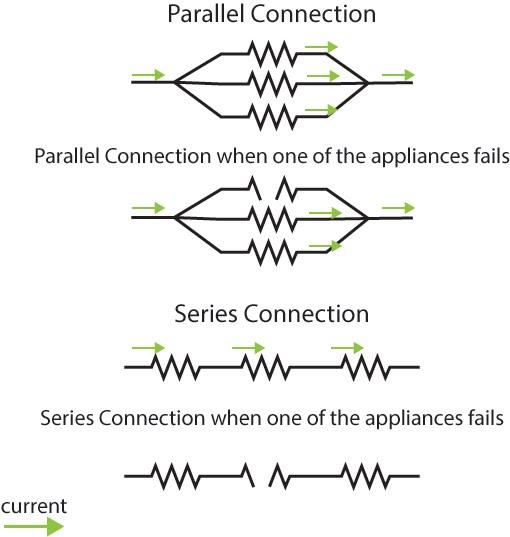
A circuit is open when electrons do not have a complete path to flow in a circuit.
Parallel connections are used in domestic wiring because:
1. If one of the appliances fails, that particular branch will fail to have current flowing in it, it will be open. Whereas, other appliances will still work. But, if the same appliances were connected in series, a fault in one of the appliances would have caused every appliance in the household to shut. As every branch is open circuit. Which is not desirable.
2. The voltage across all the electrical appliances will remain the same as the voltage of the main electric supply.
(b) Ohm's law relates current and a potential or voltage difference in a circuit. It states that the current through a conductor between two points is directly proportional to the voltage across the two points. Where, the constant of proportionality is the resistance. The equation for the law is:
$\text{Voltage}=\text{Current}\times \text{Resistance}$
Note: Resistance is not a universal constant. It varies and its value depends on its area of cross section, length and the resistivity of the material.
Complete step by step answer:
(a) In loose terms, voltage is the electrical force which drives electrons in a conductor or causes flow of current. Where, current is the amount of flow of charge per unit time. Motion of electrons causes current to flow in a circuit. The direction of flow of current is the opposite to the direction of motion of electrons in a circuit.
Two branches are said to be connected in parallel, if the voltage at both the ends of the two branches are the same. The current from the primary branch gets distributed in the branches connected in parallel (by Kirchoff’s current law). But, the voltage across all the branches is the same.
Two branches are said to be in series, if the same amount of current flows through them and the voltage across the whole series is the algebraic sum of the individual branches (by Kirchoff’s voltage law).
A circuit is open when electrons do not have a complete path to flow in a circuit.
Parallel connections are used in domestic wiring because:
1. If one of the appliances fails, that particular branch will fail to have current flowing in it, it will be open. Whereas, other appliances will still work. But, if the same appliances were connected in series, a fault in one of the appliances would have caused every appliance in the household to shut. As every branch is open circuit. Which is not desirable.
2. The voltage across all the electrical appliances will remain the same as the voltage of the main electric supply.
(b) Ohm's law relates current and a potential or voltage difference in a circuit. It states that the current through a conductor between two points is directly proportional to the voltage across the two points. Where, the constant of proportionality is the resistance. The equation for the law is:
$\text{Voltage}=\text{Current}\times \text{Resistance}$
Note: Resistance is not a universal constant. It varies and its value depends on its area of cross section, length and the resistivity of the material.
Recently Updated Pages
Master Class 12 Economics: Engaging Questions & Answers for Success

Master Class 12 Social Science: Engaging Questions & Answers for Success
Master Class 12 English: Engaging Questions & Answers for Success
Master Class 12 Maths: Engaging Questions & Answers for Success
Master Class 12 Physics: Engaging Questions & Answers for Success
Master Class 12 Biology: Engaging Questions & Answers for Success
Trending doubts
Draw a labelled sketch of the human eye class 12 physics CBSE
Which are the Top 10 Largest Countries of the World?
Draw ray diagrams each showing i myopic eye and ii class 12 physics CBSE
Which is the correct genotypic ratio of mendel dihybrid class 12 biology CBSE
Differentiate between homogeneous and heterogeneous class 12 chemistry CBSE
Which animal never drinks water in its entire life class 12 biology CBSE