




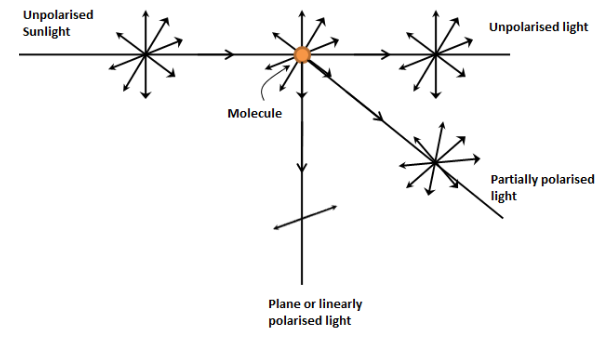
(a) Why does unpolarised light from a source do not show a variation in intensity when viewed through a Polaroid which is rotated? Show with the help of a diagram, how unpolarised light from the sun gets linearly polarized by scattering.
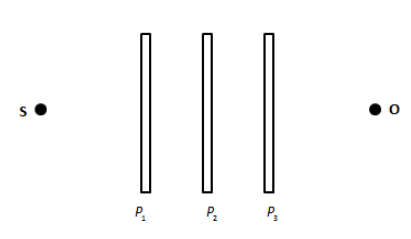
(b) Three identical Polaroid sheets \[{P_1},\,{P_2}\] and \[{P_3}\] are oriented so that the pass axis of \[{P_2}\] and \[{P_3}\] are inclined at angle of \[60^\circ \] and \[90^\circ \] respectively with the pass axis of \[{P_1}\]. A monochromatic source S of unpolarised light of intensity \[{I_0}\] is kept in front of the Polaroid sheet \[{P_1}\] as shown in the figure. Determine the intensities of light as observed by the observer at O, when Polaroid \[{P_3}\] is rotated with respect to \[{P_2}\] at angles \[\theta = 30^\circ \,{\text{and 60}}^\circ \].
Answer
 Verified
618.3k+ views
Hint:The unpolarised sunlight has vibrations of electric field along all directions and when this unpolarised light is allowed to pass through the Polaroid, the molecules in the Polaroid absorbs the electric field. To determine the intensity of the light passing through the Polaroid, recall the formula for intensity of light passing through the Polaroid placed at some angle with respect to the former Polaroid.
Complete Step by Step Answer:
(a) As we know the unpolarised light has an electric field in all the directions. The Polaroid has a chain of molecules and when the unpolarised light is allowed to pass through the Polaroid, the molecules absorb the unpolarised light and the transmitted intensity reduces to half. When we rotate the Polaroid, the intensity does not vary since the original unpolarised sunlight has the electric field in all the directions symmetrically. The following figure shows the polarization of the sunlight by the molecule.
(b) We know that the intensity of light reduces to half when it passes through the first Polaroid irrespective of the angle. Thus, the intensity of the light after passing through the first Polaroid is,
\[{I_1} = \dfrac{{{I_0}}}{2}\]
We have given that the pass axis of \[{P_2}\] and \[{P_3}\] are inclined at angles of \[60^\circ \] and \[90^\circ \] respectively with respect to the first Polaroid.
Let us determine the intensity of light after passing through the second Polaroid as follows,
\[{I_2} = {I_1}{\cos ^2}\left( {60} \right)\]
\[ \Rightarrow {I_2} = \dfrac{{{I_0}}}{2}{\cos ^2}\left( {60} \right)\]
\[ \Rightarrow {I_2} = \dfrac{{{I_0}}}{2}\left( {\dfrac{1}{4}} \right)\]
\[ \Rightarrow {I_2} = \dfrac{{{I_0}}}{8}\]
When we rotate the third Polaroid by an angle \[30^\circ \]with respect to the second Polaroid, the final angle between the second Polaroid and third Polaroid becomes \[60^\circ \].
Let us determine the intensity of light after passing through the third Polaroid as follows,
\[{I_3} = {I_2}{\cos ^2}\left( {60} \right)\]
\[ \Rightarrow {I_3} = \dfrac{{{I_1}}}{8}\left( {\dfrac{1}{4}} \right)\]
\[ \Rightarrow {I_3} = \dfrac{{{I_1}}}{{32}}\]
When we rotate the third Polaroid by an angle \[60^\circ \]with respect to the second Polaroid, the final angle between the second Polaroid and third Polaroid becomes \[90^\circ \]. Let us determine the intensity of light after passing through the third Polaroid as follows,
\[{I_3} = {I_2}{\cos ^2}\left( {90} \right)\]
\[ \therefore {I_3} = 0\]
Thus, no light will pass through the third Polaroid.
Note:The intensity of light passing through the first Polaroid is always half of the incident intensity of the unpolarised light irrespective of the pass angle. The angle for the third Polaroid is the angle of the third Polaroid with respect to the second Polaroid and not with respect to the first Polaroid. Also, students must note that when the pass angle becomes \[90^\circ \]with respect to the former Polaroid, no light passes through that Polaroid.
Complete Step by Step Answer:
(a) As we know the unpolarised light has an electric field in all the directions. The Polaroid has a chain of molecules and when the unpolarised light is allowed to pass through the Polaroid, the molecules absorb the unpolarised light and the transmitted intensity reduces to half. When we rotate the Polaroid, the intensity does not vary since the original unpolarised sunlight has the electric field in all the directions symmetrically. The following figure shows the polarization of the sunlight by the molecule.
(b) We know that the intensity of light reduces to half when it passes through the first Polaroid irrespective of the angle. Thus, the intensity of the light after passing through the first Polaroid is,
\[{I_1} = \dfrac{{{I_0}}}{2}\]
We have given that the pass axis of \[{P_2}\] and \[{P_3}\] are inclined at angles of \[60^\circ \] and \[90^\circ \] respectively with respect to the first Polaroid.
Let us determine the intensity of light after passing through the second Polaroid as follows,
\[{I_2} = {I_1}{\cos ^2}\left( {60} \right)\]
\[ \Rightarrow {I_2} = \dfrac{{{I_0}}}{2}{\cos ^2}\left( {60} \right)\]
\[ \Rightarrow {I_2} = \dfrac{{{I_0}}}{2}\left( {\dfrac{1}{4}} \right)\]
\[ \Rightarrow {I_2} = \dfrac{{{I_0}}}{8}\]
When we rotate the third Polaroid by an angle \[30^\circ \]with respect to the second Polaroid, the final angle between the second Polaroid and third Polaroid becomes \[60^\circ \].
Let us determine the intensity of light after passing through the third Polaroid as follows,
\[{I_3} = {I_2}{\cos ^2}\left( {60} \right)\]
\[ \Rightarrow {I_3} = \dfrac{{{I_1}}}{8}\left( {\dfrac{1}{4}} \right)\]
\[ \Rightarrow {I_3} = \dfrac{{{I_1}}}{{32}}\]
When we rotate the third Polaroid by an angle \[60^\circ \]with respect to the second Polaroid, the final angle between the second Polaroid and third Polaroid becomes \[90^\circ \]. Let us determine the intensity of light after passing through the third Polaroid as follows,
\[{I_3} = {I_2}{\cos ^2}\left( {90} \right)\]
\[ \therefore {I_3} = 0\]
Thus, no light will pass through the third Polaroid.
Note:The intensity of light passing through the first Polaroid is always half of the incident intensity of the unpolarised light irrespective of the pass angle. The angle for the third Polaroid is the angle of the third Polaroid with respect to the second Polaroid and not with respect to the first Polaroid. Also, students must note that when the pass angle becomes \[90^\circ \]with respect to the former Polaroid, no light passes through that Polaroid.
Recently Updated Pages
Master Class 12 Economics: Engaging Questions & Answers for Success

Master Class 12 Social Science: Engaging Questions & Answers for Success
Master Class 12 English: Engaging Questions & Answers for Success
Master Class 12 Maths: Engaging Questions & Answers for Success
Master Class 12 Physics: Engaging Questions & Answers for Success
Master Class 12 Biology: Engaging Questions & Answers for Success
Trending doubts
Draw a labelled sketch of the human eye class 12 physics CBSE
Which are the Top 10 Largest Countries of the World?
Draw ray diagrams each showing i myopic eye and ii class 12 physics CBSE
Which is the correct genotypic ratio of mendel dihybrid class 12 biology CBSE
Differentiate between homogeneous and heterogeneous class 12 chemistry CBSE
Which animal never drinks water in its entire life class 12 biology CBSE