




A wheel of radius R is free to rotate about its natural axis and I is its moment of inertia. If a tangential force F is applied on the wheel along its rim, then the angular acceleration of wheel is:
A. $IFR$
B. $\dfrac{{FR}}{I}$
C. $\dfrac{{IF}}{R}$
D. $\dfrac{{IR}}{F}$
Answer
 Verified
654.6k+ views
Hint: Initially the wheel is free to rotate about its natural axis, therefore no angular acceleration is observed. But, with the application of tangential force F, torque is observed. This torque gives rise to angular acceleration. So, first, we need to determine the torque due to the force. This can be used to find the angular acceleration of the wheel.
Formula used:
$\tau = FR\sin \theta $
$\tau = I\alpha $
Complete answer:
It is given in the question that the wheel of radius R is free to rotate about its natural axis, with the moment of Inertia I. And it is acted upon by a force F along its rim, as drawn in the figure.
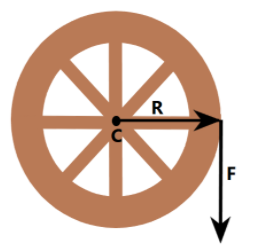
Here, the force F is acting as torque along R. Torque is the tendency of the force applied at distance, causing rotation.
The torque due to the given force F is given by,
$\eqalign{
& \vec \tau = \vec F \times \vec R \cr
& \Rightarrow \tau = FR\sin \theta \cr} $
Here, the ‘$ \times $’ indicates the cross product of the vectors and ‘$\theta $’ is said to be in the angle between the force and the radius.
From the diagram drawn above, we can see that $\theta = {90^ \circ }$. So, the torque, in this case, will be
$\tau = FR\sin {90^ \circ } = FR$
The torque can also be written as $\tau = I\alpha $. This denotes that due to the torque, on the wheel whose moment of Inertia is given as ‘$I$’, an angular acceleration ‘$\alpha $’ acts on the wheel.
So, we can write
$\eqalign{
& \tau = I\alpha = FR \cr
& \Rightarrow \alpha = \dfrac{{FR}}{I} \cr} $
Therefore, the correct option is B.
Note:
Torque in rotational form is analogous to force in the linear form.
The above question can also be solved in the term of dimensional analysis. The angular acceleration has dimensions of $[{M^0} {L^0} {T^{-2}}]$, as its unit is ${rad/{s^2}}$ but radians do not have dimensions. Therefore, the option which has the same dimension will be the answer.
One might ask why there is no angular acceleration while the wheel is rotating about its axis. As there is no external force acting upon the wheel, initially, the wheel must be under constant angular velocity. As the angular velocity is constant the angular acceleration is zero, initially.
Formula used:
$\tau = FR\sin \theta $
$\tau = I\alpha $
Complete answer:
It is given in the question that the wheel of radius R is free to rotate about its natural axis, with the moment of Inertia I. And it is acted upon by a force F along its rim, as drawn in the figure.
Here, the force F is acting as torque along R. Torque is the tendency of the force applied at distance, causing rotation.
The torque due to the given force F is given by,
$\eqalign{
& \vec \tau = \vec F \times \vec R \cr
& \Rightarrow \tau = FR\sin \theta \cr} $
Here, the ‘$ \times $’ indicates the cross product of the vectors and ‘$\theta $’ is said to be in the angle between the force and the radius.
From the diagram drawn above, we can see that $\theta = {90^ \circ }$. So, the torque, in this case, will be
$\tau = FR\sin {90^ \circ } = FR$
The torque can also be written as $\tau = I\alpha $. This denotes that due to the torque, on the wheel whose moment of Inertia is given as ‘$I$’, an angular acceleration ‘$\alpha $’ acts on the wheel.
So, we can write
$\eqalign{
& \tau = I\alpha = FR \cr
& \Rightarrow \alpha = \dfrac{{FR}}{I} \cr} $
Therefore, the correct option is B.
Note:
Torque in rotational form is analogous to force in the linear form.
The above question can also be solved in the term of dimensional analysis. The angular acceleration has dimensions of $[{M^0} {L^0} {T^{-2}}]$, as its unit is ${rad/{s^2}}$ but radians do not have dimensions. Therefore, the option which has the same dimension will be the answer.
One might ask why there is no angular acceleration while the wheel is rotating about its axis. As there is no external force acting upon the wheel, initially, the wheel must be under constant angular velocity. As the angular velocity is constant the angular acceleration is zero, initially.
Recently Updated Pages
If x a + bt + ct2 where x is in meters and t is in class 11 physics CBSE

A car covers the first half distance between two places class 11 physics CBSE
The resultant of two vectors overrightarrow P and overrightarrow class 11 physics CBSE
Find the value of cos 135 class 11 maths CBSE
A mass M is held in place by an applied force F and class 11 physics CBSE
A solution of glucose in water is labelled as 10 dfracwv class 11 chemistry CBSE
Trending doubts
Find the value of the expression given below sin 30circ class 11 maths CBSE
One Metric ton is equal to kg A 10000 B 1000 C 100 class 11 physics CBSE
Draw a diagram of nephron and explain its structur class 11 biology CBSE
10 examples of friction in our daily life
Proton was discovered by A Thomson B Rutherford C Chadwick class 11 chemistry CBSE
Bond order ofO2 O2+ O2 and O22 is in order A O2 langle class 11 chemistry CBSE