




A wheel is rolling straight on the ground without slipping. If the centre of mass of the wheel has speed $v$ , the instantaneous velocity of a point $P$ on the rim, defined by angle $\theta $ , relative to the ground will be:
A. $v\cos \left( {\dfrac{\theta }{2}} \right)$
B. $2v\cos \left( {\dfrac{\theta }{2}} \right)$
C. $v\sin \left( {\dfrac{\theta }{2}} \right)$
D. $v\sin \theta $
Answer
 Verified
518.4k+ views
Hint: This question comes under pure rolling because it is mentioned in the question that the wheel is rolling without slipping. And in this question linear velocity and angular velocity become the same. After pointing all the velocity components, we will vector sum to get the required answer.
Formula used:
$V = r\omega $
Where,
$V$ is the linear speed,
$r$ is the radius and
$\omega $ is the angular velocity.
Complete answer:
As according to the question, it is said that wheel is rolling straight on ground without slipping So we can write that,
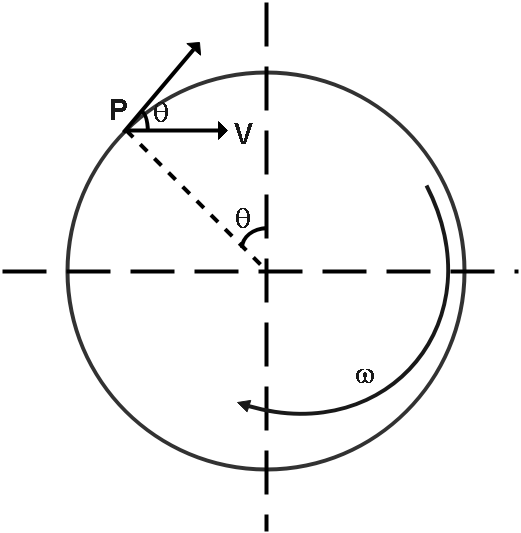
$v = r\omega $
Here, $v$ is the linear velocity of the wheel.
So now we have to find the instantaneous velocity at the point $P$ with respect to ground.
Now, vector sum of both the velocity it becomes,
${V_{net}} = \sqrt {v_1^2 + v_2^2 + 2{v_1}{v_2}\cos \theta } $
As, ${v_1}$ and ${v_2}$ are same so,
$
\Rightarrow {V_{net}} = \sqrt {v_1^2 + v_2^2 + 2{v_1}{v_2}\cos \theta } \\
\Rightarrow {V_{net}} = \sqrt {2{v^2} + 2{v^2}\cos \theta } \\
\Rightarrow {V_{net}} = v\sqrt {2(1 + \cos \theta )} \\
$
Now, we will apply trigonometry, and we know that,
$1 + \cos 2\theta = 2{\cos ^2}\theta $
And if we replace $2\theta $ by \[\dfrac{\theta }{2}\] it becomes,
$
\Rightarrow {V_{net}} = v\sqrt {2\left( {2{{\cos }^2}\dfrac{\theta }{2}} \right)} \\
\Rightarrow {V_{net}} = 2v\cos \dfrac{\theta }{2} \\
$
So, the instantaneous velocity of a point $P$ on the rim, defined by angle $\theta $ , relative to the ground is $2v\cos \dfrac{\theta }{2}$ .
Hence, the correct option is B.
Note:
In pure rolling slipping doesn’t take place whereas in rolling slipping takes place. A pure rolling body acts like it is at rest at the point where it touches the ground whereas rolling at every point of contact sliding takes place.
Do not assume that the friction is $0$ in pure rolling, that is not true. This is because there is no external force to stop this motion.
Formula used:
$V = r\omega $
Where,
$V$ is the linear speed,
$r$ is the radius and
$\omega $ is the angular velocity.
Complete answer:
As according to the question, it is said that wheel is rolling straight on ground without slipping So we can write that,
$v = r\omega $
Here, $v$ is the linear velocity of the wheel.
So now we have to find the instantaneous velocity at the point $P$ with respect to ground.
Now, vector sum of both the velocity it becomes,
${V_{net}} = \sqrt {v_1^2 + v_2^2 + 2{v_1}{v_2}\cos \theta } $
As, ${v_1}$ and ${v_2}$ are same so,
$
\Rightarrow {V_{net}} = \sqrt {v_1^2 + v_2^2 + 2{v_1}{v_2}\cos \theta } \\
\Rightarrow {V_{net}} = \sqrt {2{v^2} + 2{v^2}\cos \theta } \\
\Rightarrow {V_{net}} = v\sqrt {2(1 + \cos \theta )} \\
$
Now, we will apply trigonometry, and we know that,
$1 + \cos 2\theta = 2{\cos ^2}\theta $
And if we replace $2\theta $ by \[\dfrac{\theta }{2}\] it becomes,
$
\Rightarrow {V_{net}} = v\sqrt {2\left( {2{{\cos }^2}\dfrac{\theta }{2}} \right)} \\
\Rightarrow {V_{net}} = 2v\cos \dfrac{\theta }{2} \\
$
So, the instantaneous velocity of a point $P$ on the rim, defined by angle $\theta $ , relative to the ground is $2v\cos \dfrac{\theta }{2}$ .
Hence, the correct option is B.
Note:
In pure rolling slipping doesn’t take place whereas in rolling slipping takes place. A pure rolling body acts like it is at rest at the point where it touches the ground whereas rolling at every point of contact sliding takes place.
Do not assume that the friction is $0$ in pure rolling, that is not true. This is because there is no external force to stop this motion.
Recently Updated Pages
Master Class 11 English: Engaging Questions & Answers for Success

Master Class 11 Maths: Engaging Questions & Answers for Success
Class 11 Question and Answer - Your Ultimate Solutions Guide
Master Class 11 Biology: Engaging Questions & Answers for Success
Master Class 11 Physics: Engaging Questions & Answers for Success
Master Class 11 Accountancy: Engaging Questions & Answers for Success
Trending doubts
Differentiate between an exothermic and an endothermic class 11 chemistry CBSE
One Metric ton is equal to kg A 10000 B 1000 C 100 class 11 physics CBSE
In what year Guru Nanak Dev ji was born A15 April 1469 class 11 social science CBSE
Difference Between Prokaryotic Cells and Eukaryotic Cells
Draw a diagram of a plant cell and label at least eight class 11 biology CBSE
1 Quintal is equal to a 110 kg b 10 kg c 100kg d 1000 class 11 physics CBSE