




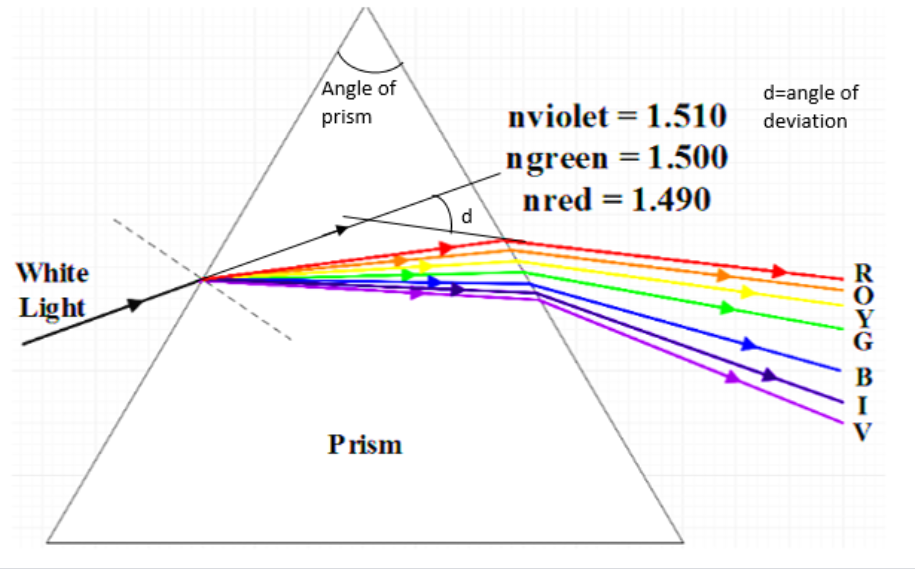
(a) What will be the prism angle and the angle of deviation for a prism?
(b) What will be the sequence of the colours in the spectrum created by the passage of white light through a prism?
(c) Describe the process of formation of rainbow.
Answer
 Verified
624.9k+ views
Hint: A rainbow will be always made in a direction opposite to that of the Sun. The water droplets will be experienced such as small prisms. They will get refracted and dispersed the incident sunlight, then internally will get reflected, and finally it will get refracted again if it comes out of the raindrop. This will help you in answering this question.
Complete step by step answer:
(a) the angle between the two lateral faces will be known as the angle of the prism or the prism angle. If the light ray can be permitted to pass through the prism, it will create the emergent ray bend at an angle to the direction of the incident ray. This angle can be known as the angle of deviation for the prism.
(b) If the white light will be permitted to pass through a prism, a spectrum of colours will be created which will be in the sequence as follows, that is,
Red colour, Orange colour, Yellow colour, Green colour, Blue colour, Indigo colour and the Violet colour.
(c) A rainbow will be a natural spectrum which will be appearing in the sky after a rain shower. It will be caused by the dispersion of the sunlight by small water droplets, seen in the atmosphere. A rainbow will be always made in a direction opposite to that of the Sun. The water droplets will be experienced such as small prisms. They will get refracted and dispersed the incident sunlight, then internally will get reflected, and finally it will get refracted again if it comes out of the raindrop. Because of the dispersion of light and the internal reflection, various colours reach the eye of the observer.
Note: A rainbow can be a natural phenomenon that will be resulting by a reflection, refraction and the dispersion of light in water droplets which will cause a spectrum of light appearing in the sky. It will be visualised by a multi-coloured circular arc.
Complete step by step answer:
(a) the angle between the two lateral faces will be known as the angle of the prism or the prism angle. If the light ray can be permitted to pass through the prism, it will create the emergent ray bend at an angle to the direction of the incident ray. This angle can be known as the angle of deviation for the prism.
(b) If the white light will be permitted to pass through a prism, a spectrum of colours will be created which will be in the sequence as follows, that is,
Red colour, Orange colour, Yellow colour, Green colour, Blue colour, Indigo colour and the Violet colour.
(c) A rainbow will be a natural spectrum which will be appearing in the sky after a rain shower. It will be caused by the dispersion of the sunlight by small water droplets, seen in the atmosphere. A rainbow will be always made in a direction opposite to that of the Sun. The water droplets will be experienced such as small prisms. They will get refracted and dispersed the incident sunlight, then internally will get reflected, and finally it will get refracted again if it comes out of the raindrop. Because of the dispersion of light and the internal reflection, various colours reach the eye of the observer.
Note: A rainbow can be a natural phenomenon that will be resulting by a reflection, refraction and the dispersion of light in water droplets which will cause a spectrum of light appearing in the sky. It will be visualised by a multi-coloured circular arc.
Recently Updated Pages
Basicity of sulphurous acid and sulphuric acid are

Master Class 12 Economics: Engaging Questions & Answers for Success
Master Class 12 Biology: Engaging Questions & Answers for Success
Master Class 11 English: Engaging Questions & Answers for Success
Master Class 11 Physics: Engaging Questions & Answers for Success
Master Class 11 Computer Science: Engaging Questions & Answers for Success
Trending doubts
Draw a labelled sketch of the human eye class 12 physics CBSE
Which are the Top 10 Largest Countries of the World?
Draw ray diagrams each showing i myopic eye and ii class 12 physics CBSE
Which is the correct genotypic ratio of mendel dihybrid class 12 biology CBSE
Draw a ray diagram of compound microscope when the class 12 physics CBSE
Give 10 examples of unisexual and bisexual flowers