




A well, whose diameter is 7 m, has been dug 22.5 m deep and the earth dug out is used to form an embankment around it. If the height of the embankment is 1.5 m, find the width of the embankment.
Answer
 Verified
545.5k+ views
Hint: Calculate the volume of earth that has been dug out from the well, using the formula \[\pi {{r}^{2}}h\], where ‘r’ is the radius and ‘h’ is the height of the well. This volume is equal to the volume of earth around the embankment. Assume the width of embankment to be ‘x’ and write the volume of embankment using the formula \[\pi \left( {{R}^{2}}-{{r}^{2}} \right)h\], where R is the outer radius, r is the inner radius and h is the height of embankment. Equate the two volumes to get the width of the embankment.
Complete Step-by-step answer:
We have data regarding a well which is dug in the earth and the earth dug out is used to form an embankment around it. We have to find the width of this embankment.
We observe that the volume of earth dug out is equal to the volume of earth used to make the embankment.
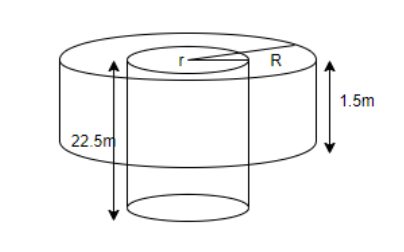
The diameter of the well dug out is 7m and its height is 22.5m.
We know that the radius of the circle is half the diameter of the circle. So, the radius of cylinder \[=\dfrac{7}{2}=3.5m\].
We know that the volume of a cylindrical vessel whose radius is ‘r’ and height is ‘h’ is given by \[\pi {{r}^{2}}h\].
Substituting \[r=3.5m,h=22.5m\] in the above formula, the volume of well dug out \[=\pi {{r}^{2}}h=\dfrac{22}{7}{{\left( 3.5 \right)}^{2}}\left( 22.5 \right)=866.25{{m}^{3}}\].
This volume of earth is equal to the volume of earth used to make embankments.
Let’s assume that the width of the embankment is ‘x’.
So, the outer radius of embankment is \[(x+3.5)m\], inner radius is 3.5m and height is 1.5m.
To calculate the volume of earth used to make embankment, we will use the formula \[\pi \left( {{R}^{2}}-{{r}^{2}} \right)h\], where R is outer radius, r is inner radius and h is the height of embankment.
Substituting the values, the volume of embankment \[=\pi \left( {{\left( x+3.5 \right)}^{2}}-{{3.5}^{2}} \right)1.5\].
Thus, we have \[866.25=\pi \left( {{\left( x+3.5 \right)}^{2}}-{{3.5}^{2}} \right)1.5\].
Simplifying the above equation, we have \[183.75={{\left( x+3.5 \right)}^{2}}-12.25\].
Thus, we have \[{{\left( x+3.5 \right)}^{2}}=183.75+12.25=196\].
So, we have \[x+3.5=\sqrt{196}=14\Rightarrow x=14-3.5=10.5m\].
Hence, the width of the embankment is 10.5m.
Note: One needs to be extremely careful about units while calculating the volume of the cylindrical region. It’s also necessary to keep in mind that we have the diameter of well dug out. So, we have to find the radius of the well and then calculate the volume. Also, we have to find the width of the embankment, not the outer radius of the embankment. To find the width, we have to separate the inner radius of embankment from the outer radius.
Complete Step-by-step answer:
We have data regarding a well which is dug in the earth and the earth dug out is used to form an embankment around it. We have to find the width of this embankment.
We observe that the volume of earth dug out is equal to the volume of earth used to make the embankment.
The diameter of the well dug out is 7m and its height is 22.5m.
We know that the radius of the circle is half the diameter of the circle. So, the radius of cylinder \[=\dfrac{7}{2}=3.5m\].
We know that the volume of a cylindrical vessel whose radius is ‘r’ and height is ‘h’ is given by \[\pi {{r}^{2}}h\].
Substituting \[r=3.5m,h=22.5m\] in the above formula, the volume of well dug out \[=\pi {{r}^{2}}h=\dfrac{22}{7}{{\left( 3.5 \right)}^{2}}\left( 22.5 \right)=866.25{{m}^{3}}\].
This volume of earth is equal to the volume of earth used to make embankments.
Let’s assume that the width of the embankment is ‘x’.
So, the outer radius of embankment is \[(x+3.5)m\], inner radius is 3.5m and height is 1.5m.
To calculate the volume of earth used to make embankment, we will use the formula \[\pi \left( {{R}^{2}}-{{r}^{2}} \right)h\], where R is outer radius, r is inner radius and h is the height of embankment.
Substituting the values, the volume of embankment \[=\pi \left( {{\left( x+3.5 \right)}^{2}}-{{3.5}^{2}} \right)1.5\].
Thus, we have \[866.25=\pi \left( {{\left( x+3.5 \right)}^{2}}-{{3.5}^{2}} \right)1.5\].
Simplifying the above equation, we have \[183.75={{\left( x+3.5 \right)}^{2}}-12.25\].
Thus, we have \[{{\left( x+3.5 \right)}^{2}}=183.75+12.25=196\].
So, we have \[x+3.5=\sqrt{196}=14\Rightarrow x=14-3.5=10.5m\].
Hence, the width of the embankment is 10.5m.
Note: One needs to be extremely careful about units while calculating the volume of the cylindrical region. It’s also necessary to keep in mind that we have the diameter of well dug out. So, we have to find the radius of the well and then calculate the volume. Also, we have to find the width of the embankment, not the outer radius of the embankment. To find the width, we have to separate the inner radius of embankment from the outer radius.
Recently Updated Pages
Master Class 10 Social Science: Engaging Questions & Answers for Success

Master Class 10 Science: Engaging Questions & Answers for Success
Master Class 10 Maths: Engaging Questions & Answers for Success
Master Class 10 General Knowledge: Engaging Questions & Answers for Success
Master Class 10 Computer Science: Engaging Questions & Answers for Success
Class 10 Question and Answer - Your Ultimate Solutions Guide
Trending doubts
Explain the Treaty of Vienna of 1815 class 10 social science CBSE
In cricket, how many legal balls are there in a standard over?
Why is there a time difference of about 5 hours between class 10 social science CBSE
Who Won 36 Oscar Awards? Record Holder Revealed
What is the median of the first 10 natural numbers class 10 maths CBSE
Distinguish between the reserved forests and protected class 10 biology CBSE