




A weightless rod is acted on by upward parallel forces of $2N$ and $4N$ ends A and B respectively, The Total length of the rod $AB = 3m$ To keep the rod in equilibrium a force of $6N$ should act in the following manner.
(A) Downward at any point between A and B.
(B) Downwards at the midpoint of AB.
(C) Downwards at a point C such that $AC = 1m$
(D) Downwards at a point D such that $BD = 1m$
Answer
 Verified
528k+ views
Hint: In order to solve this question, we should know that a body is in equilibrium when net torque acting on the body is zero when balanced under multiple forces, here we will find the net upward and downward torque acting on the rod and then will find the correct option.
Complete step by step answer:
Let us first draw a diagram, where AB is a rod of length $AB = 3m$ and ${F_A} = 2N$ and ${F_B} = 4N$ acting on both ends of the rod upwards and let D be a point at a distance of $x$ from point A and at point D a downward force of $6N$ acting, and from diagram we can see that,
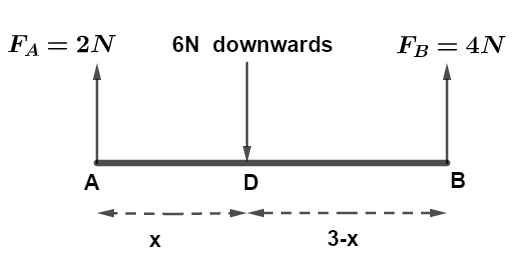
$AD = x$
$BD = 3 - x$
Now, in order to be the equilibrium of the rod the torque acting on point D due to both ends A and B must be equal.
Torque due to point A is given as
$\tau = {F_A} \times AD$
on putting the value of force we get,
$\tau = 2x \to (i)$
Torque due to point B is given as
$\tau = {F_B} \times BD$
on putting the value of force we get,
$\tau = 4(3 - x) \to (ii)$
Now, equating both equations (i) and (ii) we get,
$2x = 12 - 4x$
$6x = 12$
$ \Rightarrow x = 2m$
So, the distance BD which is $BD = 3 - x$
$BD = 3 - 2 = 1m$
So, a downward force of $6N$ should be applied at point D such that $BD = 1m$
Hence, the correct option is (D) Downwards at a point D such that $BD = 1m$.
Note: It should be remembered that, For equilibrium of no motion in a body we add all the forces to be zero but when a rod is balanced under force of gravity, to balance it the net torque on body must be zero or torque acting in one direction must be equal to that of torque acting in opposite direction.
Complete step by step answer:
Let us first draw a diagram, where AB is a rod of length $AB = 3m$ and ${F_A} = 2N$ and ${F_B} = 4N$ acting on both ends of the rod upwards and let D be a point at a distance of $x$ from point A and at point D a downward force of $6N$ acting, and from diagram we can see that,
$AD = x$
$BD = 3 - x$
Now, in order to be the equilibrium of the rod the torque acting on point D due to both ends A and B must be equal.
Torque due to point A is given as
$\tau = {F_A} \times AD$
on putting the value of force we get,
$\tau = 2x \to (i)$
Torque due to point B is given as
$\tau = {F_B} \times BD$
on putting the value of force we get,
$\tau = 4(3 - x) \to (ii)$
Now, equating both equations (i) and (ii) we get,
$2x = 12 - 4x$
$6x = 12$
$ \Rightarrow x = 2m$
So, the distance BD which is $BD = 3 - x$
$BD = 3 - 2 = 1m$
So, a downward force of $6N$ should be applied at point D such that $BD = 1m$
Hence, the correct option is (D) Downwards at a point D such that $BD = 1m$.
Note: It should be remembered that, For equilibrium of no motion in a body we add all the forces to be zero but when a rod is balanced under force of gravity, to balance it the net torque on body must be zero or torque acting in one direction must be equal to that of torque acting in opposite direction.
Recently Updated Pages
Master Class 11 Social Science: Engaging Questions & Answers for Success

Master Class 11 English: Engaging Questions & Answers for Success
Master Class 11 Maths: Engaging Questions & Answers for Success
Master Class 11 Chemistry: Engaging Questions & Answers for Success
Master Class 11 Biology: Engaging Questions & Answers for Success
Class 11 Question and Answer - Your Ultimate Solutions Guide
Trending doubts
One Metric ton is equal to kg A 10000 B 1000 C 100 class 11 physics CBSE
Difference Between Prokaryotic Cells and Eukaryotic Cells
Find the value of the expression given below sin 30circ class 11 maths CBSE
1 ton equals to A 100 kg B 1000 kg C 10 kg D 10000 class 11 physics CBSE
Two of the body parts which do not appear in MRI are class 11 biology CBSE
Draw a diagram of nephron and explain its structur class 11 biology CBSE