




A weight $Mg$ is suspended from the middle of a rope whose ends are at the same level. The rope is no longer horizontal. The minimum tension required to completely straighten the rope is
A. $\dfrac{{Mg}}{2}$
B. $Mg\cos \theta $
C. $2Mg\cos \theta $
D. Infinitely large
Answer
 Verified
535.5k+ views
Hint: We need to draw a figure showing all the components of the force acting on the weight suspended so that we do not miss out on any component and then equate the opposite forces and find the expression for the minimum tension required to straighten the rope.
Complete step by step solution:
Let us first draw a diagram to get a better understanding of the situation.
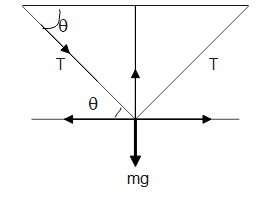
The tension is due to the weight suspended from the middle of the rope. The tension can be resolved into two components $T\cos \theta $ and $T\sin \theta $ where $\theta $ is the angle which the rope makes with the horizontal when the weight is suspended on it.
By equating the components of force in the opposite direction we can write
$2T\sin \theta = mg$
$ \Rightarrow T = \dfrac{{mg}}{{2\sin \theta }}$
When the $\theta = 0^\circ $, then the rope will be straight. Therefore to bring back the rope to a straight position we will have to angle zero.
Substituting the value we get,
$ \Rightarrow T = \dfrac{{mg}}{{2\sin 0}}$
$ \Rightarrow T = \infty $
This denotes that the minimum tension required to straighten the rope with weight suspended is infinite.
Therefore option D) is correct.
Note: When an object is suspended from a rope the force components acting on it will be balanced by each other. The vertical component of the tension will be balanced by the weight of the suspended object. Since there are two components of tension from either side in the vertical direction, factor 2 is multiplied by the vertical component. The forces are balanced when the system is in equilibrium. The amount of tension required to straighten the rope does not depend on the weight suspended at the midpoint of the rope.
Complete step by step solution:
Let us first draw a diagram to get a better understanding of the situation.
The tension is due to the weight suspended from the middle of the rope. The tension can be resolved into two components $T\cos \theta $ and $T\sin \theta $ where $\theta $ is the angle which the rope makes with the horizontal when the weight is suspended on it.
By equating the components of force in the opposite direction we can write
$2T\sin \theta = mg$
$ \Rightarrow T = \dfrac{{mg}}{{2\sin \theta }}$
When the $\theta = 0^\circ $, then the rope will be straight. Therefore to bring back the rope to a straight position we will have to angle zero.
Substituting the value we get,
$ \Rightarrow T = \dfrac{{mg}}{{2\sin 0}}$
$ \Rightarrow T = \infty $
This denotes that the minimum tension required to straighten the rope with weight suspended is infinite.
Therefore option D) is correct.
Note: When an object is suspended from a rope the force components acting on it will be balanced by each other. The vertical component of the tension will be balanced by the weight of the suspended object. Since there are two components of tension from either side in the vertical direction, factor 2 is multiplied by the vertical component. The forces are balanced when the system is in equilibrium. The amount of tension required to straighten the rope does not depend on the weight suspended at the midpoint of the rope.
Recently Updated Pages
Master Class 12 Economics: Engaging Questions & Answers for Success

Master Class 12 English: Engaging Questions & Answers for Success
Master Class 12 Social Science: Engaging Questions & Answers for Success
Master Class 12 Maths: Engaging Questions & Answers for Success
Master Class 12 Physics: Engaging Questions & Answers for Success
Master Class 9 General Knowledge: Engaging Questions & Answers for Success
Trending doubts
One Metric ton is equal to kg A 10000 B 1000 C 100 class 11 physics CBSE
Difference Between Prokaryotic Cells and Eukaryotic Cells
Find the value of the expression given below sin 30circ class 11 maths CBSE
Two of the body parts which do not appear in MRI are class 11 biology CBSE
Draw a diagram of nephron and explain its structur class 11 biology CBSE
10 examples of friction in our daily life