




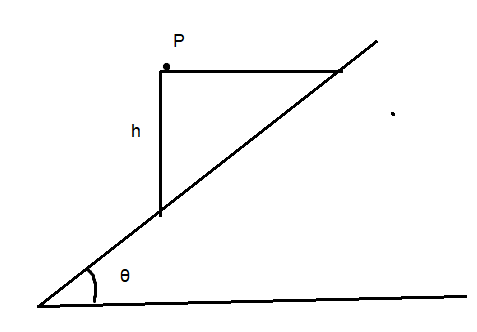
A wedge of height $h$ is released from rest with a light particle $P$ placed on it as shown. The wedge slides an incline which makes an angle $\theta $ with the horizontal. All the surfaces are smooth, find the time after which $P$ will reach the surface of the incline.
A.$\sqrt {\dfrac{{2h}}{{g{{\sin }^2}\theta }}} $
B.$\sqrt {\dfrac{h}{{g{{\sin }^2}\theta }}} $
C.$\sqrt {\dfrac{h}{{2g{{\sin }^2}\theta }}} $
D.$\sqrt {\dfrac{h}{{g{{\sin }^2}\theta }}} $
Answer
 Verified
564.3k+ views
Hint: According to Newton’s first law of motion, a body tends to be at rest or in uniform motion along a straight line unless there is no external force acting on it. Whereas pseudo force is false force felt by an object due to acceleration and its tendency to be at rest (Newton's first law of motion). Use the equation of motion for the particle in terms of distance, initial velocity, time, and acceleration where the initial velocity for this case is zero. Also, the concept of slope is needed here.
Formula Used:
$s = ut + \dfrac{1}{2}a{t^2}$
$\tan \theta = \dfrac{h}{x}$
Complete answer:
According to the given statement,
Height of wedge = $h$
The angle of inclination = $\theta $
Friction force = \[0\]
Let the distance between Point $P$ and surface be $x$ as shown below.
i.e., the total distance traveled by particle from point $P$ to $x$ can also be expressed as
$\tan \theta = \dfrac{h}{x} \Rightarrow x = \dfrac{h}{{\tan \theta }}$ …… (1)
Now, since the wedge is sliding on a frictionless surface, the net acceleration is only because of gravitational force.
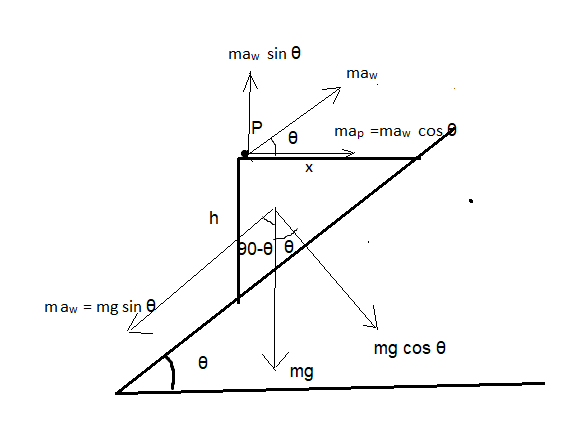
Hence according to the free body diagram, we can derive the following expression
Acceleration of wedge, \[{a_w} = gsin{\text{ }}\theta \]
Now since the particle is accelerated toward the inclined surface because of pseudo force the acceleration of the particle can be given as
\[{a_p} = {a_w}cos\theta = gsin\theta \times cos\theta ...........(2)\]
Also, according to the third kinematic equation, the relation between the acceleration of particle (ap), time to reach the inclined surface (t), and distance traveled by a particle (x) is given as
$x = ut + \dfrac{1}{2}{a_p}{t^2}$
Here, u is the initial velocity. For our simplicity consider that initially both particles and wedges are at rest.
∴$x = \dfrac{1}{2}{a_p}{t^2}$
Whereas from statements 1 and 2 we get
i.e., $\dfrac{h}{{\tan \theta }} = \dfrac{1}{2}g\sin \theta \times \cos \theta \times {t^2}$
$ \Rightarrow t = \sqrt {\dfrac{{2h}}{{\dfrac{{\sin \theta }}{{\cos \theta }} \times \sin \theta \times \cos \theta \times g}}} $
$ \Rightarrow t = \sqrt {\dfrac{{2h}}{{{\text{g si}}{{\text{n}}^2}\theta }}} $
correct option is A.
Note:
For any free body diagram it's important to draw all forces acting on block, wedge, particle, etc., to understand the relationship between balance and unbalance force. Also, we must be careful about the frame of reference and external forces acting on a block, in this case since friction across all surfaces is zero, our problem becomes much easier to solve.
In case if there was some friction between the wedge and inclined surface the equation for this will be expressed as
\[m{a_w} = mgsin\theta -f\]
Here $f$ can be considered as a frictional force.
Formula Used:
$s = ut + \dfrac{1}{2}a{t^2}$
$\tan \theta = \dfrac{h}{x}$
Complete answer:
According to the given statement,
Height of wedge = $h$
The angle of inclination = $\theta $
Friction force = \[0\]
Let the distance between Point $P$ and surface be $x$ as shown below.
i.e., the total distance traveled by particle from point $P$ to $x$ can also be expressed as
$\tan \theta = \dfrac{h}{x} \Rightarrow x = \dfrac{h}{{\tan \theta }}$ …… (1)
Now, since the wedge is sliding on a frictionless surface, the net acceleration is only because of gravitational force.
Hence according to the free body diagram, we can derive the following expression
Acceleration of wedge, \[{a_w} = gsin{\text{ }}\theta \]
Now since the particle is accelerated toward the inclined surface because of pseudo force the acceleration of the particle can be given as
\[{a_p} = {a_w}cos\theta = gsin\theta \times cos\theta ...........(2)\]
Also, according to the third kinematic equation, the relation between the acceleration of particle (ap), time to reach the inclined surface (t), and distance traveled by a particle (x) is given as
$x = ut + \dfrac{1}{2}{a_p}{t^2}$
Here, u is the initial velocity. For our simplicity consider that initially both particles and wedges are at rest.
∴$x = \dfrac{1}{2}{a_p}{t^2}$
Whereas from statements 1 and 2 we get
i.e., $\dfrac{h}{{\tan \theta }} = \dfrac{1}{2}g\sin \theta \times \cos \theta \times {t^2}$
$ \Rightarrow t = \sqrt {\dfrac{{2h}}{{\dfrac{{\sin \theta }}{{\cos \theta }} \times \sin \theta \times \cos \theta \times g}}} $
$ \Rightarrow t = \sqrt {\dfrac{{2h}}{{{\text{g si}}{{\text{n}}^2}\theta }}} $
correct option is A.
Note:
For any free body diagram it's important to draw all forces acting on block, wedge, particle, etc., to understand the relationship between balance and unbalance force. Also, we must be careful about the frame of reference and external forces acting on a block, in this case since friction across all surfaces is zero, our problem becomes much easier to solve.
In case if there was some friction between the wedge and inclined surface the equation for this will be expressed as
\[m{a_w} = mgsin\theta -f\]
Here $f$ can be considered as a frictional force.
Recently Updated Pages
If x a + bt + ct2 where x is in meters and t is in class 11 physics CBSE

A car covers the first half distance between two places class 11 physics CBSE
The resultant of two vectors overrightarrow P and overrightarrow class 11 physics CBSE
Find the value of cos 135 class 11 maths CBSE
A mass M is held in place by an applied force F and class 11 physics CBSE
A solution of glucose in water is labelled as 10 dfracwv class 11 chemistry CBSE
Trending doubts
Find the value of the expression given below sin 30circ class 11 maths CBSE
One Metric ton is equal to kg A 10000 B 1000 C 100 class 11 physics CBSE
Draw a diagram of nephron and explain its structur class 11 biology CBSE
10 examples of friction in our daily life
Proton was discovered by A Thomson B Rutherford C Chadwick class 11 chemistry CBSE
Bond order ofO2 O2+ O2 and O22 is in order A O2 langle class 11 chemistry CBSE