




A villager Ramayya has a plot of land in the shape of a quadrilateral. The gram panchayat of the village decided to take over some portion of his plot from one of the corners to construct a school. Ramayya agrees to the above proposal with the condition that he should be given an equal amount of land in exchange of his land adjoining his plot so as to form a triangular plot. Explain how his proposal will be implemented.
Answer
 Verified
616.5k+ views
Hint: In order to solve the above problem first we will make the diagram of the problem statement. Then we need to prove the old area of land is the same as the new area of land. Use the property of parallelogram that triangles formed on the parallelogram with the same base and between the same parallel lines are equal in area.
Complete step-by-step answer:
Let us solve the problem with the help of the following diagram
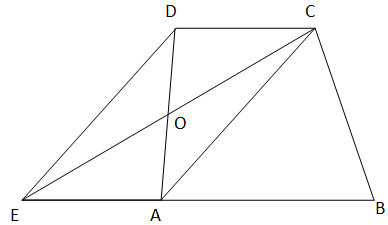
Let quadrilateral ABCD be the original shape of the field owned by Ramayya.
Let us join AC and draw \[DE||AC\] joining CE and EA.
Let gram panchayat construct its school in ar(EDC) by taking land ODC.
So Ramayya gives up ODC and takes adjacent land OEA in return.
Now, he has the land EBC.
So, we need to prove that Area of old land = Area of new land
We need to prove ar(ABCD)=ar(EBC)
As we have taken \[DE||AC\& DE = AC\]
So ACDE is a parallelogram
For triangles ACD and ACE
Both the triangles have the same base that is AC. And also they lie between sets of two parallel lines AC and DE.
As we know that triangles with the same base and between the same parallel lines are equal in area, so we have
$\therefore ar\left( {ACD} \right) = ar\left( {ACE} \right)$ ---(1)
Adding $ar\left( {ABC} \right)$ on both the sides of the equation we get:
$
\Rightarrow ar\left( {ACD} \right) + ar\left( {ABC} \right) = ar\left( {ACE} \right) + ar\left( {ABC} \right) \\
\Rightarrow ar\left( {ABCD} \right) = ar\left( {EBC} \right){\text{ }}\left[ {{\text{from the figure}}} \right] \\
$
Hence, now the area of land with ramayya is triangular and also the area of land is same as it was earlier.
Note: The problem can be solved in another way as well by considering some different shapes of quadrilaterals and triangles of different shapes. But the most important step is to construct a figure and visualize the practical problem with some geometrical figures. Also students must remember the properties of parallelogram one of which is mentioned in the solution.
Complete step-by-step answer:
Let us solve the problem with the help of the following diagram
Let quadrilateral ABCD be the original shape of the field owned by Ramayya.
Let us join AC and draw \[DE||AC\] joining CE and EA.
Let gram panchayat construct its school in ar(EDC) by taking land ODC.
So Ramayya gives up ODC and takes adjacent land OEA in return.
Now, he has the land EBC.
So, we need to prove that Area of old land = Area of new land
We need to prove ar(ABCD)=ar(EBC)
As we have taken \[DE||AC\& DE = AC\]
So ACDE is a parallelogram
For triangles ACD and ACE
Both the triangles have the same base that is AC. And also they lie between sets of two parallel lines AC and DE.
As we know that triangles with the same base and between the same parallel lines are equal in area, so we have
$\therefore ar\left( {ACD} \right) = ar\left( {ACE} \right)$ ---(1)
Adding $ar\left( {ABC} \right)$ on both the sides of the equation we get:
$
\Rightarrow ar\left( {ACD} \right) + ar\left( {ABC} \right) = ar\left( {ACE} \right) + ar\left( {ABC} \right) \\
\Rightarrow ar\left( {ABCD} \right) = ar\left( {EBC} \right){\text{ }}\left[ {{\text{from the figure}}} \right] \\
$
Hence, now the area of land with ramayya is triangular and also the area of land is same as it was earlier.
Note: The problem can be solved in another way as well by considering some different shapes of quadrilaterals and triangles of different shapes. But the most important step is to construct a figure and visualize the practical problem with some geometrical figures. Also students must remember the properties of parallelogram one of which is mentioned in the solution.

Recently Updated Pages
Master Class 7 English: Engaging Questions & Answers for Success

Master Class 7 Maths: Engaging Questions & Answers for Success
Master Class 7 Science: Engaging Questions & Answers for Success
Class 7 Question and Answer - Your Ultimate Solutions Guide
Master Class 9 General Knowledge: Engaging Questions & Answers for Success
Master Class 9 Social Science: Engaging Questions & Answers for Success
Trending doubts
The value of 6 more than 7 is A 1 B 1 C 13 D 13 class 7 maths CBSE
Convert 200 Million dollars in rupees class 7 maths CBSE
List of coprime numbers from 1 to 100 class 7 maths CBSE
AIM To prepare stained temporary mount of onion peel class 7 biology CBSE
The plural of Chief is Chieves A True B False class 7 english CBSE
Write a letter to the editor of the national daily class 7 english CBSE