




A vicinal diol has two hydroxyl groups on the same carbon atoms.
a. True
b. False
c. Ambiguous
d. None of the above
Answer
 Verified
629.4k+ views
Hint: Vicinal positions are known as adjacent positions of a compound (means on adjacent atoms). And diols are alcohol groups (- OH).
Complete answer: We know that a diol is a chemical compound which contains two hydroxyl groups (−OH groups).
Some classes of diols:
Geminal diols: Geminal diols have two hydroxyl groups bonded to the same atom. These species arise by hydration of the carbonyl compounds. Below given is the example of geminal diols:
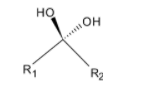
Vicinal diols: In a vicinal diol, the two hydroxyl groups occupy vicinal positions, they are attached to adjacent atoms. These compounds are called glycols. In a vicinal diol, the two hydroxyl groups occupy vicinal positions, that is, they are attached to adjacent atoms. These compounds are called glycols.
Diols such as ethylene glycol are used as co-monomer in polymerization reactions forming polymers. Below given is the structure of vicinal diol:
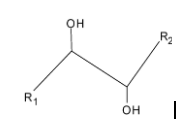
Some other diols are also there which have diols at 1,3 position, 1,4 position etc.
So, from the above explanation we can say that the given statement is ‘False’.
Complete answer: We know that a diol is a chemical compound which contains two hydroxyl groups (−OH groups).
Some classes of diols:
Geminal diols: Geminal diols have two hydroxyl groups bonded to the same atom. These species arise by hydration of the carbonyl compounds. Below given is the example of geminal diols:
Vicinal diols: In a vicinal diol, the two hydroxyl groups occupy vicinal positions, they are attached to adjacent atoms. These compounds are called glycols. In a vicinal diol, the two hydroxyl groups occupy vicinal positions, that is, they are attached to adjacent atoms. These compounds are called glycols.
Diols such as ethylene glycol are used as co-monomer in polymerization reactions forming polymers. Below given is the structure of vicinal diol:
Some other diols are also there which have diols at 1,3 position, 1,4 position etc.
So, from the above explanation we can say that the given statement is ‘False’.
Recently Updated Pages
Master Class 12 Economics: Engaging Questions & Answers for Success

Master Class 12 English: Engaging Questions & Answers for Success
Master Class 12 Social Science: Engaging Questions & Answers for Success
Master Class 12 Maths: Engaging Questions & Answers for Success
Master Class 12 Physics: Engaging Questions & Answers for Success
Master Class 9 General Knowledge: Engaging Questions & Answers for Success
Trending doubts
Which are the Top 10 Largest Countries of the World?
Draw a labelled sketch of the human eye class 12 physics CBSE
Differentiate between homogeneous and heterogeneous class 12 chemistry CBSE
Why is the cell called the structural and functional class 12 biology CBSE
Draw ray diagrams each showing i myopic eye and ii class 12 physics CBSE
Which is the correct genotypic ratio of mendel dihybrid class 12 biology CBSE