




A vessel is in the form of a hemispherical bowl surmounted by a hollow cylinder of the same diameter. The diameter of the hemispherical bowl is 14cm and the total height of the vessel is 13cm. Find the total surface area of the vessel.
Answer
 Verified
639.3k+ views
Hint: For solving this question, the diameter of the hemispherical bowl is given and using the diameter we can easily calculate the radius. By subtracting the radius of the hemisphere from the height of vessels, we get the height of the cylinder. By using the formula for surface areas, we calculate the total surface area of the vessel.
Complete step-by-step solution -
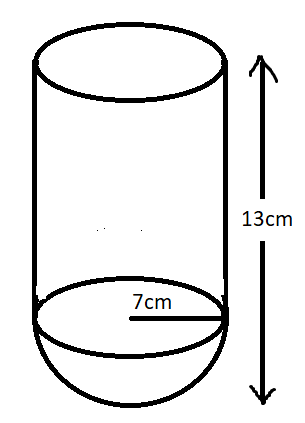
The diameter of the hemispherical bowl = 14 cm
Radius of the hemispherical bowl $=r=\dfrac{14}{2}=7cm$
Total height of the vessel = 13 cm
$\therefore $ Height of the cylinder, h = height of vessel – radius of cylinder.
$h=13cm-7cm=6cm$
Since it is a hollow vessel so the total surface area is the sum of inner and outer surfaces of the vessel.
Total surface area =2 (Curved surface area of the cylinder + curved surface of hemisphere)
As, curved surface area of cylinder = $2\pi rh$.
Curved surface area of hemisphere = $2\pi {{r}^{2}}$.
Total surface area $=2\left( 2\pi rh+2\pi {{r}^{2}} \right)=4\pi r\left( h+r \right)$
Total surface area $=4\times \dfrac{22}{7}\times 7\times \left( 6+7 \right)c{{m}^{2}}=1144c{{m}^{2}}$
Hence, the total surface area of the vessel is $1144c{{m}^{2}}$.
Note: Students must remember that we are given the total height of the vessel in the problem statement. So, to obtain the net height of the hollow cylindrical portion, we must subtract the radius of the hemispherical bowl from total height. The key point to solve this problem is knowledge of the curved surface area of the cylinder and curved surface area of the hemisphere.
Complete step-by-step solution -
The diameter of the hemispherical bowl = 14 cm
Radius of the hemispherical bowl $=r=\dfrac{14}{2}=7cm$
Total height of the vessel = 13 cm
$\therefore $ Height of the cylinder, h = height of vessel – radius of cylinder.
$h=13cm-7cm=6cm$
Since it is a hollow vessel so the total surface area is the sum of inner and outer surfaces of the vessel.
Total surface area =2 (Curved surface area of the cylinder + curved surface of hemisphere)
As, curved surface area of cylinder = $2\pi rh$.
Curved surface area of hemisphere = $2\pi {{r}^{2}}$.
Total surface area $=2\left( 2\pi rh+2\pi {{r}^{2}} \right)=4\pi r\left( h+r \right)$
Total surface area $=4\times \dfrac{22}{7}\times 7\times \left( 6+7 \right)c{{m}^{2}}=1144c{{m}^{2}}$
Hence, the total surface area of the vessel is $1144c{{m}^{2}}$.
Note: Students must remember that we are given the total height of the vessel in the problem statement. So, to obtain the net height of the hollow cylindrical portion, we must subtract the radius of the hemispherical bowl from total height. The key point to solve this problem is knowledge of the curved surface area of the cylinder and curved surface area of the hemisphere.
Recently Updated Pages
Master Class 12 Business Studies: Engaging Questions & Answers for Success

Master Class 12 Biology: Engaging Questions & Answers for Success
Master Class 12 Chemistry: Engaging Questions & Answers for Success
Class 12 Question and Answer - Your Ultimate Solutions Guide
Master Class 11 Social Science: Engaging Questions & Answers for Success
Master Class 11 English: Engaging Questions & Answers for Success
Trending doubts
What is the full form of NDA a National Democratic class 10 social science CBSE
Explain the Treaty of Vienna of 1815 class 10 social science CBSE
Who Won 36 Oscar Awards? Record Holder Revealed
Bharatiya Janata Party was founded in the year A 1979 class 10 social science CBSE
What is the median of the first 10 natural numbers class 10 maths CBSE
Why is it 530 pm in india when it is 1200 afternoon class 10 social science CBSE