




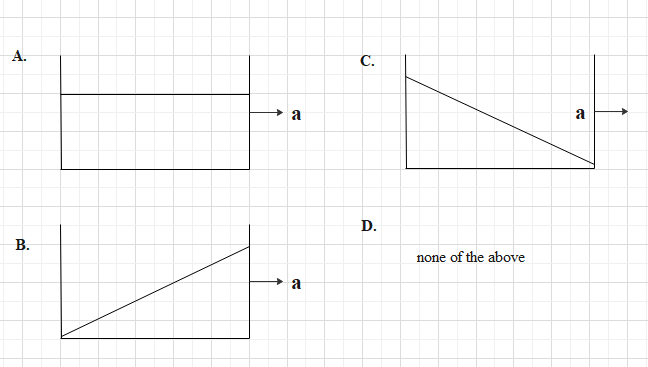
A vessel containing water is given a constant acceleration ‘a’ towards the right along a straight horizontal path. Which of the following diagrams in the figure represents the surface of the liquid?
Answer
 Verified
596.7k+ views
Hint:Define inertial and non-inertial frame. In the inertial frame, we don’t have any external force and in non-inertial frame, we have external force. Since the vessel of water is in a non-inertial frame a pseudo force will act on it. Use this concept to find the direction of the water.
Complete step by step solution:
Let the vessels contain water of mass m. the vessel is accelerated towards the right with an acceleration ‘a’.
The vessel is accelerated towards the right. So, a force is acting on the water towards the right. Since the frame of the vessel is an accelerated frame. A pseudo force will act on the water. This pseudo force will be equal and opposite to the direction of the force on the vessel.
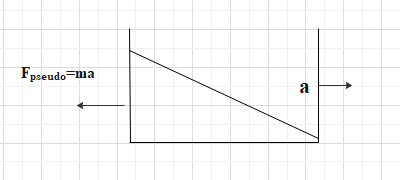
If the force on the vessel is, $F=ma$, then the pseudo force acting on the water will be,
${{F}_{\text{pseudo}}}=ma$ which will act in the opposite direction or towards the left. Due to this force, the water will move backward and due to the presence of the wall of the vessel, the water will rise towards the left.
So, figure c will represent the surface of the liquid.
Note:
1. A body at rest or in motion is in the inertial frame if no external force is acting on it. If any external force acts on a system at rest or in motion, a pseudo force acts on it in the opposite direction of the force, and the magnitude of it will be equal to that of the external force.
2. A pseudo force can be defined as a force that acts on masses that have motion in a non-inertial frame. Any accelerated frame is a non-inertial frame. If the vessel of water is moving with constant velocity, there will be no force on the vessel. Then it will be an inertial frame and the surface of the water will be horizontal.
Complete step by step solution:
Let the vessels contain water of mass m. the vessel is accelerated towards the right with an acceleration ‘a’.
The vessel is accelerated towards the right. So, a force is acting on the water towards the right. Since the frame of the vessel is an accelerated frame. A pseudo force will act on the water. This pseudo force will be equal and opposite to the direction of the force on the vessel.
If the force on the vessel is, $F=ma$, then the pseudo force acting on the water will be,
${{F}_{\text{pseudo}}}=ma$ which will act in the opposite direction or towards the left. Due to this force, the water will move backward and due to the presence of the wall of the vessel, the water will rise towards the left.
So, figure c will represent the surface of the liquid.
Note:
1. A body at rest or in motion is in the inertial frame if no external force is acting on it. If any external force acts on a system at rest or in motion, a pseudo force acts on it in the opposite direction of the force, and the magnitude of it will be equal to that of the external force.
2. A pseudo force can be defined as a force that acts on masses that have motion in a non-inertial frame. Any accelerated frame is a non-inertial frame. If the vessel of water is moving with constant velocity, there will be no force on the vessel. Then it will be an inertial frame and the surface of the water will be horizontal.
Recently Updated Pages
Master Class 11 Computer Science: Engaging Questions & Answers for Success

Master Class 11 Business Studies: Engaging Questions & Answers for Success
Master Class 11 Economics: Engaging Questions & Answers for Success
Master Class 11 English: Engaging Questions & Answers for Success
Master Class 11 Maths: Engaging Questions & Answers for Success
Master Class 11 Biology: Engaging Questions & Answers for Success
Trending doubts
One Metric ton is equal to kg A 10000 B 1000 C 100 class 11 physics CBSE
There are 720 permutations of the digits 1 2 3 4 5 class 11 maths CBSE
Discuss the various forms of bacteria class 11 biology CBSE
Draw a diagram of a plant cell and label at least eight class 11 biology CBSE
State the laws of reflection of light
Explain zero factorial class 11 maths CBSE