




A vertical tower stands on a declivity which is inclined at ${15^ \circ }$ to the horizon. From the foot of the tower, a man ascends the declivity for $80$ feet and then finds that the tower subtends at an angle of ${30^ \circ }$. Find the height of the tower.
Answer
 Verified
564.6k+ views
Hint: One side of the triangle is given that is $80$ feet and the subtended angle form by the tower is ${30^ \circ }$. Since the inclined angle is ${15^ \circ }$, the second angle of a triangle can be found by ${90^ \circ } - {15^ \circ }$, and the third angle is \[{180^ \circ } - (30 + 75)\] .
There are two angles and one side is known.
$\therefore $ apply the sine rule in the triangle. The Sine Rule can be applied in any triangle where one side and its opposite angle are known.
Here, use the Sine formula,
$ \Rightarrow$ $\dfrac{a}{{\operatorname{Sin} A}} = \dfrac{b}{{\operatorname{Sin} B}}$
$ \Rightarrow$ $\dfrac{{80}}{{\operatorname{Sin} {{75}^ \circ }}} = \dfrac{b}{{\operatorname{Sin} {{30}^ \circ }}}$
Here, $b$ is the height of the tower.
Complete answer:
Consider the vertical height of the tower is $AB$. The declivity is the downward slope inclined at ${15^ \circ }$ to the horizon.
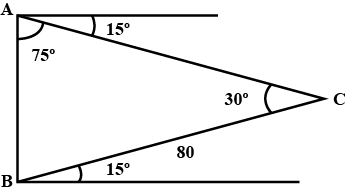
From the above figure the side $BC$ of the triangle $ABC$ is $80$ feet and the tower subtends an angle $C$ is ${30^ \circ }$ .
$\therefore \angle BCA = {30^ \circ }$
Here, vertical pole $AB$ is making ${90^ \circ }$ with the horizon.
Find the angle $\angle ABC$ ,
$ \Rightarrow$ $\angle ABC = {90^ \circ } - {15^ \circ }$
$ \Rightarrow$ $\angle ABC = {75^ \circ }$
The sum of the angles of the triangle is ${180^ \circ }$. In the triangle$ABC$,
$ \Rightarrow$ $\angle A + \angle B + \angle C = {180^ \circ }$
Substitute, $\angle B = {75^ \circ }$,$\angle C = {30^ \circ }$ into the formula and find $\angle A$,
$ \Rightarrow$ $\angle A + {75^ \circ } + {30^ \circ } = {180^ \circ }$
$ \Rightarrow$ $\angle A + {105^ \circ } = {180^ \circ }$
Simplify the equation by subtracting ${105^ \circ }$ from each side of the equation,
$ \Rightarrow$ $\angle A = {180^ \circ } - {105^ \circ }$
$ \Rightarrow$ $\angle A = {75^ \circ }$
Apply the Sine rule of the triangle,
If a, b and c are the sides of the triangle and their corresponding opposite angles are A , B and C then,
$ \Rightarrow$ $\dfrac{a}{{\operatorname{Sin} A}} = \dfrac{b}{{\operatorname{Sin} B}} = \dfrac{c}{{\operatorname{Sin} C}}$
Substitute, $a = {80^ \circ }$, $A = {75^ \circ }$ and $C = {30^ \circ }$ into the Sine Rule,
$ \Rightarrow$ $\dfrac{a}{{\operatorname{Sin} A}} = \dfrac{c}{{\operatorname{Sin} C}}$
$ \Rightarrow$ $\dfrac{{80}}{{\operatorname{Sin} {{75}^ \circ }}} = \dfrac{c}{{\operatorname{Sin} {{30}^ \circ }}}$
Here, $c = AB$ and, it is the height of the tower.
$ \Rightarrow$ $\dfrac{{80}}{{\operatorname{Sin} {{75}^ \circ }}} = \dfrac{c}{{\operatorname{Sin} {{30}^ \circ }}}$
$ \Rightarrow$ $c = \dfrac{{80 \times \operatorname{Sin} {{30}^ \circ }}}{{\operatorname{Sin} {{75}^ \circ }}}$
Write the angle ${75^ \circ }$ as the sum of ${45^ \circ }$ and ${30^ \circ }$.
$ \Rightarrow$ $c = \dfrac{{80 \times \sin {{30}^ \circ }}}{{\sin ({{45}^ \circ } + {{30}^ \circ })}} \ldots (1)$
First solve, $\sin ({45^ \circ } + {30^ \circ })$ by using the trigonometric addition formula of sine ;
$ \Rightarrow$ $\sin (A + B) = \sin A\cos B + \cos A\sin B$
Substitute $A = {45^ \circ }$ and $B = {30^ \circ }$ into the formula,
$ \Rightarrow$ $\sin ({45^ \circ } + {30^ \circ }) = \sin {45^ \circ }\cos {30^ \circ } + \cos {45^ \circ }\sin {30^ \circ }$
Use the trigonometric values, $\sin {45^ \circ } = \dfrac{1}{{\sqrt 2 }}$ , $\cos {30^ \circ } = \dfrac{{\sqrt 3 }}{2}$, $\cos {45^ \circ } = \dfrac{1}{{\sqrt 2 }}$ and $\sin {30^ \circ } = \dfrac{1}{2}$.
$ \Rightarrow$ $\sin ({45^ \circ } + {30^ \circ }) = \dfrac{1}{{\sqrt 2 }} \times \dfrac{{\sqrt 3 }}{2} + \dfrac{1}{{\sqrt 2 }} \times \dfrac{1}{2}$
$ \Rightarrow$ $\sin ({45^ \circ } + {30^ \circ }) = \dfrac{{\sqrt 3 }}{{2\sqrt 2 }} + \dfrac{1}{{2\sqrt 2 }}$
$ \Rightarrow$ $\sin ({45^ \circ } + {30^ \circ }) = \dfrac{{\sqrt 3 + 1}}{{2\sqrt 2 }} \ldots (2)$
Substitute equation $(2)$ into the equation $(1)$ and use $\sin {30^ \circ } = \dfrac{1}{2}$ .
$ \Rightarrow$ $c = \dfrac{{80 \times \dfrac{1}{2}}}{{\dfrac{{\sqrt 3 + 1}}{{2\sqrt 2 }}}}$
Simplify further calculation,
$ \Rightarrow$ $c = \dfrac{{40 \times 2\sqrt 2 }}{{\sqrt 3 + 1}}$
Rationalize the term by multiplying the numerator and denominator of the right hand side by $\sqrt 3 - 1$.
$ \Rightarrow$ $c = \dfrac{{40 \times 2\sqrt 2 }}{{\sqrt 3 + 1}} \times \dfrac{{\sqrt 3 - 1}}{{\sqrt 3 - 1}}$
$ \Rightarrow$ $c = \dfrac{{40 \times 2\sqrt 2 (\sqrt 3 - 1)}}{{(\sqrt 3 + 1) \times (\sqrt 3 - 1)}}$
$ \Rightarrow$ $c = \dfrac{{40 \times 2\sqrt 2 (\sqrt 3 - 1)}}{{3 - 1}}$
$ \Rightarrow$ $c = \dfrac{{40 \times 2\sqrt 2 (\sqrt 3 - 1)}}{2}$
$ \Rightarrow$ $c = 40 \times \sqrt 2 (\sqrt 3 - 1)$
Multiply and simplify the calculation,
$ \Rightarrow$ $c = 40 \times (\sqrt 6 - \sqrt 2 )$
The height of the tower is $40 \times (\sqrt 6 - \sqrt 2 )$feet.
Note:
If It is asked to find the length of a side, you need to use the version of the Sine Rule where the lengths are on the top:
$ \Rightarrow$ $\dfrac{a}{{\operatorname{Sin} A}} = \dfrac{b}{{\operatorname{Sin} B}}$
You will only ever need two parts of the Sine Rule formula, not all three.
If It is asked to find the angle of the triangle, you need to use the version of the Sine Rule where the angles are on the top:
$ \Rightarrow$ $\dfrac{{\operatorname{Sin} A}}{a} = \dfrac{{\operatorname{Sin} B}}{b}$
Here, a is the side opposite to angle A and b is the side opposite to angle B.
There are two angles and one side is known.
$\therefore $ apply the sine rule in the triangle. The Sine Rule can be applied in any triangle where one side and its opposite angle are known.
Here, use the Sine formula,
$ \Rightarrow$ $\dfrac{a}{{\operatorname{Sin} A}} = \dfrac{b}{{\operatorname{Sin} B}}$
$ \Rightarrow$ $\dfrac{{80}}{{\operatorname{Sin} {{75}^ \circ }}} = \dfrac{b}{{\operatorname{Sin} {{30}^ \circ }}}$
Here, $b$ is the height of the tower.
Complete answer:
Consider the vertical height of the tower is $AB$. The declivity is the downward slope inclined at ${15^ \circ }$ to the horizon.
From the above figure the side $BC$ of the triangle $ABC$ is $80$ feet and the tower subtends an angle $C$ is ${30^ \circ }$ .
$\therefore \angle BCA = {30^ \circ }$
Here, vertical pole $AB$ is making ${90^ \circ }$ with the horizon.
Find the angle $\angle ABC$ ,
$ \Rightarrow$ $\angle ABC = {90^ \circ } - {15^ \circ }$
$ \Rightarrow$ $\angle ABC = {75^ \circ }$
The sum of the angles of the triangle is ${180^ \circ }$. In the triangle$ABC$,
$ \Rightarrow$ $\angle A + \angle B + \angle C = {180^ \circ }$
Substitute, $\angle B = {75^ \circ }$,$\angle C = {30^ \circ }$ into the formula and find $\angle A$,
$ \Rightarrow$ $\angle A + {75^ \circ } + {30^ \circ } = {180^ \circ }$
$ \Rightarrow$ $\angle A + {105^ \circ } = {180^ \circ }$
Simplify the equation by subtracting ${105^ \circ }$ from each side of the equation,
$ \Rightarrow$ $\angle A = {180^ \circ } - {105^ \circ }$
$ \Rightarrow$ $\angle A = {75^ \circ }$
Apply the Sine rule of the triangle,
If a, b and c are the sides of the triangle and their corresponding opposite angles are A , B and C then,
$ \Rightarrow$ $\dfrac{a}{{\operatorname{Sin} A}} = \dfrac{b}{{\operatorname{Sin} B}} = \dfrac{c}{{\operatorname{Sin} C}}$
Substitute, $a = {80^ \circ }$, $A = {75^ \circ }$ and $C = {30^ \circ }$ into the Sine Rule,
$ \Rightarrow$ $\dfrac{a}{{\operatorname{Sin} A}} = \dfrac{c}{{\operatorname{Sin} C}}$
$ \Rightarrow$ $\dfrac{{80}}{{\operatorname{Sin} {{75}^ \circ }}} = \dfrac{c}{{\operatorname{Sin} {{30}^ \circ }}}$
Here, $c = AB$ and, it is the height of the tower.
$ \Rightarrow$ $\dfrac{{80}}{{\operatorname{Sin} {{75}^ \circ }}} = \dfrac{c}{{\operatorname{Sin} {{30}^ \circ }}}$
$ \Rightarrow$ $c = \dfrac{{80 \times \operatorname{Sin} {{30}^ \circ }}}{{\operatorname{Sin} {{75}^ \circ }}}$
Write the angle ${75^ \circ }$ as the sum of ${45^ \circ }$ and ${30^ \circ }$.
$ \Rightarrow$ $c = \dfrac{{80 \times \sin {{30}^ \circ }}}{{\sin ({{45}^ \circ } + {{30}^ \circ })}} \ldots (1)$
First solve, $\sin ({45^ \circ } + {30^ \circ })$ by using the trigonometric addition formula of sine ;
$ \Rightarrow$ $\sin (A + B) = \sin A\cos B + \cos A\sin B$
Substitute $A = {45^ \circ }$ and $B = {30^ \circ }$ into the formula,
$ \Rightarrow$ $\sin ({45^ \circ } + {30^ \circ }) = \sin {45^ \circ }\cos {30^ \circ } + \cos {45^ \circ }\sin {30^ \circ }$
Use the trigonometric values, $\sin {45^ \circ } = \dfrac{1}{{\sqrt 2 }}$ , $\cos {30^ \circ } = \dfrac{{\sqrt 3 }}{2}$, $\cos {45^ \circ } = \dfrac{1}{{\sqrt 2 }}$ and $\sin {30^ \circ } = \dfrac{1}{2}$.
$ \Rightarrow$ $\sin ({45^ \circ } + {30^ \circ }) = \dfrac{1}{{\sqrt 2 }} \times \dfrac{{\sqrt 3 }}{2} + \dfrac{1}{{\sqrt 2 }} \times \dfrac{1}{2}$
$ \Rightarrow$ $\sin ({45^ \circ } + {30^ \circ }) = \dfrac{{\sqrt 3 }}{{2\sqrt 2 }} + \dfrac{1}{{2\sqrt 2 }}$
$ \Rightarrow$ $\sin ({45^ \circ } + {30^ \circ }) = \dfrac{{\sqrt 3 + 1}}{{2\sqrt 2 }} \ldots (2)$
Substitute equation $(2)$ into the equation $(1)$ and use $\sin {30^ \circ } = \dfrac{1}{2}$ .
$ \Rightarrow$ $c = \dfrac{{80 \times \dfrac{1}{2}}}{{\dfrac{{\sqrt 3 + 1}}{{2\sqrt 2 }}}}$
Simplify further calculation,
$ \Rightarrow$ $c = \dfrac{{40 \times 2\sqrt 2 }}{{\sqrt 3 + 1}}$
Rationalize the term by multiplying the numerator and denominator of the right hand side by $\sqrt 3 - 1$.
$ \Rightarrow$ $c = \dfrac{{40 \times 2\sqrt 2 }}{{\sqrt 3 + 1}} \times \dfrac{{\sqrt 3 - 1}}{{\sqrt 3 - 1}}$
$ \Rightarrow$ $c = \dfrac{{40 \times 2\sqrt 2 (\sqrt 3 - 1)}}{{(\sqrt 3 + 1) \times (\sqrt 3 - 1)}}$
$ \Rightarrow$ $c = \dfrac{{40 \times 2\sqrt 2 (\sqrt 3 - 1)}}{{3 - 1}}$
$ \Rightarrow$ $c = \dfrac{{40 \times 2\sqrt 2 (\sqrt 3 - 1)}}{2}$
$ \Rightarrow$ $c = 40 \times \sqrt 2 (\sqrt 3 - 1)$
Multiply and simplify the calculation,
$ \Rightarrow$ $c = 40 \times (\sqrt 6 - \sqrt 2 )$
The height of the tower is $40 \times (\sqrt 6 - \sqrt 2 )$feet.
Note:
If It is asked to find the length of a side, you need to use the version of the Sine Rule where the lengths are on the top:
$ \Rightarrow$ $\dfrac{a}{{\operatorname{Sin} A}} = \dfrac{b}{{\operatorname{Sin} B}}$
You will only ever need two parts of the Sine Rule formula, not all three.
If It is asked to find the angle of the triangle, you need to use the version of the Sine Rule where the angles are on the top:
$ \Rightarrow$ $\dfrac{{\operatorname{Sin} A}}{a} = \dfrac{{\operatorname{Sin} B}}{b}$
Here, a is the side opposite to angle A and b is the side opposite to angle B.
Recently Updated Pages
Master Class 11 Computer Science: Engaging Questions & Answers for Success

Master Class 11 Business Studies: Engaging Questions & Answers for Success
Master Class 11 Economics: Engaging Questions & Answers for Success
Master Class 11 English: Engaging Questions & Answers for Success
Master Class 11 Maths: Engaging Questions & Answers for Success
Master Class 11 Biology: Engaging Questions & Answers for Success
Trending doubts
One Metric ton is equal to kg A 10000 B 1000 C 100 class 11 physics CBSE
There are 720 permutations of the digits 1 2 3 4 5 class 11 maths CBSE
Discuss the various forms of bacteria class 11 biology CBSE
Draw a diagram of a plant cell and label at least eight class 11 biology CBSE
State the laws of reflection of light
Explain zero factorial class 11 maths CBSE