




A vertical pole has a red mark at some height. A stone is projected from a fixed point on the ground. When projected at an angle of \[45^\circ \] it hits the pole orthogonally \[1{\rm{ m}}\] above the mark. When projected with a different velocity at an angle of \[{\tan ^{ - 1}}\left( {{3 {\left/{\vphantom {3 4}} \right.} 4}} \right)\], it hits the pole orthogonally \[1.5{\rm{ m}}\] below the mark. Find the velocity and angle of projection so that it hits the mark orthogonally to the pole. \[\left[ {g = 10{{\rm{m}} {\left/{\vphantom {{\rm{m}} {{\rm{se}}{{\rm{c}}^2}}}} \right.} {{\rm{se}}{{\rm{c}}^2}}}} \right]\]
Answer
 Verified
604.2k+ views
Hint:It is said that the stone hits the pole orthogonally, which means that stone is at the maximum point of the trajectory. We will be using the relationship of range and maximum height which gives the relation in the form of the angle of projection, velocity and acceleration due to gravity.
Complete step by step answer:
Let H be the height of the red mark on the pole from the ground.
Given:
The angle at which stone is thrown the first time is \[{\theta _1} = 45^\circ \].
The angle at which stone is thrown the second time is \[{\theta _2} = {\tan ^{ - 1}}\left( {\dfrac{3}{4}} \right) = 36.87^\circ \].
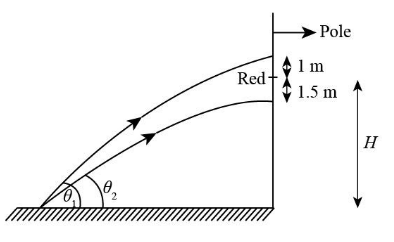
It is given that when a stone is projected at an angle of \[45^\circ \] it hits the pole orthogonally \[1{\rm{ m}}\] above the mark so we can say that the maximum height of the stone is \[\left( {H + 1} \right)\] which is equal to:
\[H + 1 = \dfrac{{u_1^2{{\sin }^2}{\theta _1}}}{{2g}}\]……(1)
Here \[{u_1}\] is the velocity of the stone when projected with angle \[{\theta _1}\].
Substitute \[45^\circ \] for \[{\theta _1}\] in equation (1).
\[
H + 1 = \dfrac{{u_1^2{{\sin }^2}\left( {45^\circ } \right)}}{{2g}}\\
\Rightarrow H + 1 = \dfrac{{u_1^2}}{{4g}}
\]……(2)
The expression for range when stone is thrown at angle \[{\theta _1}\].
\[R = \dfrac{{u_1^2\sin 2{\theta _1}}}{g}\]……(3)
Substitute \[45^\circ \] for \[{\theta _1}\] in equation (3).
\[
R = \dfrac{{u_1^2\sin 2\left( {45^\circ } \right)}}{g}\\
\Rightarrow R = \dfrac{{u_1^2}}{g}
\]……..(4)
From equation (2) and equation (4), we can write:
\[4\left( {H + 1} \right) = R\]……(5)
When the stone is projected at an angle of \[36.87^\circ \] it hits the pole orthogonally \[1.5{\rm{ m}}\] below the mark so we can say that the maximum height of the stone is \[\left( {H - 1.5} \right)\] which is equal to:
\[H - 1.5 = \dfrac{{u_2^2{{\sin }^2}{\theta _2}}}{{2g}}\]……(6)
Here \[{u_2}\] is the velocity of the stone when projected with angle \[{\theta _2}\].
Substitute \[36.87^\circ \] for \[{\theta _2}\] in equation (6).
\[
H - 1.5 = \dfrac{{u_2^2{{\sin }^2}\left( {36.87^\circ } \right)}}{{2g}}\\
\Rightarrow H - 1.5 = 0.18\left( {\dfrac{{u_2^2}}{g}} \right)
\]……(7)
The expression for range when the stone is thrown at an angle \[{\theta _2}\].
\[R = \dfrac{{u_1^2\sin 2{\theta _2}}}{g}\]……(8)
Substitute \[36.87^\circ \] for \[{\theta _2}\] in equation (8).
\[
R = \dfrac{{u_2^2\sin 2\left( {36.87^\circ } \right)}}{g}\\
\Rightarrow R = 0.96\left( {\dfrac{{u_2^2}}{g}} \right)
\]……(9)
From equation (7) and equation (9), we can write:
\[5.33\left( {H - 1.5} \right) = R\]……(10)
Substitute \[4\left( {H + 1} \right)\] for R from equation (5) in equation (10).
\[
5.33\left( {H - 1.5} \right) = 4\left( {H + 1} \right)\\
\Rightarrow 5..33H - 4H = 4 + 7.995\\
\Rightarrow H = 9{\rm{ m}}
\]
Substitute \[9{\rm{ m}}\] for H in equation (5).
\[
R = 4\left( {9 + 1} \right)\\
\Rightarrow R = 40{\rm{ m}}
\]
Write the expression for maximum height when the stone is thrown at an angle \[\theta \] so that it hits the red mark.
\[H = \dfrac{{{u^2}{{\sin }^2}\theta }}{{2g}}\]
Substitute \[9{\rm{ m}}\] for R in the above equation.
\[
9{\rm{ m}} = \dfrac{{{u^2}{{\sin }^2}\theta }}{{2g}}\\
\Rightarrow 9{\rm{ m}} = \dfrac{{{u^2}\sin \theta \sin \theta }}{g}\]……(11)
Write the expression for range when the stone is thrown at an angle \[\theta \] so that it hits the red mark.
\[R = \dfrac{{{u^2}\sin 2\theta }}{g}\]
Substitute \[40{\rm{ m}}\] for R in the above expression.
\[
40{\rm{ m}} = \dfrac{{{u^2}\sin 2\theta }}{g}\\
\Rightarrow 20{\rm{ m}} = \dfrac{{{u^2}\sin \theta \cos \theta }}{g}
\]……(12)
From equation (11) and equation (12), we can write:
\[
\tan \theta = \dfrac{{18}}{{20}}\\
\Rightarrow\theta = 41.98^\circ
\]
Substitute \[41.98^\circ \] for \[\theta \] and \[10{{\rm{m}} {\left/
{\vphantom {{\rm{m}} {{\rm{se}}{{\rm{c}}^2}}}} \right.
} {{\rm{se}}{{\rm{c}}^2}}}\] for g in equation (12)
\[
20{\rm{ m}} = \dfrac{{{u^2}\sin \left( {41.98^\circ } \right)\cos \left( {41.98^\circ } \right)}}{{10{{\rm{m}} {\left/
{\vphantom {{\rm{m}} {{\rm{se}}{{\rm{c}}^2}}}} \right.
} {{\rm{se}}{{\rm{c}}^2}}}}}\\
\Rightarrow {u^2} = 402.22{\rm{ }}{{{{\rm{m}}^2}} {\left/
{\vphantom {{{{\rm{m}}^2}} {{\rm{se}}{{\rm{c}}^2}}}} \right.
} {{\rm{se}}{{\rm{c}}^2}}}\\
\therefore u = 20.05{{{\rm{ m}}} {\left/
{\vphantom {{{\rm{ m}}} {{\rm{sec}}}}} \right.
} {{\rm{sec}}}}
\]
Therefore, we can say that \[41.98^\circ \] is the angle of projection and \[20.05{{{\rm{ m}}} {\left/{\vphantom {{{\rm{ m}}} {{\rm{sec}}}}} \right.} {{\rm{sec}}}}\] velocity required by the stone to hit the red mark.
Note: Understand the given statement carefully and draw a diagram for it so that there will be no confusion regarding various mark points. Also, it would be an advantage if we remember various relations of projectile motion, especially range and maximum height.
Complete step by step answer:
Let H be the height of the red mark on the pole from the ground.
Given:
The angle at which stone is thrown the first time is \[{\theta _1} = 45^\circ \].
The angle at which stone is thrown the second time is \[{\theta _2} = {\tan ^{ - 1}}\left( {\dfrac{3}{4}} \right) = 36.87^\circ \].
It is given that when a stone is projected at an angle of \[45^\circ \] it hits the pole orthogonally \[1{\rm{ m}}\] above the mark so we can say that the maximum height of the stone is \[\left( {H + 1} \right)\] which is equal to:
\[H + 1 = \dfrac{{u_1^2{{\sin }^2}{\theta _1}}}{{2g}}\]……(1)
Here \[{u_1}\] is the velocity of the stone when projected with angle \[{\theta _1}\].
Substitute \[45^\circ \] for \[{\theta _1}\] in equation (1).
\[
H + 1 = \dfrac{{u_1^2{{\sin }^2}\left( {45^\circ } \right)}}{{2g}}\\
\Rightarrow H + 1 = \dfrac{{u_1^2}}{{4g}}
\]……(2)
The expression for range when stone is thrown at angle \[{\theta _1}\].
\[R = \dfrac{{u_1^2\sin 2{\theta _1}}}{g}\]……(3)
Substitute \[45^\circ \] for \[{\theta _1}\] in equation (3).
\[
R = \dfrac{{u_1^2\sin 2\left( {45^\circ } \right)}}{g}\\
\Rightarrow R = \dfrac{{u_1^2}}{g}
\]……..(4)
From equation (2) and equation (4), we can write:
\[4\left( {H + 1} \right) = R\]……(5)
When the stone is projected at an angle of \[36.87^\circ \] it hits the pole orthogonally \[1.5{\rm{ m}}\] below the mark so we can say that the maximum height of the stone is \[\left( {H - 1.5} \right)\] which is equal to:
\[H - 1.5 = \dfrac{{u_2^2{{\sin }^2}{\theta _2}}}{{2g}}\]……(6)
Here \[{u_2}\] is the velocity of the stone when projected with angle \[{\theta _2}\].
Substitute \[36.87^\circ \] for \[{\theta _2}\] in equation (6).
\[
H - 1.5 = \dfrac{{u_2^2{{\sin }^2}\left( {36.87^\circ } \right)}}{{2g}}\\
\Rightarrow H - 1.5 = 0.18\left( {\dfrac{{u_2^2}}{g}} \right)
\]……(7)
The expression for range when the stone is thrown at an angle \[{\theta _2}\].
\[R = \dfrac{{u_1^2\sin 2{\theta _2}}}{g}\]……(8)
Substitute \[36.87^\circ \] for \[{\theta _2}\] in equation (8).
\[
R = \dfrac{{u_2^2\sin 2\left( {36.87^\circ } \right)}}{g}\\
\Rightarrow R = 0.96\left( {\dfrac{{u_2^2}}{g}} \right)
\]……(9)
From equation (7) and equation (9), we can write:
\[5.33\left( {H - 1.5} \right) = R\]……(10)
Substitute \[4\left( {H + 1} \right)\] for R from equation (5) in equation (10).
\[
5.33\left( {H - 1.5} \right) = 4\left( {H + 1} \right)\\
\Rightarrow 5..33H - 4H = 4 + 7.995\\
\Rightarrow H = 9{\rm{ m}}
\]
Substitute \[9{\rm{ m}}\] for H in equation (5).
\[
R = 4\left( {9 + 1} \right)\\
\Rightarrow R = 40{\rm{ m}}
\]
Write the expression for maximum height when the stone is thrown at an angle \[\theta \] so that it hits the red mark.
\[H = \dfrac{{{u^2}{{\sin }^2}\theta }}{{2g}}\]
Substitute \[9{\rm{ m}}\] for R in the above equation.
\[
9{\rm{ m}} = \dfrac{{{u^2}{{\sin }^2}\theta }}{{2g}}\\
\Rightarrow 9{\rm{ m}} = \dfrac{{{u^2}\sin \theta \sin \theta }}{g}\]……(11)
Write the expression for range when the stone is thrown at an angle \[\theta \] so that it hits the red mark.
\[R = \dfrac{{{u^2}\sin 2\theta }}{g}\]
Substitute \[40{\rm{ m}}\] for R in the above expression.
\[
40{\rm{ m}} = \dfrac{{{u^2}\sin 2\theta }}{g}\\
\Rightarrow 20{\rm{ m}} = \dfrac{{{u^2}\sin \theta \cos \theta }}{g}
\]……(12)
From equation (11) and equation (12), we can write:
\[
\tan \theta = \dfrac{{18}}{{20}}\\
\Rightarrow\theta = 41.98^\circ
\]
Substitute \[41.98^\circ \] for \[\theta \] and \[10{{\rm{m}} {\left/
{\vphantom {{\rm{m}} {{\rm{se}}{{\rm{c}}^2}}}} \right.
} {{\rm{se}}{{\rm{c}}^2}}}\] for g in equation (12)
\[
20{\rm{ m}} = \dfrac{{{u^2}\sin \left( {41.98^\circ } \right)\cos \left( {41.98^\circ } \right)}}{{10{{\rm{m}} {\left/
{\vphantom {{\rm{m}} {{\rm{se}}{{\rm{c}}^2}}}} \right.
} {{\rm{se}}{{\rm{c}}^2}}}}}\\
\Rightarrow {u^2} = 402.22{\rm{ }}{{{{\rm{m}}^2}} {\left/
{\vphantom {{{{\rm{m}}^2}} {{\rm{se}}{{\rm{c}}^2}}}} \right.
} {{\rm{se}}{{\rm{c}}^2}}}\\
\therefore u = 20.05{{{\rm{ m}}} {\left/
{\vphantom {{{\rm{ m}}} {{\rm{sec}}}}} \right.
} {{\rm{sec}}}}
\]
Therefore, we can say that \[41.98^\circ \] is the angle of projection and \[20.05{{{\rm{ m}}} {\left/{\vphantom {{{\rm{ m}}} {{\rm{sec}}}}} \right.} {{\rm{sec}}}}\] velocity required by the stone to hit the red mark.
Note: Understand the given statement carefully and draw a diagram for it so that there will be no confusion regarding various mark points. Also, it would be an advantage if we remember various relations of projectile motion, especially range and maximum height.
Recently Updated Pages
Master Class 9 General Knowledge: Engaging Questions & Answers for Success

Master Class 9 Maths: Engaging Questions & Answers for Success
Master Class 9 Science: Engaging Questions & Answers for Success
Master Class 9 English: Engaging Questions & Answers for Success
Master Class 9 Social Science: Engaging Questions & Answers for Success
Class 9 Question and Answer - Your Ultimate Solutions Guide
Trending doubts
One Metric ton is equal to kg A 10000 B 1000 C 100 class 11 physics CBSE
Difference Between Prokaryotic Cells and Eukaryotic Cells
Two of the body parts which do not appear in MRI are class 11 biology CBSE
1 ton equals to A 100 kg B 1000 kg C 10 kg D 10000 class 11 physics CBSE
10 examples of friction in our daily life
Name the Largest and the Smallest Cell in the Human Body ?