




A vertical lamp post of height 9 meters stands at the corner of a rectangular field. The angle of evolution of its top from the farthest corner is \[{30^ \circ }\], which from another corner it is \[{45^ \circ }\], the area of the field is
\[\begin{array}{l}A.9\sqrt 2 {\rm{ mete}}{{\rm{r}}^{\rm{2}}}\\B.81\sqrt 3 {\rm{ mete}}{{\rm{r}}^{\rm{2}}}\\C.81\sqrt 2 {\rm{ mete}}{{\rm{r}}^{\rm{2}}}\\D.9\sqrt 3 {\rm{ mete}}{{\rm{r}}^{\rm{2}}}\end{array}\]
Answer
 Verified
658.2k+ views
Hint: First of all, we will draw the diagram and then, by using the trigonometric ratios, we will find the side of a rectangle, we will be using the tangent ratio which is the ratio of perpendicular to base. Value of \[\tan \theta \]at standard angles such as \[\tan {30^ \circ } = \dfrac{1}{{\sqrt 3 }}{\rm{ and }}\,{\rm{tan4}}{{\rm{5}}^ \circ }{\rm{ = 1}}\] must be known and used in the solution and we will use the formula of area of rectangle, which is equal to the product of length and breadth of a rectangle.
Complete step-by-step answer:
We have been given that, a lamp post of height 9 meters stands at the corner of a rectangular field. Also, the angle of elevation of its top from farthest corner is \[{30^ \circ }\] while from another corner is \[{45^ \circ }\]
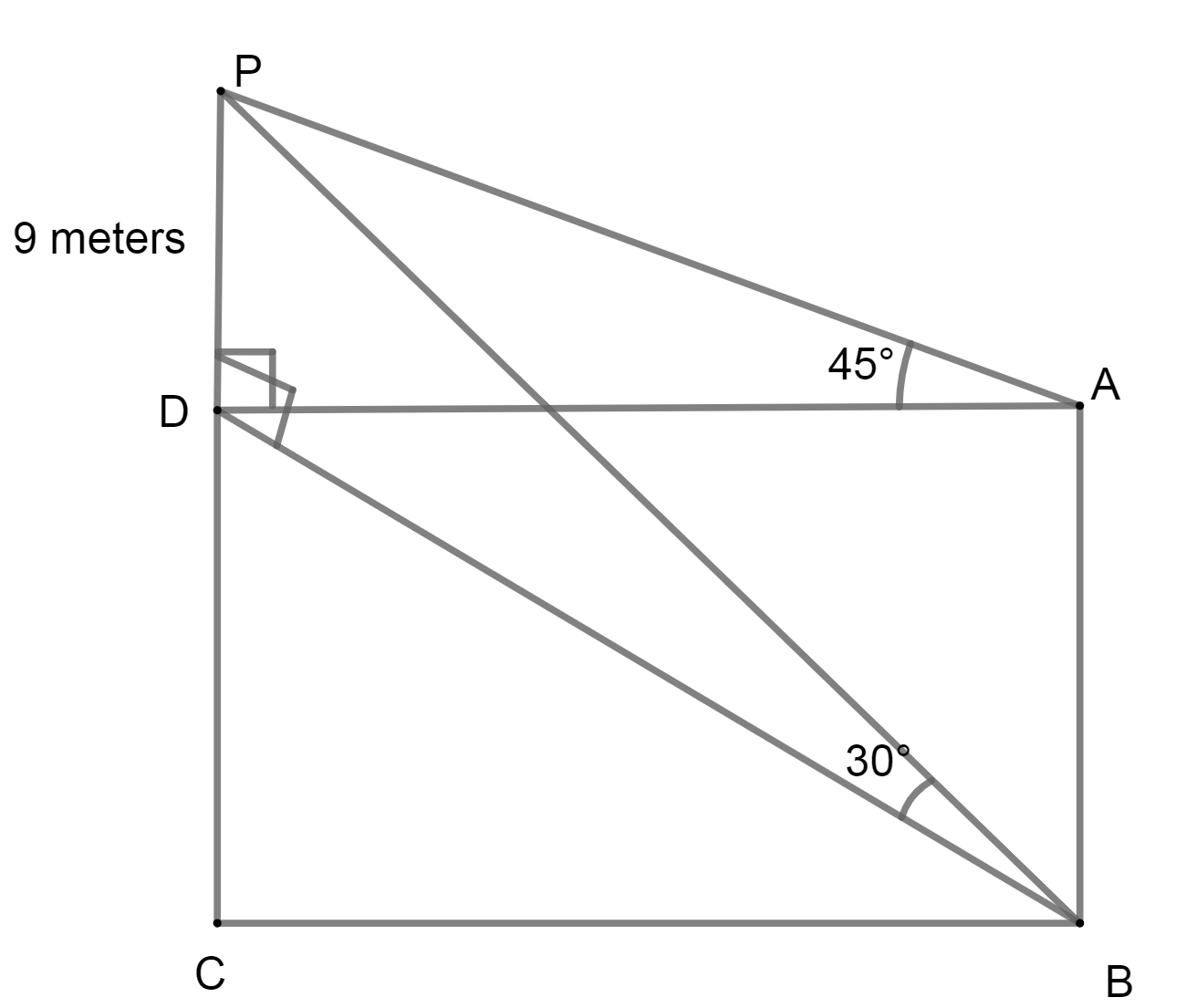
We have PD= 9 meters
Now, in \[\Delta AOP\],
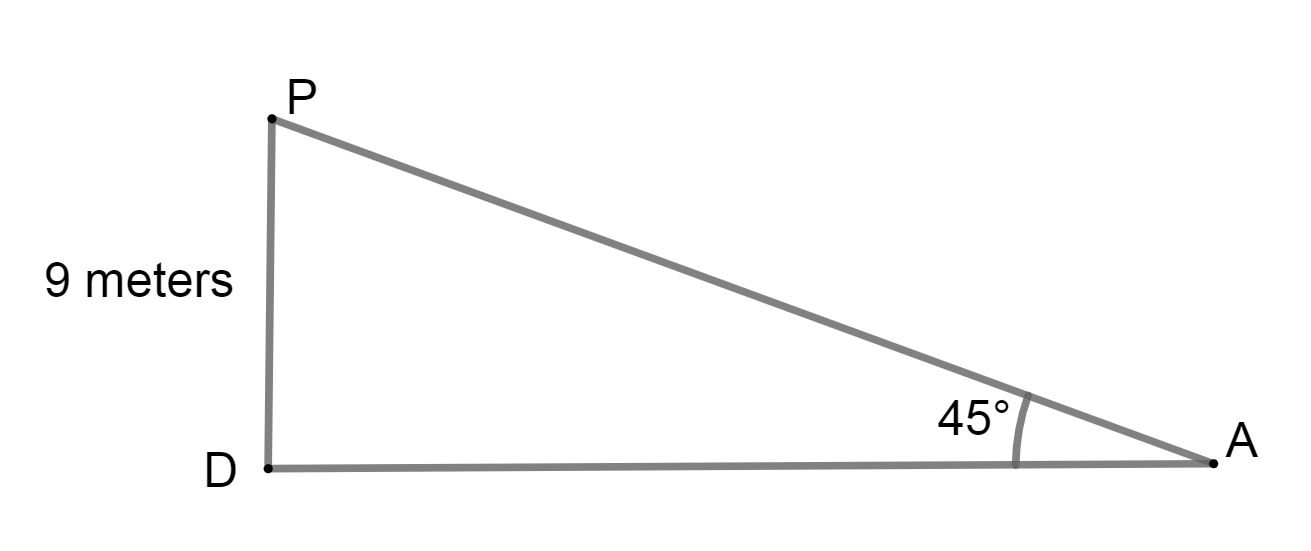
\[\begin{array}{l}\tan A = \dfrac{{PD}}{{AD}}\\ \Rightarrow \tan {45^ \circ } = \dfrac{9}{{AD}}\end{array}\]
We know that, \[\tan {45^ \circ } = 1\]
\[\begin{array}{l} \Rightarrow 1 = \dfrac{9}{{AD}}\\ \Rightarrow AD = 9{\rm{ meter}}\end{array}\]
Again, in\[\Delta PDB\],
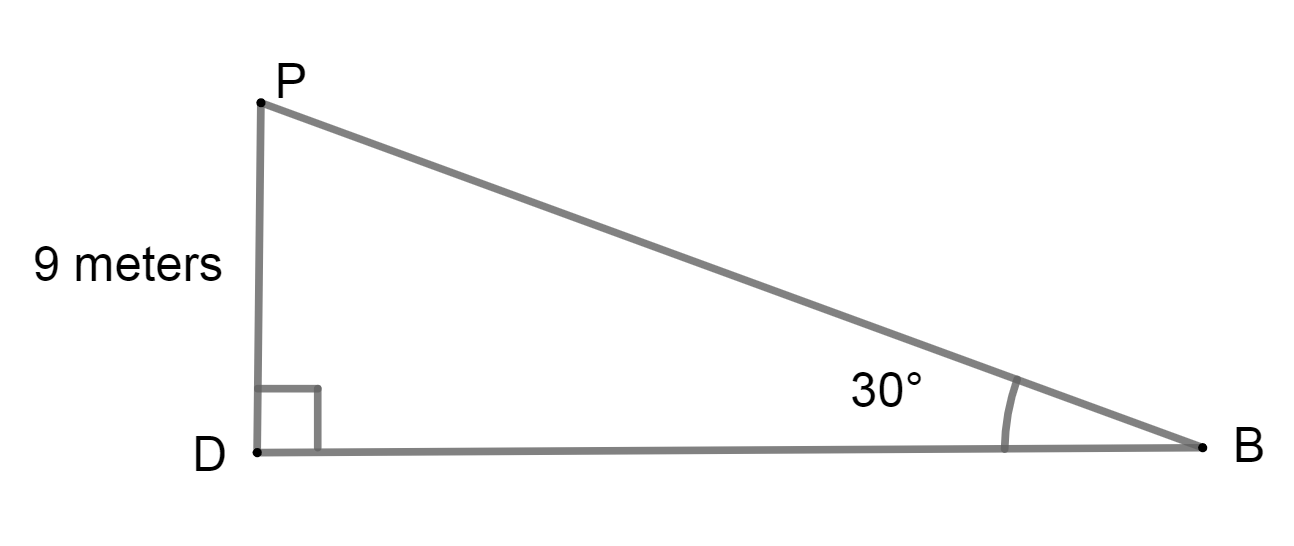
\[\begin{array}{l}\tan B = \dfrac{{PD}}{{BD}}\\ \Rightarrow \tan {30^ \circ } = \dfrac{9}{{BD}}\end{array}\]
We know that, \[\tan {30^ \circ } = \dfrac{1}{{\sqrt 3 }}\]
\[\begin{array}{l} \Rightarrow \dfrac{1}{{\sqrt 3 }} = \dfrac{9}{{BD}}\\ \Rightarrow BD = 9\sqrt 3 {\rm{ meter}}\end{array}\]
Now, 2n right angled triangle i.e. \[\Delta DAB\] by using Pythagoras theorem, we get
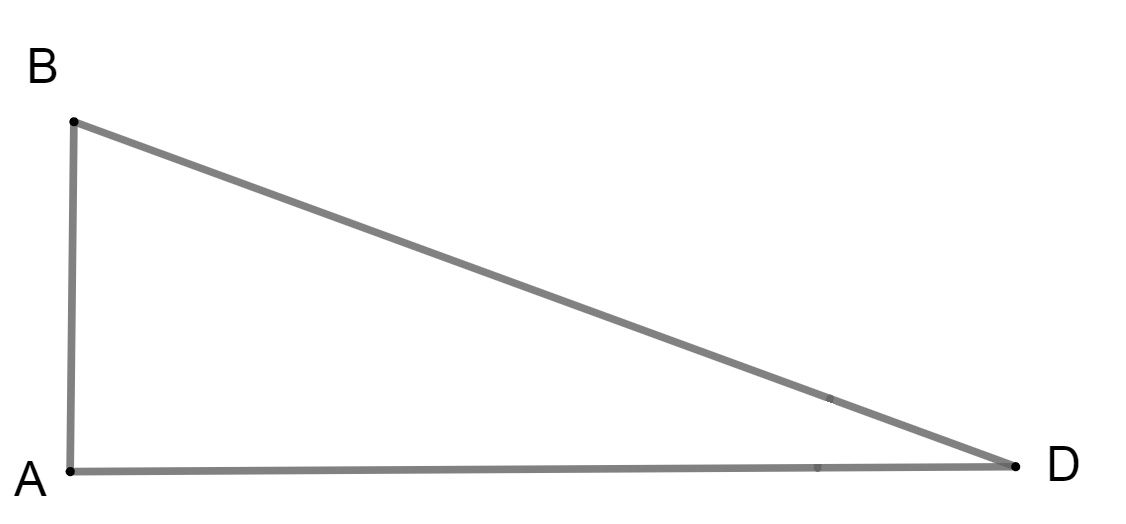
\[\begin{array}{l}A{B^2} + A{D^2} = B{D^2}\\A{B^2} + {9^2} = {\left( {9\sqrt 3 } \right)^2}\\A{B^2} + 81 = 243\\A{B^2} = 243 - 81\\A{B^2} = 162\\AB = \sqrt {162} \\AB = 9\sqrt 2 {\rm{ meter}}\end{array}\]
We know that, area of a rectangle is equal to the product of its length and breadth.
We have length = AD = 9 meter and
Breadth = AB = \[9\sqrt 2 {\rm{ meter}}\]
So,
\[\begin{array}{l}Area = AD \times AB\\ \Rightarrow 9 \times 9\sqrt 2 {\rm{ }}{{\rm{m}}^2}\\ \Rightarrow 81\sqrt 2 {\rm{ }}{{\rm{m}}^2}\end{array}\]
Therefore, the correct option is C.
Note: It is very important to draw the diagram in height and distance problem as it becomes easy to visualize the things, which helps us to proceed further in the question. In this question, we might take \[{\rm{tan3}}{0^ \circ }\] as \[\sqrt 3 \] and get different answers. We have to find the sides of the rectangle, so we can use any technique to obtain the length. We must try to figure out how to proceed and then start calculating, this saves time and efforts too.
Complete step-by-step answer:
We have been given that, a lamp post of height 9 meters stands at the corner of a rectangular field. Also, the angle of elevation of its top from farthest corner is \[{30^ \circ }\] while from another corner is \[{45^ \circ }\]
We have PD= 9 meters
Now, in \[\Delta AOP\],
\[\begin{array}{l}\tan A = \dfrac{{PD}}{{AD}}\\ \Rightarrow \tan {45^ \circ } = \dfrac{9}{{AD}}\end{array}\]
We know that, \[\tan {45^ \circ } = 1\]
\[\begin{array}{l} \Rightarrow 1 = \dfrac{9}{{AD}}\\ \Rightarrow AD = 9{\rm{ meter}}\end{array}\]
Again, in\[\Delta PDB\],
\[\begin{array}{l}\tan B = \dfrac{{PD}}{{BD}}\\ \Rightarrow \tan {30^ \circ } = \dfrac{9}{{BD}}\end{array}\]
We know that, \[\tan {30^ \circ } = \dfrac{1}{{\sqrt 3 }}\]
\[\begin{array}{l} \Rightarrow \dfrac{1}{{\sqrt 3 }} = \dfrac{9}{{BD}}\\ \Rightarrow BD = 9\sqrt 3 {\rm{ meter}}\end{array}\]
Now, 2n right angled triangle i.e. \[\Delta DAB\] by using Pythagoras theorem, we get
\[\begin{array}{l}A{B^2} + A{D^2} = B{D^2}\\A{B^2} + {9^2} = {\left( {9\sqrt 3 } \right)^2}\\A{B^2} + 81 = 243\\A{B^2} = 243 - 81\\A{B^2} = 162\\AB = \sqrt {162} \\AB = 9\sqrt 2 {\rm{ meter}}\end{array}\]
We know that, area of a rectangle is equal to the product of its length and breadth.
We have length = AD = 9 meter and
Breadth = AB = \[9\sqrt 2 {\rm{ meter}}\]
So,
\[\begin{array}{l}Area = AD \times AB\\ \Rightarrow 9 \times 9\sqrt 2 {\rm{ }}{{\rm{m}}^2}\\ \Rightarrow 81\sqrt 2 {\rm{ }}{{\rm{m}}^2}\end{array}\]
Therefore, the correct option is C.
Note: It is very important to draw the diagram in height and distance problem as it becomes easy to visualize the things, which helps us to proceed further in the question. In this question, we might take \[{\rm{tan3}}{0^ \circ }\] as \[\sqrt 3 \] and get different answers. We have to find the sides of the rectangle, so we can use any technique to obtain the length. We must try to figure out how to proceed and then start calculating, this saves time and efforts too.
Recently Updated Pages
Which will be the least stable resonating structure class 11 chemistry CBSE

How many 5 digit telephone numbers can be construc-class-11-maths-CBSE
How do you find the angle of the resultant vector class 11 physics CBSE
Draw labelled diagram of the following i Gram seed class 11 biology CBSE
1 Quintal is equal to a 110 kg b 10 kg c 100kg d 1000 class 11 physics CBSE
What is the need and importance of classification class 11 biology CBSE
Trending doubts
One Metric ton is equal to kg A 10000 B 1000 C 100 class 11 physics CBSE
Find the value of the expression given below sin 30circ class 11 maths CBSE
Draw a diagram of nephron and explain its structur class 11 biology CBSE
10 examples of friction in our daily life
Proton was discovered by A Thomson B Rutherford C Chadwick class 11 chemistry CBSE
The teeth used for biting and cutting food are called class 11 biology CBSE