




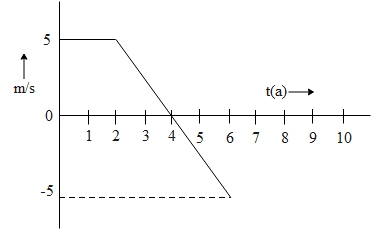
A velocity-time graph for a moving object is shown below. What will be the total displacement during time t =0 to t = 6s
a) 10m
b) 20m
c) 15m
d) 0.0m
Answer
 Verified
602.4k+ views
Hint: The displacement of the body is nothing but the change in position with respect to time. In the above graph we see the variation of the velocity of a body with respect to time. Hence taking the sum of the area under the above line graph will enable us to select the correct alternatives from those provided.
Formula used:
$d=v\times t$
Complete answer:
Let us say there is a body moving with a constant velocity ‘v’. If the body gets displaced by ‘d’ in a interval of time ‘t’, than the relation of the above parameters of motion is given by,
$d=v\times t$
More specifically if the graph of variation of velocity with time is given, then the area under the curve of the graph will give us the net displacement of the body. This is because the area under the graph is the variation of y parameter i.e. velocity and the x parameter i.e. time which is nothing but the displacement of the body. In this case it is not necessary that the body moves with constant velocity.
From the above graph, the body moves with constant velocity i.e. from the time interval of ${{t}_{0}}=0$ to ${{t}_{2}}=2s$ seconds. Hence the displacement (d)of the body i.e. area under the curve is,
$\begin{align}
& d=v\left( {{t}_{2}}-{{t}_{0}} \right) \\
& \Rightarrow d=5m{{s}^{-1}}\left( 2s-0s \right) \\
& \therefore d=10m \\
\end{align}$
Further from the time interval of two seconds to four seconds, the body gets displaced which is equal to the area of the triangle whose height is $5m{{s}^{-1}}$ and base is 2 sec. Similarly as the body moves further from the time interval of 4 seconds to 6 seconds the body gets displaced which is also equal to the area of the triangle whose height is $-5m{{s}^{-1}}$ and base is 2 sec. The displacement of the body from a time interval of 4 seconds to 6 seconds is negative with respect to that of from two seconds to four seconds. Hence the net displacement between the time interval of 2s to 6s will be zero.
Therefore the total displacement of the body will be 10m.
Hence the correct answer of the above question is option a.
Note:
It is very obvious that the area under the curve of the velocity-time graph for a body moving with constant velocity will give the displacement. But when the body changes its velocity, we can break the time interval into small parts such that the velocity is constant and integrate for the total time interval. As the result of this is just the area under the curve, the above result also is valid when the velocity changes.
Formula used:
$d=v\times t$
Complete answer:
Let us say there is a body moving with a constant velocity ‘v’. If the body gets displaced by ‘d’ in a interval of time ‘t’, than the relation of the above parameters of motion is given by,
$d=v\times t$
More specifically if the graph of variation of velocity with time is given, then the area under the curve of the graph will give us the net displacement of the body. This is because the area under the graph is the variation of y parameter i.e. velocity and the x parameter i.e. time which is nothing but the displacement of the body. In this case it is not necessary that the body moves with constant velocity.
From the above graph, the body moves with constant velocity i.e. from the time interval of ${{t}_{0}}=0$ to ${{t}_{2}}=2s$ seconds. Hence the displacement (d)of the body i.e. area under the curve is,
$\begin{align}
& d=v\left( {{t}_{2}}-{{t}_{0}} \right) \\
& \Rightarrow d=5m{{s}^{-1}}\left( 2s-0s \right) \\
& \therefore d=10m \\
\end{align}$
Further from the time interval of two seconds to four seconds, the body gets displaced which is equal to the area of the triangle whose height is $5m{{s}^{-1}}$ and base is 2 sec. Similarly as the body moves further from the time interval of 4 seconds to 6 seconds the body gets displaced which is also equal to the area of the triangle whose height is $-5m{{s}^{-1}}$ and base is 2 sec. The displacement of the body from a time interval of 4 seconds to 6 seconds is negative with respect to that of from two seconds to four seconds. Hence the net displacement between the time interval of 2s to 6s will be zero.
Therefore the total displacement of the body will be 10m.
Hence the correct answer of the above question is option a.
Note:
It is very obvious that the area under the curve of the velocity-time graph for a body moving with constant velocity will give the displacement. But when the body changes its velocity, we can break the time interval into small parts such that the velocity is constant and integrate for the total time interval. As the result of this is just the area under the curve, the above result also is valid when the velocity changes.
Recently Updated Pages
Write any three differences between metals and nonmetals class 10 social science CBSE

Amit standing on a horizontal plane finds a bird flying class 10 maths CBSE
Two circles of radii 5 cm and 3 cm intersect at two class 10 maths CBSE
Solve the following i John and Jivanti together have class 10 maths CBSE
What is the relation between orthocenter circumcentre class 10 maths CBSE
Two plane mirrors are inclined at 70circ A ray incident class 10 physics CBSE
Trending doubts
Explain the Treaty of Vienna of 1815 class 10 social science CBSE
Which country is known as "The land of Fire and Ice"?
1 GB equals how many MB?
10 examples of evaporation in daily life with explanations
What is the full form of POSCO class 10 social science CBSE
Make a sketch of the human nerve cell What function class 10 biology CBSE