




A vehicle moving on a straight road sounds a whistle of frequency 256 Hz while nearing a hill with a velocity 10m/s. The number of beats per second observed by a person travelling in the vehicle is (V=330m/s)
A) zero
B) 10
C) 14
D) 16
Answer
 Verified
587.1k+ views
Hint: Beat is produced by interference of two sound waves. Here a person is approaching a hill i.e. moving towards while blowing a whistle which will produce a sound wave. The hill he is approaching is stationary, for better understanding we can draw a diagram to solve it. V is the speed of sound.
Complete answer:
A vehicle is moving towards a hill by blowing a whistle which produces a sound wave of frequency 256 Hz, where hill is stationary, and the diagram for the set-up can be given as
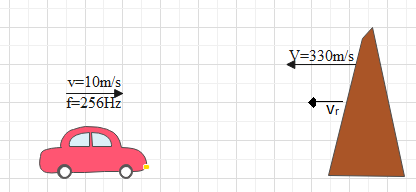
As we can see the sound wave of the whistle produced by the vehicle (car) is in the opposite direction to the sound which is echoed back from the hill as a reflected wave. Since, both are in opposite directions and beats are produced due to interference of two waves, therefore in this case no beat will be produced.
So, the correct answer is “Option A”.
Note:
Interference is a process in which two have superimpose to produce one wave, but the condition is the waves should be of nearly the same frequency and travelling in the same direction or from the same source.
Here a beat would have been produced if there were two vehicles approaching the hill. Here the source of sound is the same that is whistle therefore one can be confused that beat will produce but the waves are travelling in opposite directions therefore no beats are produced.
Complete answer:
A vehicle is moving towards a hill by blowing a whistle which produces a sound wave of frequency 256 Hz, where hill is stationary, and the diagram for the set-up can be given as
As we can see the sound wave of the whistle produced by the vehicle (car) is in the opposite direction to the sound which is echoed back from the hill as a reflected wave. Since, both are in opposite directions and beats are produced due to interference of two waves, therefore in this case no beat will be produced.
So, the correct answer is “Option A”.
Note:
Interference is a process in which two have superimpose to produce one wave, but the condition is the waves should be of nearly the same frequency and travelling in the same direction or from the same source.
Here a beat would have been produced if there were two vehicles approaching the hill. Here the source of sound is the same that is whistle therefore one can be confused that beat will produce but the waves are travelling in opposite directions therefore no beats are produced.
Recently Updated Pages
Master Class 11 Computer Science: Engaging Questions & Answers for Success

Master Class 11 Business Studies: Engaging Questions & Answers for Success
Master Class 11 Economics: Engaging Questions & Answers for Success
Master Class 11 English: Engaging Questions & Answers for Success
Master Class 11 Maths: Engaging Questions & Answers for Success
Master Class 11 Biology: Engaging Questions & Answers for Success
Trending doubts
One Metric ton is equal to kg A 10000 B 1000 C 100 class 11 physics CBSE
There are 720 permutations of the digits 1 2 3 4 5 class 11 maths CBSE
Discuss the various forms of bacteria class 11 biology CBSE
Draw a diagram of a plant cell and label at least eight class 11 biology CBSE
State the laws of reflection of light
Explain zero factorial class 11 maths CBSE