




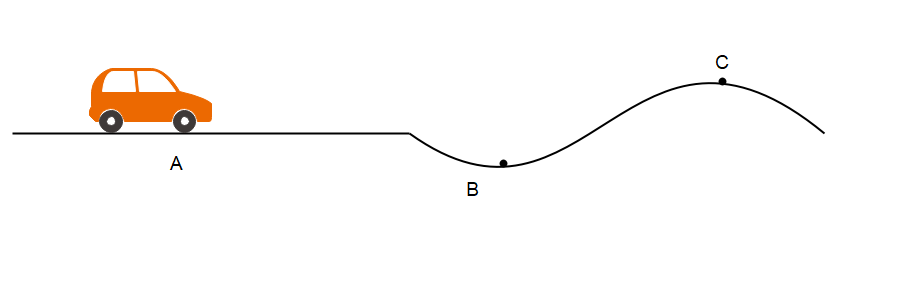
A vehicle is moving on a track with constant speed as shown in the figure. The apparent weight of the vehicle is
A) Maximum at A
B) Maximum at B
C) Maximum at C
D) Maximum at A, B, and C
Answer
 Verified
594k+ views
Hint: The apparent weight of the car will be due to its weight and the centripetal force of the car. The radius of curvature is positive for point B and negative for point C.
Complete step by step answer:
The vehicle when moving on the track will experience different centripetal forces. The net weight experienced by the car will be the normal force acting on the car by the surface which will be the sum of the weight of the car and the centripetal force of the car. Mathematically this can be written as
$N = mg + \dfrac{{m{v^2}}}{r}$ where $N$ is the normal force acting on the car of mass $m$, moving with velocity $v$ on a surface of radius of curvature $r$ under gravitational acceleration $g$.
Now at point A, the normal force will just be due to gravity such the surface is flat (which means the radius of curvature is infinite).
So, ${N_A} = mg$
For point B, the car will experience gravitational acceleration as well as centripetal force since the road is curved. For point B, since the center of curvature lies upwards, the radius of curvature will be considered positive and the normal force on the car will be
${N_B} = mg + \dfrac{{m{v^2}}}{r}$
For point C, the car will experience gravitational acceleration as well as centripetal force since again, the road is curved. For point C, since the centre of curvature lies downwards of the road, the radius of curvature will be considered positive and the normal force on the car will be
${N_B} = mg - \dfrac{{m{v^2}}}{r}$
Hence, we can see that the maximum normal force is for point B and hence the apparent weight of the car will be maximum at point B.
Therefore, the right answer is option B.
Note: For centripetal force to act on the car, the road must be curved which is only applicable at points B and C. We can also experience this phenomenon in a Ferris wheel where we feel the heaviest when we are near the bottom of the Ferris wheel since the centripetal force will be ‘pushing’ us downwards.
Complete step by step answer:
The vehicle when moving on the track will experience different centripetal forces. The net weight experienced by the car will be the normal force acting on the car by the surface which will be the sum of the weight of the car and the centripetal force of the car. Mathematically this can be written as
$N = mg + \dfrac{{m{v^2}}}{r}$ where $N$ is the normal force acting on the car of mass $m$, moving with velocity $v$ on a surface of radius of curvature $r$ under gravitational acceleration $g$.
Now at point A, the normal force will just be due to gravity such the surface is flat (which means the radius of curvature is infinite).
So, ${N_A} = mg$
For point B, the car will experience gravitational acceleration as well as centripetal force since the road is curved. For point B, since the center of curvature lies upwards, the radius of curvature will be considered positive and the normal force on the car will be
${N_B} = mg + \dfrac{{m{v^2}}}{r}$
For point C, the car will experience gravitational acceleration as well as centripetal force since again, the road is curved. For point C, since the centre of curvature lies downwards of the road, the radius of curvature will be considered positive and the normal force on the car will be
${N_B} = mg - \dfrac{{m{v^2}}}{r}$
Hence, we can see that the maximum normal force is for point B and hence the apparent weight of the car will be maximum at point B.
Therefore, the right answer is option B.
Note: For centripetal force to act on the car, the road must be curved which is only applicable at points B and C. We can also experience this phenomenon in a Ferris wheel where we feel the heaviest when we are near the bottom of the Ferris wheel since the centripetal force will be ‘pushing’ us downwards.
Recently Updated Pages
Master Class 12 Economics: Engaging Questions & Answers for Success

Master Class 12 English: Engaging Questions & Answers for Success
Master Class 12 Social Science: Engaging Questions & Answers for Success
Master Class 12 Maths: Engaging Questions & Answers for Success
Master Class 12 Physics: Engaging Questions & Answers for Success
Master Class 9 General Knowledge: Engaging Questions & Answers for Success
Trending doubts
One Metric ton is equal to kg A 10000 B 1000 C 100 class 11 physics CBSE
Difference Between Prokaryotic Cells and Eukaryotic Cells
Find the value of the expression given below sin 30circ class 11 maths CBSE
Two of the body parts which do not appear in MRI are class 11 biology CBSE
Draw a diagram of nephron and explain its structur class 11 biology CBSE
10 examples of friction in our daily life