




A vector $\vec {A}$ is rotated by a small angle $\Delta \theta$ radians ($\Delta \theta << 1$) to get a new vector $\vec {B}$. In that case $|\vec{A}-\vec {B}|$ is
A. $|\vec{A}| (1-\dfrac {\Delta {\theta}^{2}}{2})$
B. 0
C. $|\vec{A}| \Delta \theta$
D. $|\vec{B}| \Delta \theta - |\vec{A}|$
Answer
 Verified
595.8k+ views
Hint: It is mentioned that the angle between the two vectors is very small. So, the rotation can be neglected and we can consider one vector to be equal to another. Now, use the formula for resultant magnitude of two vectors. Substitute the values in the formula. Then, substitute $|\vec{A}|= |\vec{B}|$ and solve the equation. Thus, find the value of the resultant magnitude of two vectors i.e. $|\vec{A}-\vec {B}|$.
Complete step by step answer:
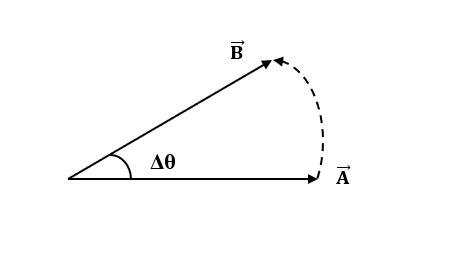
It is given that the change in vector is very small ($\Delta \theta <<1$).
$\therefore|\vec{A}|= |\vec{B}|$ …(1)
The resultant magnitude of two vectors is given by,
$|\vec{A}-\vec {B} |=\sqrt { { |\overrightarrow { A } | }^{ 2 }+{ |\overrightarrow { B } | }^{ 2 }-2|\overrightarrow { A } ||\overrightarrow { B } |\cos {\Delta \theta } }$
Substituting equation. (1) in above equation we get,
$|\vec {A}- \vec {B}|=\sqrt { { |\overrightarrow { A } | }^{ 2 }+{ |\overrightarrow { A } | }^{ 2 }-2|\overrightarrow {{ A}^{2} } |\cos {\Delta \theta } }$
$\Rightarrow |\vec {A}- \vec {B} |= \sqrt {2{|\vec A|}^{2}- 2|\overrightarrow {{ A}^{2} } |\cos {\Delta \theta } }$
$\Rightarrow |\vec {A}- \vec {B}|= 2 |\vec {A}| \sqrt{\dfrac {(1-\cos {\Delta \theta})}{2}}$
$\Rightarrow |\vec{A}-\vec {B} |= 2 |\vec {A}| \sqrt {{\sin}^{2}({\dfrac {\Delta \theta}{2}})}$
$\Rightarrow |\vec{A}-\vec {B}|= 2 |\vec {A}| \sin {\dfrac {\Delta \theta}{2}}$ …(2)
As $\Delta \theta <<1$,
$\dfrac {\Delta \theta }{2}<<1$.
$\therefore \sin {\dfrac {\Delta \theta}{2}} \approx \dfrac {\Delta \theta}{2}$ …(3)
Substituting equation. (2) in equation. (3) we get,
$|\vec{A}-\vec {B} |= 2| \vec {A}| \times \dfrac {\Delta \theta}{2}$
$| \vec{A}-\vec {B}|= |\vec {A}| \Delta \theta$
So, the correct answer is “Option C”.
Note: Students must remember that while adding two vectors don’t only consider the magnitude of the vectors but also consider the direction of both the vectors. If you don’t consider the direction then there might be an error in your calculation. Students must understand that if we double the resultant vector and reverse one of the vectors then the resultant vector gets doubled again.
Complete step by step answer:
It is given that the change in vector is very small ($\Delta \theta <<1$).
$\therefore|\vec{A}|= |\vec{B}|$ …(1)
The resultant magnitude of two vectors is given by,
$|\vec{A}-\vec {B} |=\sqrt { { |\overrightarrow { A } | }^{ 2 }+{ |\overrightarrow { B } | }^{ 2 }-2|\overrightarrow { A } ||\overrightarrow { B } |\cos {\Delta \theta } }$
Substituting equation. (1) in above equation we get,
$|\vec {A}- \vec {B}|=\sqrt { { |\overrightarrow { A } | }^{ 2 }+{ |\overrightarrow { A } | }^{ 2 }-2|\overrightarrow {{ A}^{2} } |\cos {\Delta \theta } }$
$\Rightarrow |\vec {A}- \vec {B} |= \sqrt {2{|\vec A|}^{2}- 2|\overrightarrow {{ A}^{2} } |\cos {\Delta \theta } }$
$\Rightarrow |\vec {A}- \vec {B}|= 2 |\vec {A}| \sqrt{\dfrac {(1-\cos {\Delta \theta})}{2}}$
$\Rightarrow |\vec{A}-\vec {B} |= 2 |\vec {A}| \sqrt {{\sin}^{2}({\dfrac {\Delta \theta}{2}})}$
$\Rightarrow |\vec{A}-\vec {B}|= 2 |\vec {A}| \sin {\dfrac {\Delta \theta}{2}}$ …(2)
As $\Delta \theta <<1$,
$\dfrac {\Delta \theta }{2}<<1$.
$\therefore \sin {\dfrac {\Delta \theta}{2}} \approx \dfrac {\Delta \theta}{2}$ …(3)
Substituting equation. (2) in equation. (3) we get,
$|\vec{A}-\vec {B} |= 2| \vec {A}| \times \dfrac {\Delta \theta}{2}$
$| \vec{A}-\vec {B}|= |\vec {A}| \Delta \theta$
So, the correct answer is “Option C”.
Note: Students must remember that while adding two vectors don’t only consider the magnitude of the vectors but also consider the direction of both the vectors. If you don’t consider the direction then there might be an error in your calculation. Students must understand that if we double the resultant vector and reverse one of the vectors then the resultant vector gets doubled again.
Recently Updated Pages
Master Class 11 Social Science: Engaging Questions & Answers for Success

Master Class 11 English: Engaging Questions & Answers for Success
Master Class 11 Maths: Engaging Questions & Answers for Success
Master Class 11 Chemistry: Engaging Questions & Answers for Success
Master Class 11 Biology: Engaging Questions & Answers for Success
Master Class 11 Physics: Engaging Questions & Answers for Success
Trending doubts
Differentiate between an exothermic and an endothermic class 11 chemistry CBSE
One Metric ton is equal to kg A 10000 B 1000 C 100 class 11 physics CBSE
Difference Between Prokaryotic Cells and Eukaryotic Cells
There are 720 permutations of the digits 1 2 3 4 5 class 11 maths CBSE
Draw a diagram of a plant cell and label at least eight class 11 biology CBSE
1 Quintal is equal to a 110 kg b 10 kg c 100kg d 1000 class 11 physics CBSE