




A U-tube is partially filled with water. Oil, which does not mix with water, is next poured into one side until water rises by 25 cm on the other side, if the specific gravity of oil be 0.8, the oil level will stand higher than the water level by:
A. 6.25 cm
B. 12.50 cm
C. 31.25 cm
D. 62.50 cm
Answer
 Verified
588.9k+ views
Hint: Manometer is a device used for measuring the pressure in liquids. One of the most common types of manometers are called U-tube manometers which consist of a U-shaped tube. The pressure is calculated by measuring the height difference between the two limbs of the manometer.
Complete step by step answer:
Let us consider a U-tube manometer partially filled with water, as shown:
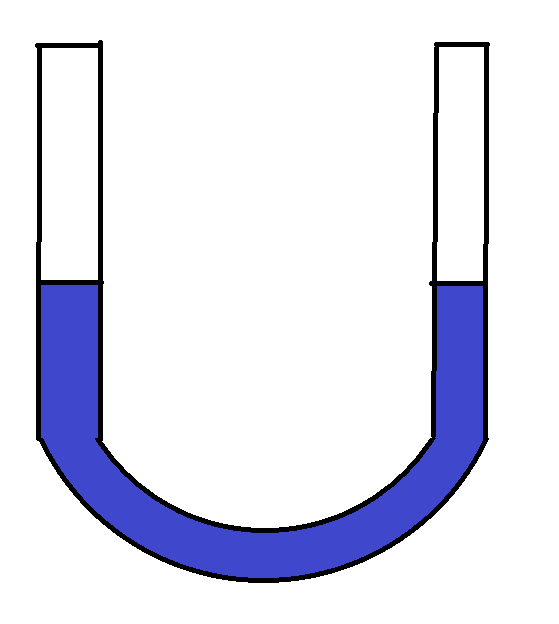
When oil is added to one side, the water on the other limb rises by 25 cm as shown.
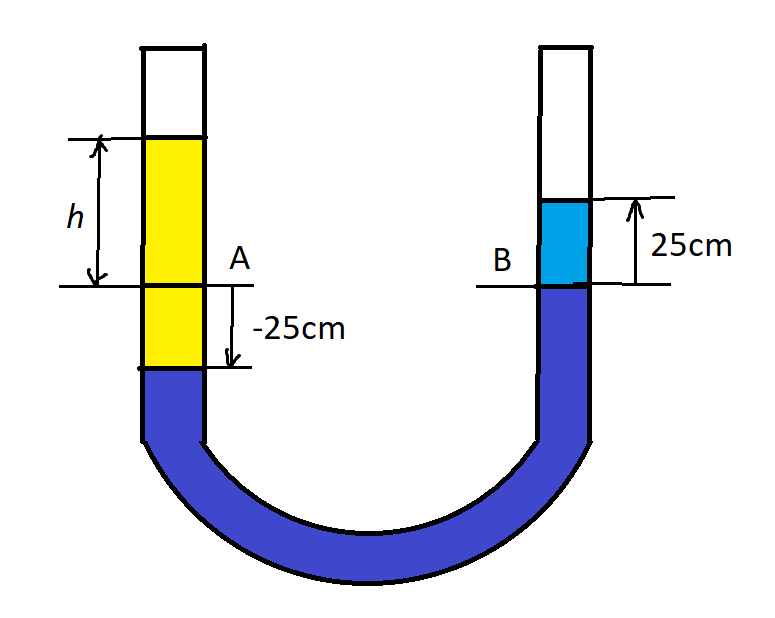
Let h be the height to which the oil is filled.
If the level of water in one end rises by 25 cm at point B, the water level in the other end decreases by 25 cm at point A when the oil is added on top of it.
At the points A and B, the pressure will be equal.
Pressure at A = Pressure at B
${P_A} = {P_B}$
Pressure at point A,${P_A} = {\rho _{oil}} \times g \times (h + 25)$
Pressure at point B,${P_B} = {\rho _{water}} \times g \times 25$
Equating, we get –
${\rho _{oil}} \times g \times (h + 25)$= ${\rho _{water}} \times g \times 25$
Given, specific gravity of oil = 0.8
Specific gravity, $\dfrac{{{\rho _{oil}}}}{{{\rho _{water}}}} = 0.8$
\[
{\rho _{oil}} \times{g} \times (h + 25) = {\rho _{water}} \times {g} \times 25 \\
\dfrac{{{\rho _{oil}}}}{{{\rho _{water}}}} \times (h + 25) = 25 \\
Substituting, \\
0.8 \times (h + 25) = 25 \\
\Rightarrow (h + 25) = \dfrac{{25}}{{0.8}} \\
\Rightarrow h + 25 = 31.25 \\
\Rightarrow h = 31.25 - 25 \\
\Rightarrow h = 6.25cm \\
\]
Thus, the correct option is Option A.
Note: When the manometer is used to measure the pressure, the pressure, so recorded, is called absolute pressure. This pressure includes the atmospheric pressure. Now, if we subtract the atmospheric pressure from the absolute pressure, we get something called as gauge pressure.
Complete step by step answer:
Let us consider a U-tube manometer partially filled with water, as shown:
When oil is added to one side, the water on the other limb rises by 25 cm as shown.
Let h be the height to which the oil is filled.
If the level of water in one end rises by 25 cm at point B, the water level in the other end decreases by 25 cm at point A when the oil is added on top of it.
At the points A and B, the pressure will be equal.
Pressure at A = Pressure at B
${P_A} = {P_B}$
Pressure at point A,${P_A} = {\rho _{oil}} \times g \times (h + 25)$
Pressure at point B,${P_B} = {\rho _{water}} \times g \times 25$
Equating, we get –
${\rho _{oil}} \times g \times (h + 25)$= ${\rho _{water}} \times g \times 25$
Given, specific gravity of oil = 0.8
Specific gravity, $\dfrac{{{\rho _{oil}}}}{{{\rho _{water}}}} = 0.8$
\[
{\rho _{oil}} \times{g} \times (h + 25) = {\rho _{water}} \times {g} \times 25 \\
\dfrac{{{\rho _{oil}}}}{{{\rho _{water}}}} \times (h + 25) = 25 \\
Substituting, \\
0.8 \times (h + 25) = 25 \\
\Rightarrow (h + 25) = \dfrac{{25}}{{0.8}} \\
\Rightarrow h + 25 = 31.25 \\
\Rightarrow h = 31.25 - 25 \\
\Rightarrow h = 6.25cm \\
\]
Thus, the correct option is Option A.
Note: When the manometer is used to measure the pressure, the pressure, so recorded, is called absolute pressure. This pressure includes the atmospheric pressure. Now, if we subtract the atmospheric pressure from the absolute pressure, we get something called as gauge pressure.
Recently Updated Pages
Master Class 11 Computer Science: Engaging Questions & Answers for Success

Master Class 11 Business Studies: Engaging Questions & Answers for Success
Master Class 11 Economics: Engaging Questions & Answers for Success
Master Class 11 English: Engaging Questions & Answers for Success
Master Class 11 Maths: Engaging Questions & Answers for Success
Master Class 11 Biology: Engaging Questions & Answers for Success
Trending doubts
One Metric ton is equal to kg A 10000 B 1000 C 100 class 11 physics CBSE
There are 720 permutations of the digits 1 2 3 4 5 class 11 maths CBSE
Discuss the various forms of bacteria class 11 biology CBSE
Draw a diagram of a plant cell and label at least eight class 11 biology CBSE
State the laws of reflection of light
Explain zero factorial class 11 maths CBSE