




A unit radian is approximately equal to
[a] $57{}^\circ 17'43''$
[b] $57{}^\circ 17'45''$
[c] $57{}^\circ 17'47''$
[d] $57{}^\circ 17'49''$
Answer
 Verified
632.1k+ views
Hint: Use the fact that one complete angle in degrees is equal to $360{}^\circ $ and in radians is equal to $2\pi $radians. Hence find the measure of one radian in degrees.
Complete step-by-step answer:
Systems of measurement of an angle:
[i] Sexagesimal system or English system: In this system of measurement, an angle is measured in degrees, minutes and seconds. One complete rotation is equal to $360{}^\circ $ , and one degree consists of 60 minutes and one minute consists of 60 seconds.
[ii] Centesimal system or the French system: In this system of measurement, an angle is measured in grades, minutes and seconds. One right angle consists of 100 grads, and one grade consists of 100 minutes and one minute consists of 100 seconds.
[iii] Circular system: This is the standard system of measurement of an angle. In this system, an angle is measured in radians. The angle subtended by an arc of length equal to the radius of a circle at the centre of the circle is equal to 1 radian.
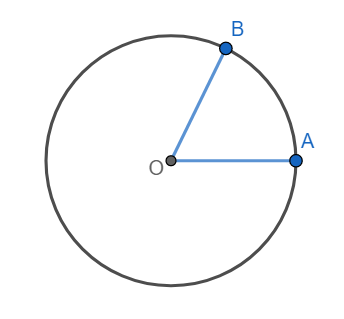
Consider angle AOB in which OA = 1unit and arc AB is of length 1 unit. Hence according to the definition $\angle AOB=1$ radians.
Since the complete length of the circular arc $=2\pi $, we have one complete rotation that is equal to $2\pi $ radians.
But one complete rotation is equal to $360{}^\circ $
Hence we have
$360{}^\circ =2\pi $ radians
Hence $1\text{ radian = }\dfrac{360{}^\circ }{2\pi }=57.296{}^\circ $
Now we have $0.296{}^\circ =0.296\times 60=17.76'$
Also, we have $0.76'=0.76\times 60=45.6''$
Hence $1\text{ radian }\approx \text{57}{}^\circ \text{17 }\!\!'\!\!\text{ 45}''$
Hence option [b] is correct.
Note: Alternatively, we can find the measure of one radian by calculating the area of the sector AOB in two different ways.
In the circulatory system area of the sector AOB $=\dfrac{1}{2\pi }\times \pi {{\left( 1 \right)}^{2}}$
In the sexagesimal system area of sector AOB $=\dfrac{\theta }{360{}^\circ }\times \pi {{\left( 1 \right)}^{2}}$, where $\theta $ is the measure of the angle in the sexagesimal system.
Hence we have
$\begin{align}
& \dfrac{\theta }{360{}^\circ }\times \pi =\dfrac{1}{2\pi }\times \pi \\
& \Rightarrow \theta =\dfrac{360{}^\circ }{2\pi } \\
\end{align}$
which is the same as obtained above.
Complete step-by-step answer:
Systems of measurement of an angle:
[i] Sexagesimal system or English system: In this system of measurement, an angle is measured in degrees, minutes and seconds. One complete rotation is equal to $360{}^\circ $ , and one degree consists of 60 minutes and one minute consists of 60 seconds.
[ii] Centesimal system or the French system: In this system of measurement, an angle is measured in grades, minutes and seconds. One right angle consists of 100 grads, and one grade consists of 100 minutes and one minute consists of 100 seconds.
[iii] Circular system: This is the standard system of measurement of an angle. In this system, an angle is measured in radians. The angle subtended by an arc of length equal to the radius of a circle at the centre of the circle is equal to 1 radian.
Consider angle AOB in which OA = 1unit and arc AB is of length 1 unit. Hence according to the definition $\angle AOB=1$ radians.
Since the complete length of the circular arc $=2\pi $, we have one complete rotation that is equal to $2\pi $ radians.
But one complete rotation is equal to $360{}^\circ $
Hence we have
$360{}^\circ =2\pi $ radians
Hence $1\text{ radian = }\dfrac{360{}^\circ }{2\pi }=57.296{}^\circ $
Now we have $0.296{}^\circ =0.296\times 60=17.76'$
Also, we have $0.76'=0.76\times 60=45.6''$
Hence $1\text{ radian }\approx \text{57}{}^\circ \text{17 }\!\!'\!\!\text{ 45}''$
Hence option [b] is correct.
Note: Alternatively, we can find the measure of one radian by calculating the area of the sector AOB in two different ways.
In the circulatory system area of the sector AOB $=\dfrac{1}{2\pi }\times \pi {{\left( 1 \right)}^{2}}$
In the sexagesimal system area of sector AOB $=\dfrac{\theta }{360{}^\circ }\times \pi {{\left( 1 \right)}^{2}}$, where $\theta $ is the measure of the angle in the sexagesimal system.
Hence we have
$\begin{align}
& \dfrac{\theta }{360{}^\circ }\times \pi =\dfrac{1}{2\pi }\times \pi \\
& \Rightarrow \theta =\dfrac{360{}^\circ }{2\pi } \\
\end{align}$
which is the same as obtained above.
Recently Updated Pages
Three beakers labelled as A B and C each containing 25 mL of water were taken A small amount of NaOH anhydrous CuSO4 and NaCl were added to the beakers A B and C respectively It was observed that there was an increase in the temperature of the solutions contained in beakers A and B whereas in case of beaker C the temperature of the solution falls Which one of the following statements isarecorrect i In beakers A and B exothermic process has occurred ii In beakers A and B endothermic process has occurred iii In beaker C exothermic process has occurred iv In beaker C endothermic process has occurred

Master Class 11 Social Science: Engaging Questions & Answers for Success
Master Class 11 Physics: Engaging Questions & Answers for Success
Master Class 11 Maths: Engaging Questions & Answers for Success
Master Class 11 Economics: Engaging Questions & Answers for Success
Master Class 11 Computer Science: Engaging Questions & Answers for Success
Three beakers labelled as A B and C each containing 25 mL of water were taken A small amount of NaOH anhydrous CuSO4 and NaCl were added to the beakers A B and C respectively It was observed that there was an increase in the temperature of the solutions contained in beakers A and B whereas in case of beaker C the temperature of the solution falls Which one of the following statements isarecorrect i In beakers A and B exothermic process has occurred ii In beakers A and B endothermic process has occurred iii In beaker C exothermic process has occurred iv In beaker C endothermic process has occurred
Master Class 11 Social Science: Engaging Questions & Answers for Success
Master Class 11 Physics: Engaging Questions & Answers for Success
Trending doubts
One Metric ton is equal to kg A 10000 B 1000 C 100 class 11 physics CBSE
There are 720 permutations of the digits 1 2 3 4 5 class 11 maths CBSE
State and prove Bernoullis theorem class 11 physics CBSE
Draw a diagram of a plant cell and label at least eight class 11 biology CBSE
Difference Between Prokaryotic Cells and Eukaryotic Cells
1 Quintal is equal to a 110 kg b 10 kg c 100kg d 1000 class 11 physics CBSE