




A unit N-pole is placed on the axis of a circular coil carrying current in an anti-clockwise direction. It experiences a force: (contains multiple correct answers)
A. Towards the coil
B. $90^{\circ}$ to the coil
C. of repulsion
D. Parallel to the coil
Answer
 Verified
598.8k+ views
Hint: A magnet is metal that can produce a magnetic field. A magnet has two different poles, namely the North and the South Pole on two sides of the metal. These metals show a special property called the magnetic effect.
Complete step by step answer:
We know that the magnetic field is an invisible force which is a vector that influences an electric charge and a few magnetic metals. Since it’s a vector clearly, it has both direction and magnitude. A magnet has two different poles, namely the North and the South Pole. Generally, the like poles attract, while the unlike poles repel. This is saying that, North Pole of one magnet repels from the north pole of another magnet, this is true for two South Pole also. However, if a North Pole of one magnet is brought near the south pole of another magnet, then they attract.
We also know that when current is passed through a coil, a magnetic field is created in the coil. This magnetic field restricts the current to flow through the coil. Then the direction of the magnetic field is given by the write hand thumb rule. According to this, if the right thumb points towards the direction of the current, then the direction of the magnetic field is given by the curled fingers, which is clearly perpendicular to the plane. As shown in the figure, below.
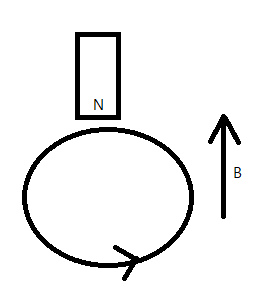
We also know that a current carrying acts a bar magnet, then we know that the magnetic field lines move from north to south outside the magnet, thus we can say the end of the coil which is pointing towards the north pole of the magnet is also north and hence both will repel each other.
Hence the correct answer is option B. to the coil and C. of repulsion
Note:
There are two types of magnets on the basis of their magnetic strength namely the permanent and the temporary magnets. A permanent magnet produces a strong magnetic field always, whereas the magnetic field produced by a temporary magnet is short spanned and weak.
Complete step by step answer:
We know that the magnetic field is an invisible force which is a vector that influences an electric charge and a few magnetic metals. Since it’s a vector clearly, it has both direction and magnitude. A magnet has two different poles, namely the North and the South Pole. Generally, the like poles attract, while the unlike poles repel. This is saying that, North Pole of one magnet repels from the north pole of another magnet, this is true for two South Pole also. However, if a North Pole of one magnet is brought near the south pole of another magnet, then they attract.
We also know that when current is passed through a coil, a magnetic field is created in the coil. This magnetic field restricts the current to flow through the coil. Then the direction of the magnetic field is given by the write hand thumb rule. According to this, if the right thumb points towards the direction of the current, then the direction of the magnetic field is given by the curled fingers, which is clearly perpendicular to the plane. As shown in the figure, below.
We also know that a current carrying acts a bar magnet, then we know that the magnetic field lines move from north to south outside the magnet, thus we can say the end of the coil which is pointing towards the north pole of the magnet is also north and hence both will repel each other.
Hence the correct answer is option B. to the coil and C. of repulsion
Note:
There are two types of magnets on the basis of their magnetic strength namely the permanent and the temporary magnets. A permanent magnet produces a strong magnetic field always, whereas the magnetic field produced by a temporary magnet is short spanned and weak.
Recently Updated Pages
Master Class 12 Business Studies: Engaging Questions & Answers for Success

Master Class 12 Chemistry: Engaging Questions & Answers for Success
Master Class 12 Biology: Engaging Questions & Answers for Success
Class 12 Question and Answer - Your Ultimate Solutions Guide
Master Class 11 English: Engaging Questions & Answers for Success
Master Class 11 Maths: Engaging Questions & Answers for Success
Trending doubts
Which is more stable and why class 12 chemistry CBSE
Which are the Top 10 Largest Countries of the World?
Draw a labelled sketch of the human eye class 12 physics CBSE
Differentiate between homogeneous and heterogeneous class 12 chemistry CBSE
What are the major means of transport Explain each class 12 social science CBSE
Sulphuric acid is known as the king of acids State class 12 chemistry CBSE