




A uniform string of length 20m is suspended from a rigid support. A short-wave pulse is introduced at the lowest end. It starts moving up the string. The time taken to reach the support is (Take \[g=10m{{s}^{-2}}\])
A. \[2\pi \sqrt{2}s\]
B. 2s
C. \[2\sqrt{2}s\]
D. \[\sqrt{2}s\]
Answer
 Verified
577.5k+ views
Hint: The velocity of the pulse formed in a string depends on the Tension and mass distribution. The formula for the velocity of pulse is given below. The tension of a string suspended from support varies with height, In case of string of mass the tension of a point at a distance x form the lower end is given as
\[T=\mu gx\]
Formula used:
\[v=\sqrt{\dfrac{T}{\mu }}\]
Complete answer:
The given string is uniform. That means the mass distribution of the string is constant. Let that be \[\mu \]
\[\mu =\dfrac{m}{L}\]
Where m is the mass of the string and L is the length of the string
We also know that in case of string the velocity of the pulse is given as
\[v=\sqrt{\dfrac{T}{\mu }}\]…..(1)
Where T is the tension on the string.
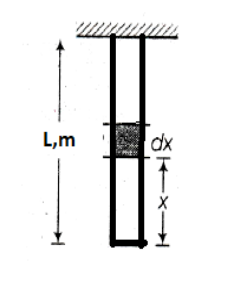
In case of string of mass the tension of a point at a distance x form the lower end is given as
\[T=\mu gx\]
And we also know that \[v=\dfrac{dx}{dt}\]
So 1 can be written as
\[v=\sqrt{\dfrac{T}{\mu }}\]
\[\begin{align}
& \Rightarrow \dfrac{dx}{dt}=\sqrt{\dfrac{\mu gx}{\mu }} \\
& \Rightarrow \dfrac{dx}{dt}=\sqrt{\dfrac{mgx/L}{m/L}} \\
& \Rightarrow \dfrac{dx}{dt}=\sqrt{g}\sqrt{x} \\
& \Rightarrow \dfrac{dx}{\sqrt{x}}=\sqrt{g}dt \\
\end{align}\]
Here we have a relation between the distance x from the lower end of the string and time. Integrating both sides of this equation for the entire duration it takes the pulse to reach the top we get
\[\begin{align}
& \dfrac{dx}{\sqrt{x}}=\sqrt{g}dt \\
& \Rightarrow \int\limits_{0}^{L}{{{x}^{-1/2}}dx}=\sqrt{g}\int\limits_{0}^{L}{dt} \\
& \Rightarrow {{\left[ \dfrac{{{x}^{1/2}}}{1/2} \right]}^{L}}_{0}=\sqrt{gt} \\
& \Rightarrow \dfrac{\sqrt{L}-0}{1/2}=\sqrt{gt} \\
& \Rightarrow t=\dfrac{2\sqrt{L}}{\sqrt{g}} \\
\end{align}\]
We now have the time taken by the pulse to reach the support. Plugging in the Values given in question
\[\begin{align}
& \Rightarrow t=\dfrac{2\sqrt{L}}{\sqrt{g}} \\
& \Rightarrow t=2\times \sqrt{\dfrac{20}{10}} \\
& \Rightarrow t=2\sqrt{2}s \\
\end{align}\]
So, the pulse will take \[2\sqrt{2}s\] to reach the support
So, the correct answer is “Option C”.
Note:
Generally, in physics the string taken is considered massless. A massless string has constant tension throughout its length and directed away from connected masses. Meanwhile a string with mass, as in case of the given question, may have varying tension due to its own weight and students should be extra careful when dealing with strings with masses.
\[T=\mu gx\]
Formula used:
\[v=\sqrt{\dfrac{T}{\mu }}\]
Complete answer:
The given string is uniform. That means the mass distribution of the string is constant. Let that be \[\mu \]
\[\mu =\dfrac{m}{L}\]
Where m is the mass of the string and L is the length of the string
We also know that in case of string the velocity of the pulse is given as
\[v=\sqrt{\dfrac{T}{\mu }}\]…..(1)
Where T is the tension on the string.
In case of string of mass the tension of a point at a distance x form the lower end is given as
\[T=\mu gx\]
And we also know that \[v=\dfrac{dx}{dt}\]
So 1 can be written as
\[v=\sqrt{\dfrac{T}{\mu }}\]
\[\begin{align}
& \Rightarrow \dfrac{dx}{dt}=\sqrt{\dfrac{\mu gx}{\mu }} \\
& \Rightarrow \dfrac{dx}{dt}=\sqrt{\dfrac{mgx/L}{m/L}} \\
& \Rightarrow \dfrac{dx}{dt}=\sqrt{g}\sqrt{x} \\
& \Rightarrow \dfrac{dx}{\sqrt{x}}=\sqrt{g}dt \\
\end{align}\]
Here we have a relation between the distance x from the lower end of the string and time. Integrating both sides of this equation for the entire duration it takes the pulse to reach the top we get
\[\begin{align}
& \dfrac{dx}{\sqrt{x}}=\sqrt{g}dt \\
& \Rightarrow \int\limits_{0}^{L}{{{x}^{-1/2}}dx}=\sqrt{g}\int\limits_{0}^{L}{dt} \\
& \Rightarrow {{\left[ \dfrac{{{x}^{1/2}}}{1/2} \right]}^{L}}_{0}=\sqrt{gt} \\
& \Rightarrow \dfrac{\sqrt{L}-0}{1/2}=\sqrt{gt} \\
& \Rightarrow t=\dfrac{2\sqrt{L}}{\sqrt{g}} \\
\end{align}\]
We now have the time taken by the pulse to reach the support. Plugging in the Values given in question
\[\begin{align}
& \Rightarrow t=\dfrac{2\sqrt{L}}{\sqrt{g}} \\
& \Rightarrow t=2\times \sqrt{\dfrac{20}{10}} \\
& \Rightarrow t=2\sqrt{2}s \\
\end{align}\]
So, the pulse will take \[2\sqrt{2}s\] to reach the support
So, the correct answer is “Option C”.
Note:
Generally, in physics the string taken is considered massless. A massless string has constant tension throughout its length and directed away from connected masses. Meanwhile a string with mass, as in case of the given question, may have varying tension due to its own weight and students should be extra careful when dealing with strings with masses.
Recently Updated Pages
Master Class 11 Computer Science: Engaging Questions & Answers for Success

Master Class 11 Business Studies: Engaging Questions & Answers for Success
Master Class 11 Economics: Engaging Questions & Answers for Success
Master Class 11 English: Engaging Questions & Answers for Success
Master Class 11 Maths: Engaging Questions & Answers for Success
Master Class 11 Biology: Engaging Questions & Answers for Success
Trending doubts
One Metric ton is equal to kg A 10000 B 1000 C 100 class 11 physics CBSE
There are 720 permutations of the digits 1 2 3 4 5 class 11 maths CBSE
Discuss the various forms of bacteria class 11 biology CBSE
Draw a diagram of a plant cell and label at least eight class 11 biology CBSE
State the laws of reflection of light
Explain zero factorial class 11 maths CBSE