




A uniform sphere is placed on a smooth horizontal surface and a horizontal force $F$ is applied to it at a distance $h$ above the surface. The acceleration of the centre
A) is maximum when $h=0$
B) is maximum when $h=R$
C) is maximum when $h=2R$
D) is independent of $h$
Answer
 Verified
510.3k+ views
Hint: In order to solve the question, we will first use the relation of velocity, acceleration and time after then we will use the relation of velocity, distance and time then we will substitute the velocity in the relation of acceleration and velocity and from there we will deduce that how acceleration is dependent on $h$.
Formula used:
1. $v = \dfrac{{dx}}{{dt}}$
$v$ is velocity
$x$ is distance
$t$ is time
2. $a = \dfrac{{dv}}{{dt}}$
$a$ is acceleration
$v$ is velocity
$t$ is time
Complete step by step answer:
In the question we are given that a uniform sphere is placed on a smooth horizontal surface and a horizontal force F is applied to it at a distance h above the surface and we have to find the relation of acceleration of the centre with the distance $h$.
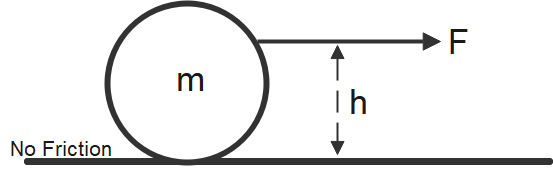
First, we will use the relation between acceleration, velocity and time in order to deduce the relation of acceleration and height we will use the formula
$a = \dfrac{{dv}}{{dt}}$………………… (Equation 1)
In the above relation we will substitute the value of v
Relation of velocity
$v = \dfrac{{dx}}{{dt}}$………………… (Equation 2)
Now we will be substituting the equation 2 in equation 1
$a = \dfrac{d}{{dt}}\left( {\dfrac{{dx}}{{dt}}} \right)$
In the above equation we will find double derivative
$a = \dfrac{{{d^2}x}}{{d{t^2}}}$
And we can also use F = ma, to deduce that same thing as acceleration is dependent on force and mass and not on height
So, from the formula we can find that the acceleration of the centre of mass of the sphere is independent of h, acceleration is independent of h
Hence, the correct option is (D) independent of $h$.
Note: There might be a chance of confusing as $h$ is distance and we have seen that acceleration is dependent on distance x but we have concluded that it doesn’t depend because a on which acceleration is depended in horizontal distance while h is vertical distance on which acceleration doesn’t depends
Formula used:
1. $v = \dfrac{{dx}}{{dt}}$
$v$ is velocity
$x$ is distance
$t$ is time
2. $a = \dfrac{{dv}}{{dt}}$
$a$ is acceleration
$v$ is velocity
$t$ is time
Complete step by step answer:
In the question we are given that a uniform sphere is placed on a smooth horizontal surface and a horizontal force F is applied to it at a distance h above the surface and we have to find the relation of acceleration of the centre with the distance $h$.
First, we will use the relation between acceleration, velocity and time in order to deduce the relation of acceleration and height we will use the formula
$a = \dfrac{{dv}}{{dt}}$………………… (Equation 1)
In the above relation we will substitute the value of v
Relation of velocity
$v = \dfrac{{dx}}{{dt}}$………………… (Equation 2)
Now we will be substituting the equation 2 in equation 1
$a = \dfrac{d}{{dt}}\left( {\dfrac{{dx}}{{dt}}} \right)$
In the above equation we will find double derivative
$a = \dfrac{{{d^2}x}}{{d{t^2}}}$
And we can also use F = ma, to deduce that same thing as acceleration is dependent on force and mass and not on height
So, from the formula we can find that the acceleration of the centre of mass of the sphere is independent of h, acceleration is independent of h
Hence, the correct option is (D) independent of $h$.
Note: There might be a chance of confusing as $h$ is distance and we have seen that acceleration is dependent on distance x but we have concluded that it doesn’t depend because a on which acceleration is depended in horizontal distance while h is vertical distance on which acceleration doesn’t depends
Recently Updated Pages
Master Class 12 Economics: Engaging Questions & Answers for Success

Master Class 12 English: Engaging Questions & Answers for Success
Master Class 12 Social Science: Engaging Questions & Answers for Success
Master Class 12 Maths: Engaging Questions & Answers for Success
Master Class 12 Physics: Engaging Questions & Answers for Success
Master Class 11 Social Science: Engaging Questions & Answers for Success
Trending doubts
One Metric ton is equal to kg A 10000 B 1000 C 100 class 11 physics CBSE
Difference Between Prokaryotic Cells and Eukaryotic Cells
Two of the body parts which do not appear in MRI are class 11 biology CBSE
1 ton equals to A 100 kg B 1000 kg C 10 kg D 10000 class 11 physics CBSE
Draw a diagram of nephron and explain its structur class 11 biology CBSE
10 examples of friction in our daily life