




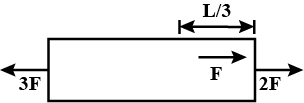
A uniform slender rod of length $ L $ , cross-sectional area $ A $ and Young's modulus $ Y $ is acted upon by the forces shown in the figure. The elongation of the rod is:
$ (A)\dfrac{{3FL}}{{5AY}} $
$ (B)\dfrac{{2FL}}{{5AY}} $
$ (C)\dfrac{{3FL}}{{8AY}} $
$ (D)\dfrac{{8FL}}{{3AY}} $
Answer
 Verified
493.8k+ views
Hint: Young's modulus $ Y $ , which is also known as the modulus of elasticity in tension, is a mechanical property of matter that measures the tensile stiffness of a solid material. In simple words, we can also say that it is a measure of elasticity, equal to the ratio of the stress acting on a substance to the strain produced.
Complete step by step solution:
When forces pull on an object and cause its elongation, like the stretching of an elastic band, we call such stress a tensile stress. In such a case, when deforming forces act tangentially to the object's surface, we call them 'shear' forces and the stress they cause is called shear stress.
Tensile (or compressive) stress causes elongation (or shortening) of the object or medium and is due to an external force acting along only one direction perpendicular to the cross-section. Bulk strain is the response of an object or medium to bulk stress.
According to the given diagram, we can clearly see that the rod is divided into two parts of length $ \dfrac{L}{3} $ and $ \dfrac{{2L}}{3} $ .
So, we will solve this question for the two parts of rods separately.
We can clearly see that the force acting on both the sides of the part $ \dfrac{{2L}}{3} $ is $ 3F $
So the extension $ x = \dfrac{{8FL}}{{3AY}} $ $ {x_1} = \dfrac{{\left[ {3F \times \dfrac{{2L}}{3}} \right]}}{{AY}}.......(1) $
Similarly, the force acting on both the sides of part $ \dfrac{L}{3} $ is $ 2F $
So the extension $ {x_2} = \dfrac{{\left[ {2F \times \dfrac{L}{3}} \right]}}{{AY}}.......(2) $
Now the total extension will be calculated by adding equation (1) and (2),
$ x = {x_1} + {x_2} $
$ x = \dfrac{{\left[ {3F \times \dfrac{{2L}}{3}} \right]}}{{AY}} + \dfrac{{\left[ {2F \times \dfrac{L}{3}} \right]}}{{AY}} $
On simplifying the above equation, we get,
$ x = \dfrac{{8FL}}{{3AY}} $
So, the final answer is $ (D)\dfrac{{8FL}}{{3AY}} $ .
Note:
The insight that Young's modulus represents the strength of the bonds between all the atoms in a crystal has a first important consequence for the elastic properties of sword blades. A few percent of other bonds, for example to carbon atoms in steel, will at best make a difference of a few percent in Young's modulus.
Complete step by step solution:
When forces pull on an object and cause its elongation, like the stretching of an elastic band, we call such stress a tensile stress. In such a case, when deforming forces act tangentially to the object's surface, we call them 'shear' forces and the stress they cause is called shear stress.
Tensile (or compressive) stress causes elongation (or shortening) of the object or medium and is due to an external force acting along only one direction perpendicular to the cross-section. Bulk strain is the response of an object or medium to bulk stress.
According to the given diagram, we can clearly see that the rod is divided into two parts of length $ \dfrac{L}{3} $ and $ \dfrac{{2L}}{3} $ .
So, we will solve this question for the two parts of rods separately.
We can clearly see that the force acting on both the sides of the part $ \dfrac{{2L}}{3} $ is $ 3F $
So the extension $ x = \dfrac{{8FL}}{{3AY}} $ $ {x_1} = \dfrac{{\left[ {3F \times \dfrac{{2L}}{3}} \right]}}{{AY}}.......(1) $
Similarly, the force acting on both the sides of part $ \dfrac{L}{3} $ is $ 2F $
So the extension $ {x_2} = \dfrac{{\left[ {2F \times \dfrac{L}{3}} \right]}}{{AY}}.......(2) $
Now the total extension will be calculated by adding equation (1) and (2),
$ x = {x_1} + {x_2} $
$ x = \dfrac{{\left[ {3F \times \dfrac{{2L}}{3}} \right]}}{{AY}} + \dfrac{{\left[ {2F \times \dfrac{L}{3}} \right]}}{{AY}} $
On simplifying the above equation, we get,
$ x = \dfrac{{8FL}}{{3AY}} $
So, the final answer is $ (D)\dfrac{{8FL}}{{3AY}} $ .
Note:
The insight that Young's modulus represents the strength of the bonds between all the atoms in a crystal has a first important consequence for the elastic properties of sword blades. A few percent of other bonds, for example to carbon atoms in steel, will at best make a difference of a few percent in Young's modulus.
Recently Updated Pages
Master Class 11 Computer Science: Engaging Questions & Answers for Success

Master Class 11 Business Studies: Engaging Questions & Answers for Success
Master Class 11 Economics: Engaging Questions & Answers for Success
Master Class 11 English: Engaging Questions & Answers for Success
Master Class 11 Maths: Engaging Questions & Answers for Success
Master Class 11 Biology: Engaging Questions & Answers for Success
Trending doubts
One Metric ton is equal to kg A 10000 B 1000 C 100 class 11 physics CBSE
There are 720 permutations of the digits 1 2 3 4 5 class 11 maths CBSE
Discuss the various forms of bacteria class 11 biology CBSE
Draw a diagram of a plant cell and label at least eight class 11 biology CBSE
State the laws of reflection of light
10 examples of friction in our daily life