




A uniform rope of mass \[M\;\] and length \[L\] is fixed at its upper end vertically from a rigid support. Then the tension in the rope at the distance \[l\;\]from the rigid support is.
Answer
 Verified
525k+ views
Hint: Tension is defined as the pulling force that is transmitted axially with the help of a string, a cable, chain, or by each end of a rod. Tension is also used to define the force applied by the ends of the dimensional, continuous materials like a rod or turns member. Hence we can find these forces applied to the rope and its direction.
Complete step by step solution:
String-like bodies in relativistic theories like the strings used in some models of the instructions between quarks, or those used in the modern theories also possess tension. These strings are examined and the energy is normally proportional to the length of the strings. Tension in a string is said to be a scalar quantity. Zero tension is slack. A string or rope is frequently ideal and taken as one dimension, which has length but it is massless with zero cross-section.
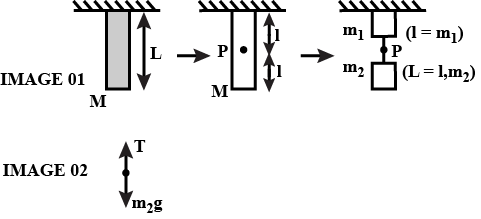
Mass \[ = {\text{ M}}\]
Length $ = L$
Tension $ = mass{\text{ }} \times {\text{ }}acceleration{\text{ }}due{\text{ }}to{\text{ }}gravity$
\[T{\text{ }} = {\text{ }}{m_2}g\]
Now when we do the differentiating we get
\[dT{\text{ }} = {\text{ }}d{m_2}g\]
$d{m_2}{\text{ = }}\dfrac{{{\text{M}}dx}}{{\text{L}}}$
Integrating from \[I{\text{ }}to{\text{ }}L\]
${\text{T = }}\dfrac{{{\text{Mdxg}}}}{{\text{I}}} = \dfrac{{{\text{Mg(L - I)}}}}{{\text{L}}}$
The ends of a string or the other object transferring tension will apply forces on the object to which the string or the rod is linked in the direction of the string at the point of attachment.
Note:
There are two fundamental possibilities for the system of the objects which are held by the strings. Both acceleration and the system are null, therefore it is in equilibrium, or there is acceleration, and hence a total force is present in the system. Tensions are forces transferred as an action, reaction pair of the forces, or as a restoring force which may be a force and will have its units of force in Newton.
Complete step by step solution:
String-like bodies in relativistic theories like the strings used in some models of the instructions between quarks, or those used in the modern theories also possess tension. These strings are examined and the energy is normally proportional to the length of the strings. Tension in a string is said to be a scalar quantity. Zero tension is slack. A string or rope is frequently ideal and taken as one dimension, which has length but it is massless with zero cross-section.
Mass \[ = {\text{ M}}\]
Length $ = L$
Tension $ = mass{\text{ }} \times {\text{ }}acceleration{\text{ }}due{\text{ }}to{\text{ }}gravity$
\[T{\text{ }} = {\text{ }}{m_2}g\]
Now when we do the differentiating we get
\[dT{\text{ }} = {\text{ }}d{m_2}g\]
$d{m_2}{\text{ = }}\dfrac{{{\text{M}}dx}}{{\text{L}}}$
Integrating from \[I{\text{ }}to{\text{ }}L\]
${\text{T = }}\dfrac{{{\text{Mdxg}}}}{{\text{I}}} = \dfrac{{{\text{Mg(L - I)}}}}{{\text{L}}}$
The ends of a string or the other object transferring tension will apply forces on the object to which the string or the rod is linked in the direction of the string at the point of attachment.
Note:
There are two fundamental possibilities for the system of the objects which are held by the strings. Both acceleration and the system are null, therefore it is in equilibrium, or there is acceleration, and hence a total force is present in the system. Tensions are forces transferred as an action, reaction pair of the forces, or as a restoring force which may be a force and will have its units of force in Newton.
Recently Updated Pages
Master Class 12 Business Studies: Engaging Questions & Answers for Success

Master Class 12 Chemistry: Engaging Questions & Answers for Success
Master Class 12 Biology: Engaging Questions & Answers for Success
Class 12 Question and Answer - Your Ultimate Solutions Guide
Master Class 10 English: Engaging Questions & Answers for Success
Master Class 10 Social Science: Engaging Questions & Answers for Success
Trending doubts
One Metric ton is equal to kg A 10000 B 1000 C 100 class 11 physics CBSE
Difference Between Prokaryotic Cells and Eukaryotic Cells
How many of the following diseases can be studied with class 11 biology CBSE
Two of the body parts which do not appear in MRI are class 11 biology CBSE
Which of the following enzymes is used for carboxylation class 11 biology CBSE
Explain zero factorial class 11 maths CBSE